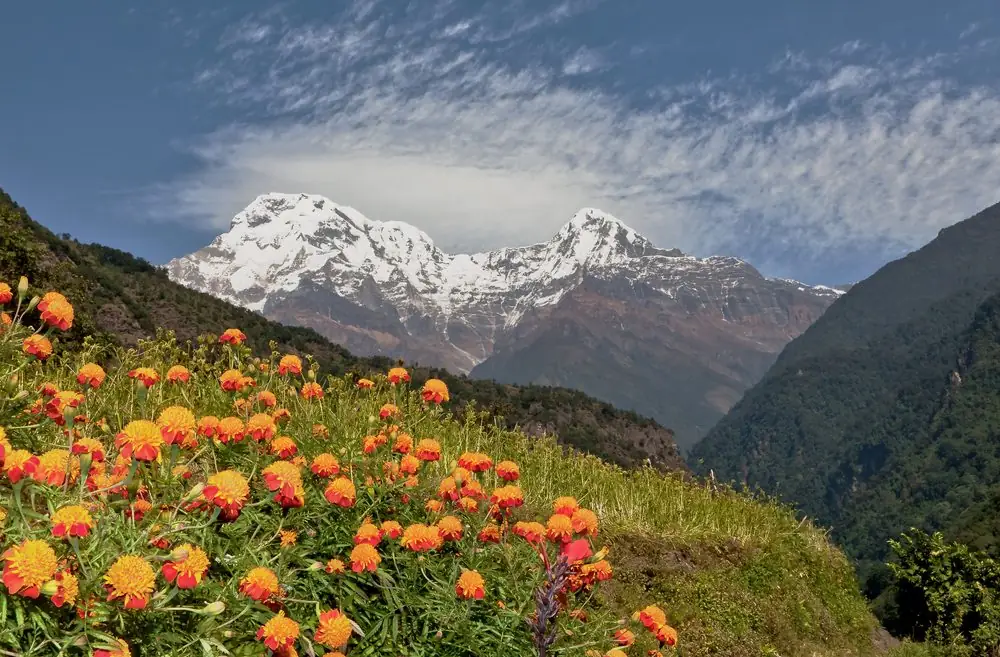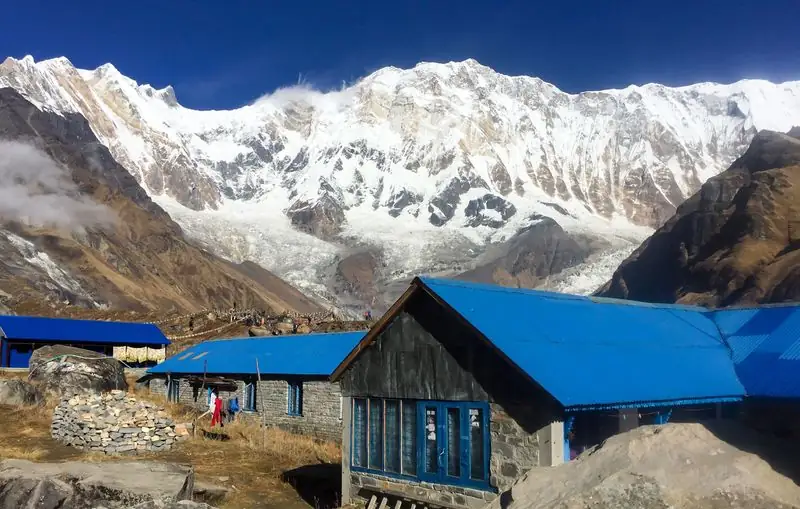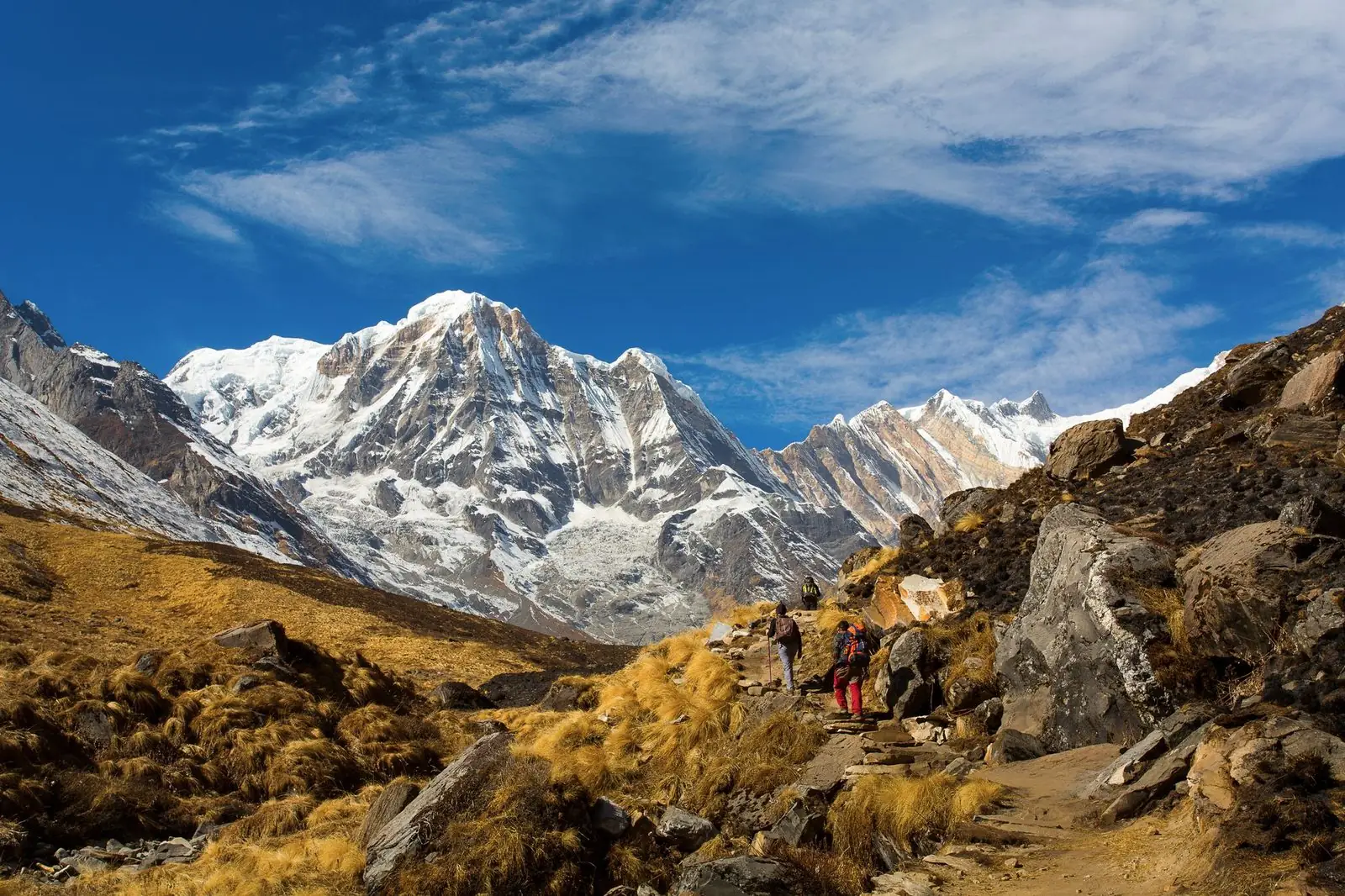
The Annapurna Base Camp trek, often shortened to ABC, climbs into the Annapurna Sanctuary, a high glacial basin ringed by Annapurna I, Annapurna South, Hiunchuli, Gangapurna and the fishtail spire of Machhapuchhre. Most operators plan between 9 and 12 days from Pokhara to Pokhara. The sequence below is a sensible 11-day shape with a gentle start. Altitudes are approximate and times depend on pace, weather and how many photo stops you take.
Days 1 to 3: the lower valleys and rhododendron forest
Day 1 is a drive from Pokhara to Nayapul and a short walk to a village such as Tikhedhunga or Ulleri. The road ride takes roughly one and a half to two hours, which leaves time for your first steps on the trail. Day 2 climbs the famous stone staircase above Ulleri and continues through forest to a village such as Ghorepani at about 2,860 m, or you can take the gentler line through Ghandruk. Many itineraries add a sunrise walk to Poon Hill on the morning of day 3, then cross to Tadapani through ancient rhododendron and oak. This opening section gives your legs and lungs a gradual introduction before the real altitude begins.
Days 4 and 5: Chhomrong and the Modi Khola valley
From Tadapani the trail drops to Chhomrong, a large Gurung village at about 2,170 m with sweeping views of Annapurna South and Machhapuchhre. A long stone staircase leads out of the village on the next day and down into the Modi Khola gorge. You then continue upstream through Sinuwa, Bamboo and Dovan. These sections are humid, green and often steep, with bamboo groves, waterfalls and a number of suspension bridges. Expect legs that ache from the repeated ups and downs rather than from altitude at this stage.
Days 6 and 7: Himalaya, Deurali and Machhapuchhre Base Camp
Above Dovan the forest thins into alpine terrain. Himalaya and Deurali sit at roughly 2,900 m and 3,200 m, and the valley narrows between steep walls. Deurali to Machhapuchhre Base Camp (MBC, about 3,700 m) is the stretch where avalanche awareness matters most, especially after fresh snow. Most trekkers sleep at MBC, which gives a gentler altitude gain than pushing straight up to ABC.
Day 7 or 8: Annapurna Base Camp
From MBC it is a walk of two to three hours to Annapurna Base Camp at about 4,130 m. You arrive in a vast amphitheatre of snow and rock with the Annapurna massif on three sides. Plan to sleep there if lodges have space, because dawn and dusk light on the walls is the real prize. Eat and drink well and keep your jacket close, as temperatures fall fast once the sun drops.
Days 8 to 11: the return
You descend the same valley, usually to Bamboo or Chhomrong on day 8, then to Jhinu Danda for the natural hot springs on day 9. The springs are a welcome reward for tired legs. Day 10 walks out to Nayapul or Siwai for the drive to Pokhara, and day 11 is a buffer or onward travel day.
Where to add spare days
- Add a night at MBC or Deurali if you feel headachy, so you climb more slowly.
- Add a rest day at Chhomrong or Jhinu if knees complain on the stairs.
- Keep one flexible day at the end if you must catch an international flight from Kathmandu.
How to compare itineraries
If a quote promises ABC in six or seven days from Pokhara, ask where you sleep each night and how much altitude you gain between nights. A compressed plan is possible for fit trekkers with experience, but it leaves less margin for weather, avalanche delays or an upset stomach. A plan with at least one spare day is almost always the better buy.
What a typical walking day feels like
Most days follow the same rhythm. You wake before dawn, drink tea, eat breakfast of porridge, eggs or Tibetan bread and set off by seven or eight in the morning. The morning is the best time to walk because the sky is clearest and the air is coolest. You reach a village by late morning for lunch, then continue for another two or three hours in the afternoon. By four you are in your lodge, washing, resting and drinking tea. Dinner is early, often by six, and most trekkers are asleep by nine because the next day begins before sunrise.
Weather decisions that change the plan
In the lower valley rain and leeches matter only in the monsoon. From Deurali upwards the question becomes snow and avalanche risk. Guides listen to reports from other groups and lodge owners every evening, and they may delay the departure from Deurali or stay a night at MBC if conditions are uncertain. An itinerary with a built-in spare day lets you wait without losing the chance to reach base camp, which is why the extra day is worth its cost.
Packing your day bag for each stage
Keep rain gear, a warm layer, a litre and a half of water, sun cream, snacks and your camera or phone within reach. Everything else travels with the porter. On the day to MBC and ABC bring your down jacket in the daypack rather than the main bag, because the temperature can fall quickly once the sun goes behind the ridge. Keep a small amount of cash in a pocket for tea stops.
Making the most of the days
- Arrive at each lodge by mid-afternoon to claim a good room and hot shower.
- Use the evenings to stretch, hydrate and write notes, rather than only scrolling your phone.
- Talk with lodge families, since they know the valley and its stories.
- Take photographs of trail junctions, so you can orient yourself on the way back.