




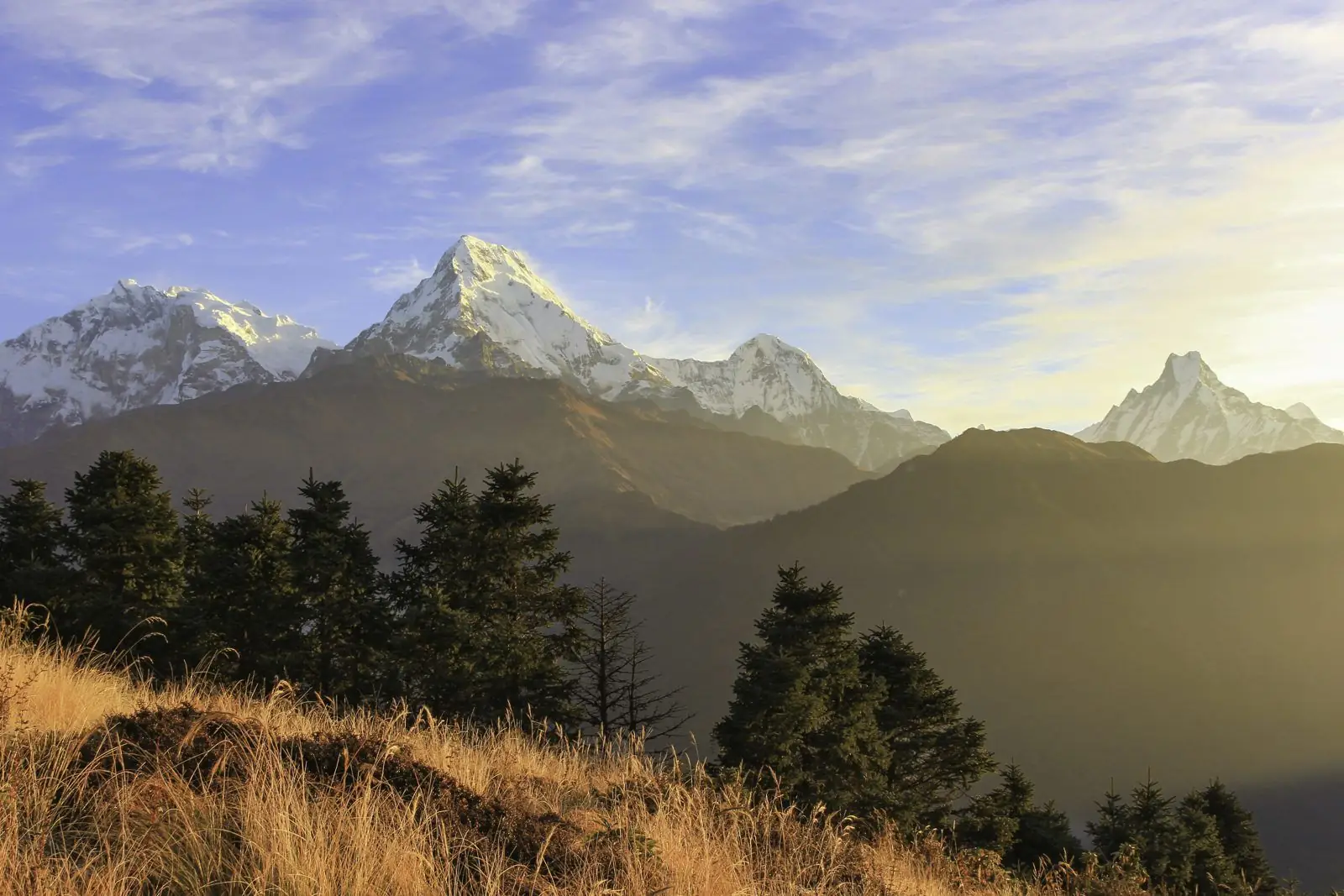
A typical Panorama trek lasts six days from Pokhara. It climbs to Ghorepani, visits Poon Hill, crosses to Tadapani and descends to Ghandruk and the road.
Six days, one big loop
The usual Annapurna Panorama plan takes six days from Pokhara to Pokhara. A shorter version cuts one night, and longer versions add Jhinu Danda or Mardi Himal. The heights and times below are approximate.
Day 1: Pokhara to Ulleri or Tikhedhunga
Drive to Nayapul in about 1.5 hours, register at Birethanti and start walking. Many groups stop at Tikhedhunga at 1,540 m, while faster groups climb the first part of the Ulleri staircase.
Day 2: to Ghorepani
Climb Ulleri and continue through Banthanti and Nangethanti into rhododendron forest. Ghorepani is at about 2,860 m. Expect six to seven hours of walking.
Day 3: Poon Hill sunrise, then to Tadapani
Before dawn hike to Poon Hill (3,210 m) for sunrise, return for breakfast and then follow the ridge and forest trail to Tadapani at around 2,630 m. This is a long, scenic day.
Day 4: Tadapani to Ghandruk
A descent through forest and terraced fields to Ghandruk at about 1,940 m. You will have time to visit the museum.
Day 5: Ghandruk to Nayapul
A final walk down to the road, with lunch at Birethanti, and a drive to Pokhara.
Where to stay
Lodges at Ghorepani and Tadapani are comfortable, with dining rooms heated by wood stoves and rooms with blankets. Ghandruk has a wider choice, including community lodges and guesthouses. Book ahead in October and April.
Pacing and rest
Keep a modest pace on day two. A break at Banthanti and a late lunch at Nangethanti make the climb easier. On the descent to Ghandruk, shorten your stride and use poles to save your knees.
Common questions
- Can I shorten it? Yes, by skipping Tadapani and descending from Ghorepani to Nayapul in one long day.
- Can I extend it? Yes, by adding Jhinu Danda hot springs or Mardi Himal.
- Where do I start? Nayapul, about 1.5 hours by road from Pokhara.
Options
Add a day at Ghorepani for a second sunrise or extend to Jhinu Danda for hot springs. See the difficulty guide.


