Lo Manthang is the old capital of the Kingdom of Lo, a former Himalayan kingdom in the northern part of Mustang, close to the Tibetan border. It sits on a high plateau at about 3,800 m and is encircled by an earthen wall. It was closed to foreign visitors until 1992, and it remains one of the most intact medieval settlements in the Himalaya.
The city in brief
Use the numbers below to plan, not to measure. Maps, watches and lodge boards rarely agree to the metre.
- Founded: in the late 14th century as the royal capital, with its great temples added in the 15th century.
- Height: about 3,800 m on an open plateau.
- Walls: an earthen wall roughly six metres high with corner towers surrounds the town.
- Monuments: Jampa Lhakhang and Thubchen (Thupchen) Lhakhang, both 15th century, the royal palace, and Choede (Chode) monastery, the main monastery of the town.
- Status: on Nepal's tentative list for World Heritage.
The Lo people
The Lobas are culturally and ethnically related to the peoples of Western and Central Tibet and follow Tibetan Buddhism, largely of the Sakya tradition. Many ancient rituals and festivals are still performed, including the Tiji festival. See Tiji festival in Lo Manthang.
A kingdom without a king
The kings of Lo ruled through a long period of relative autonomy. The royal title was abolished with the end of the monarchy in Nepal in 2008, though the royal family remains respected locally. Ask your guide to explain recent history.
Restoration
Restoration work on the main temples and parts of the wall has been carried out in recent years, often with international support. Some interiors may be closed or restricted for conservation.
Where to read next
Lo Manthang: what to see in the walled city and how to get there.
What to look for as you walk the lanes
- The thick earthen walls and the narrow gates.
- Whitewashed houses with flat roofs piled with firewood.
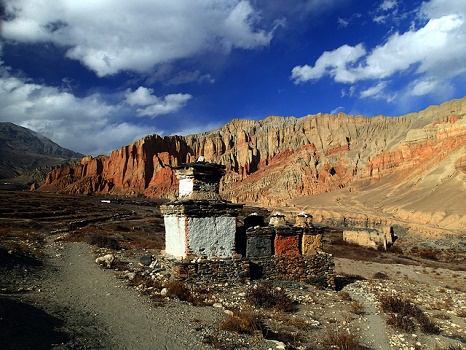
- Chhorten and mani walls inside and outside the city.
- The royal palace, a large white building at the heart of the town.
- The three main temples: Jampa, Thubchen and Choede.
Understanding Sakya Buddhism
The Lo people follow the Sakya school of Tibetan Buddhism. Its monasteries are known for rich murals and statues, and its rituals include masked dances and long recitations. Visitors can learn a great deal by asking their guide about the symbolism of the paintings and the roles of different deities.
A living city
Lo Manthang is not a ruin. Around 1,000 people live inside and near the walls, running shops, lodges and farms. Respect their privacy, ask before photographing, and spend money locally.
Common questions
When was Lo Manthang built?
Tradition dates it to the late 14th century, with its great temples built in the 15th, as the capital of the Kingdom of Lo.
How high is it?
About 3,800 m.
When did it open to foreigners?
In 1992; before that it was closed.