




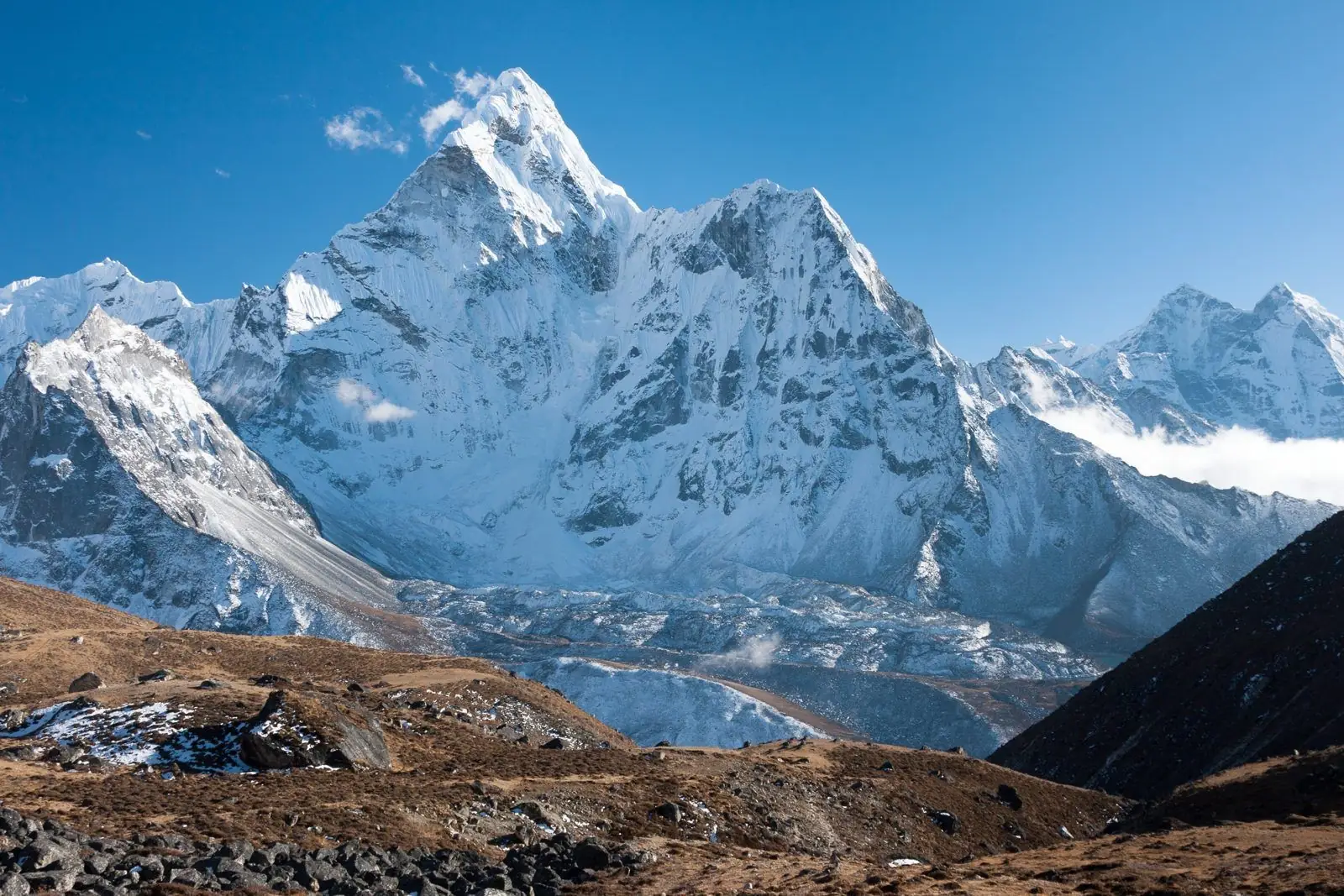
Ama Dablam is visible from many points on the Everest trail. The best are around Tengboche, Pangboche and Dingboche, and the views are often clearest in the early morning.
Views at every stage
The mountain appears early and stays with you. It first shows as a small peak above Namche, grows at Tengboche, and towers at Pangboche, Dingboche and Thukla. Each viewpoint has its own character.
Tengboche
The monastery meadow is famous. Ama Dablam rises to the right of Everest, Lhotse and Nuptse. Sunrise light brings colour.
Pangboche and Dingboche
These villages place the mountain close above. The ridges look steep and sharp. Foreground details like stone walls and prayer flags make good compositions.
Thukla Pass and Lobuche
Looking back from higher ground, the mountain appears further away and more isolated.
Photography
Early morning gives the best light. Afternoon cloud often covers the peak. Use a telephoto lens to isolate the shape.
A walking guide to the views
Ama Dablam is one of the few Himalayan peaks that gets more beautiful the closer you come. On day three of the Everest trek it appears as a small pointed tooth above the Dudh Kosi, and by Tengboche, on day four or five, it dominates the eastern horizon. Above Pangboche the ridges close in and the summit seems almost overhead. Beyond Dingboche you turn away and then look back from the trail to Lobuche, when the peak shrinks into the skyline again. Give yourself time for pauses at each step.
Where to stop for the best photographs
The meadow below Tengboche monastery is a classic spot, particularly in the early morning when the sun lights the summit before the valley. A second good position is a bridge flag area above Pangboche, where the foreground has prayer flags and juniper. In Dingboche, the walls of the fields around the village make a strong foreground for dusk shots. If you want a quiet view, walk uphill from Dingboche on the ridge behind the village.
Related
See the Lhotse viewpoint guide.
Best viewpoints
Ama Dablam, about 6,812 m, is visible from Tengboche, Pangboche and Dingboche. Morning light is best. Each spot offers a different angle of its steep south-west ridge.


