Gokyo Ri stands at about 5,357 m, roughly 500 to 570 m above Gokyo village. Allow two to three hours to climb and about an hour to come down.
The numbers
Gokyo village lies at roughly 4,790 m, and the summit of Gokyo Ri at about 5,357 m. That is a climb of about 500 to 570 m depending on where you start. Kala Patthar, the usual viewpoint on the Everest Base Camp route, is a little higher at about 5,545 m.
Climb time
Plan on two to three hours up on a steady zigzag path and about one hour down. A slow pace at altitude is normal. See the sunrise and view guide for the best time of day.
Fitting it into the itinerary
Climb after at least one night at Gokyo, with a spare day if the weather is poor. The route up the valley (Dole, Machhermo, Gokyo) is a gradual gain. See the Gokyo itinerary and altitude and acclimatisation.
Pacing the climb
Take short rests, sip water and keep a steady rhythm. Turn back if you have a worsening headache, nausea or heavy breathlessness.
What the climb is like
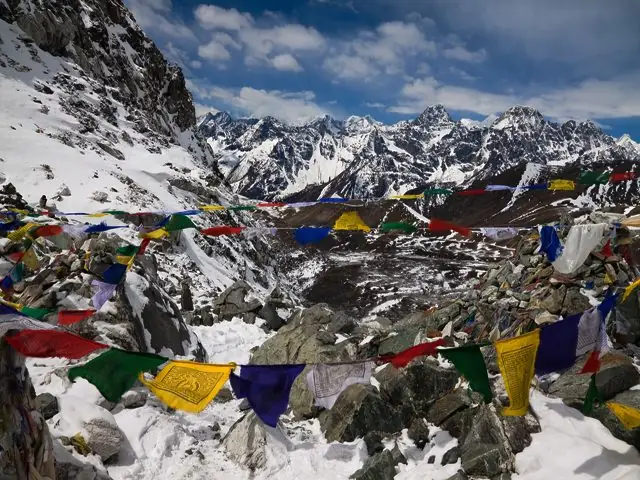
The trail zigzags steeply on loose stone above the lake, with a final section of rocky steps to the prayer flags. It is steady rather than technical. Many people stop several times, and that is normal at this altitude. Take small steps, breathe regularly and carry water.
The reward at the top
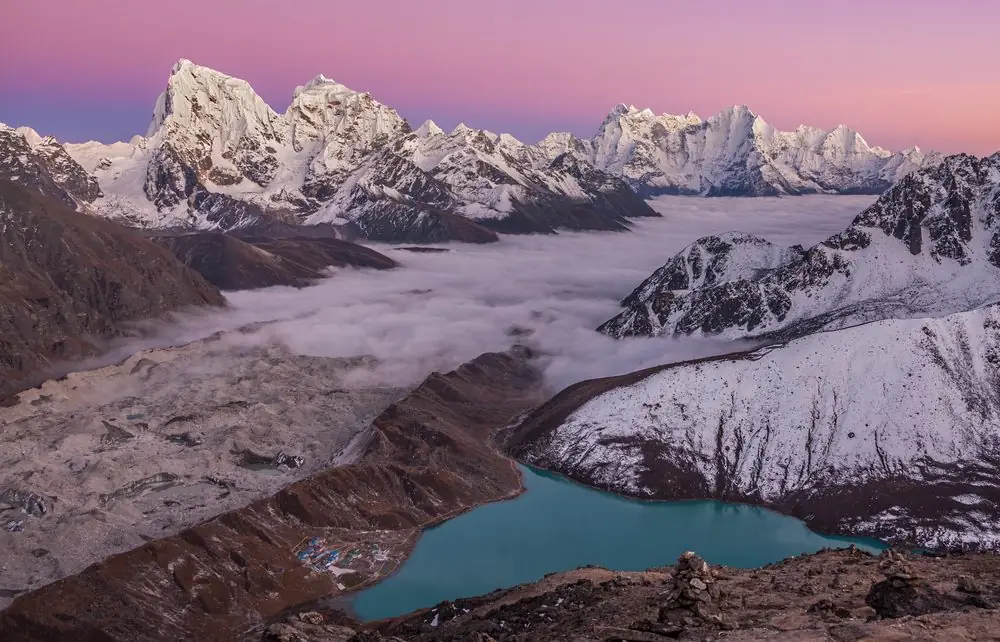
On a clear morning the summit shows Everest, Lhotse, Makalu and Cho Oyu in one sweep, with the Ngozumpa glacier below and the lakes shining in the valley. The view is considered by many to be better than Kala Patthar because of the wide perspective. Dress warmly, because the wind at the top is strong.
Gokyo Ri or Kala Patthar
Both are about the same effort. Gokyo Ri looks over the lakes and the Ngozumpa glacier; Kala Patthar looks directly at Everest. See Gokyo compared with Everest Base Camp.
How the climb feels
Gokyo Ri, about 5,357 m, rises steeply above the lakes. Most trekkers need two to three hours to climb and about an hour to return. Start early to catch the morning light and avoid wind.
Reading your own body
Go slowly and take breaks. The summit gives views of Everest, Lhotse, Makalu and Cho Oyu. If you feel unwell, go down. The view is still good lower down.