




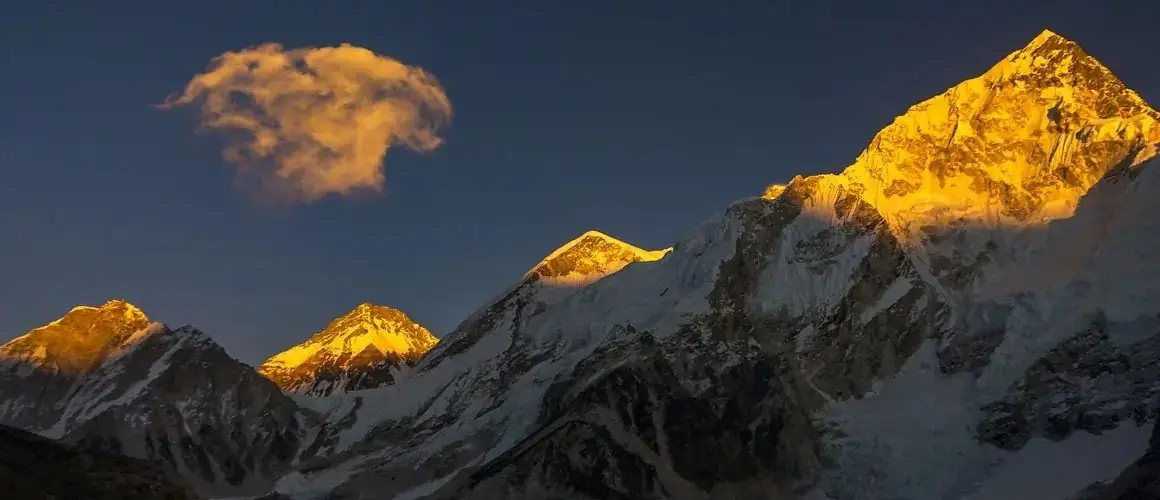
Lhotse is visible from many points on the Everest trail. The best are Dingboche and Chhukung, where the south face fills the sky, and Kala Patthar, where Lhotse, Nuptse and Everest appear together.
A mountain that appears in stages
On the walk to Everest Base Camp Lhotse reveals itself gradually. It is hidden by closer ridges for the first days, shows its upper summit from the high trail beyond Tengboche, and only above Dingboche does its full south face open up. The trick is to know where to stand, and when.
Dingboche and Chhukung
The best view of the south face is from the Imja valley. From Dingboche, the face rises above the village, and from Chhukung, at about 4,730 m, the wall seems to hang overhead. Island Peak sits in front of it. A rest or acclimatisation day here, with a short hike up the ridge behind Dingboche, gives the best chance to study it.
Lobuche and Gorak Shep
Further up the valley the angle changes. Lhotse becomes a vast curved wall behind Nuptse, and the summit appears just beyond Everest. At sunrise and sunset the ice glows orange and pink. These are the same views climbers use to plan their routes.
Kala Patthar
The viewpoint at about 5,550 m is the classic place to see Everest, Nuptse and Lhotse in one frame. The summit of Lhotse lies directly right of Everest. Climb early in the morning for clear skies, and carry warm clothing because winds are strong.
Photography and timing
Mornings are best because cloud builds later in the day. Use a long lens to compress the distance and show the wall details, and include foreground boulders or prayer flags for scale. In autumn the air is dry and the views are sharp.
Common questions
- Where is the best view? Kala Patthar at sunrise.
- Can I see it from Namche? Distant views are possible on clear days.
- Which side shows the south face? The Dingboche and Chhukung side.
Related
See the Nuptse viewpoint guide and the Everest Base Camp trek.
Seeing the fourth highest mountain
Lhotse, about 8,516 m, is best seen from Kala Patthar and Gokyo Ri. From Base Camp it is hidden behind Nuptse. The south face is one of the steepest walls in the Himalaya.


