




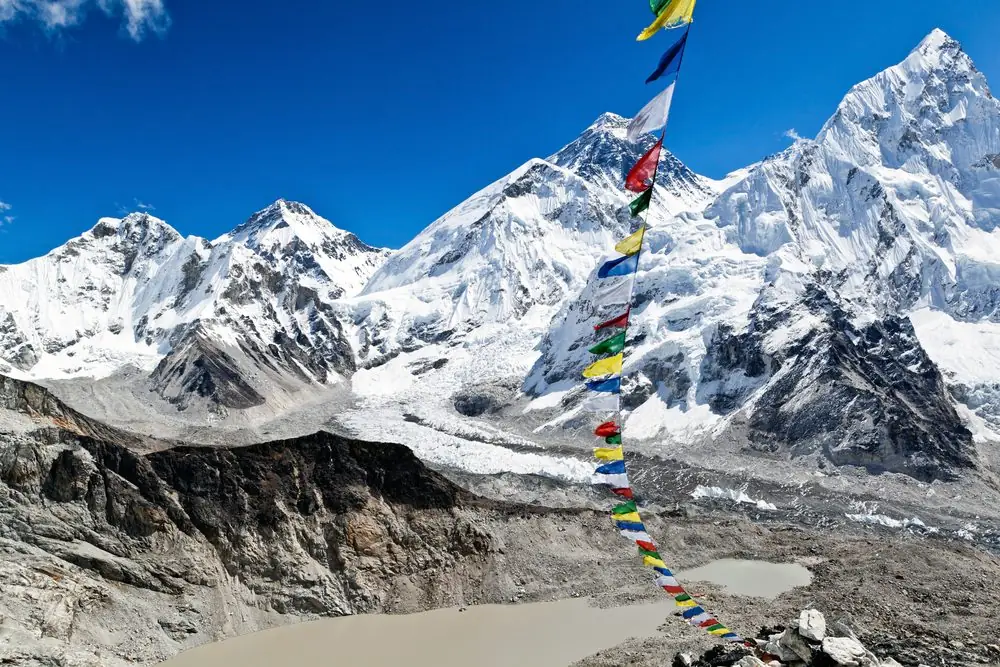
Advanced Base Camp (ABC) on Mount Everest is the high camp at about 6,400 m on the north, or Tibet, side of the mountain, at the foot of the North Col. It is roughly 1,000 m higher than the base camp trekkers visit in Nepal (5,364 m) and is often called the highest place a non-climber can walk to.
Two sides, several base camps
Everest has two normal climbing routes, and each has its own camps. On the south side, in Nepal, base camp sits on the Khumbu Glacier at 5,364 m and is the goal of the classic trek. On the north side, in Tibet, the roadhead base camp is at about 5,150 to 5,200 m near Rongbuk monastery, and vehicles can drive almost to it. Because the north side route continues for about 20 km over moraine before the real climbing starts, expeditions set up a second, higher base: Advanced Base Camp.
How high is Advanced Base Camp?
About 6,400 m (roughly 21,000 ft). Different sources give figures from 6,340 to 6,500 m, because the camp is spread along a moraine and moves a little from year to year. At that height the air holds less than half the oxygen found at sea level. For comparison, Kala Patthar, the high point of the Nepal trek, is 5,545 m, and Island Peak, a popular climbing peak, is 6,189 m.
The route from Rongbuk
- Base camp, about 5,200 m, near Rongbuk.
- Interim camp, about 5,800 m, part-way up the East Rongbuk Glacier, used to break the journey.
- Advanced Base Camp, about 6,400 m, on the moraine below the North Col, with Changtse (7,543 m), the "north peak", rising beside it.
- North Col (Camp 1), about 7,000 m, where the technical climbing begins.
Yaks carry loads as far as Advanced Base Camp, which is unusual for such a height. The walking is not technical, but it is long, rough and very high.
Is there an "Advanced Base Camp trek"?
In past years a small number of operators have run treks to Advanced Base Camp for strong, experienced walkers, taking about three weeks from Lhasa or Kathmandu with careful acclimatisation. Access depends entirely on the rules of the Chinese and Tibetan authorities, which have changed several times and have at times closed the area above the roadhead base camp to non-climbers. Anyone interested needs current advice at the time of booking. It should be treated as an expedition-style journey and not as an ordinary trek.
How it compares with the Nepal base camp trek
- Height: Nepal base camp 5,364 m; Advanced Base Camp about 6,400 m.
- Approach: Nepal is a walk of eight to nine days up from Lukla through Sherpa villages; Tibet is a drive to the roadhead and then a few days on glacier moraine.
- Acclimatisation: Nepal's trek gains height gradually on foot. Tibet's road gains it fast, so extra rest days are essential.
- Lodging: tea houses all the way in Nepal; tents on the north side.
- Views: from the north, the whole north face of Everest is in sight from Rongbuk. From Nepal the summit is hidden at base camp itself and is best seen from Kala Patthar.
- Paperwork: a national park permit and local permit in Nepal; a Chinese visa and Tibet travel permits, arranged only through an agency, for the north.
Risks at 6,400 m
The main danger is altitude illness, including the serious forms that affect the lungs and the brain. At this height the body does not fully adapt, sleep is poor and appetite fades. Cold, wind and distance from help add to the risk, and helicopter rescue of the kind used in Nepal is not generally available on the Tibet side. Slow ascent, spare days and a leader who will turn people round are what keep a group safe.
Not to be confused with Annapurna Base Camp
In Nepal the letters ABC nearly always mean Annapurna Base Camp, a popular trek to 4,130 m in the Annapurna Sanctuary. That is a much easier and lower goal. See the Annapurna Base Camp guides.
What we suggest instead
For most people the Nepal side gives more: villages, monasteries, a steady climb and the view from Kala Patthar. If you want to go higher than a trek, the usual next steps in the Everest region are Island Peak (6,189 m), Lobuche East (6,119 m) or Mera Peak (6,476 m), each a guided climb for fit trekkers. For how the camps on the Nepal route are arranged, see Everest Base Camp altitude and the climbing camps.
A little history
The north side was the route of all the early Everest expeditions. British teams in the 1920s came through Tibet, because Nepal was closed to foreigners, and it was from the North Col route that George Mallory and Andrew Irvine disappeared in 1924. The first confirmed ascent from the north was made by a Chinese team in 1960. The East Rongbuk Glacier, which leads to Advanced Base Camp, was found in 1921 to be the key to reaching the North Col.
Common questions
What is the height of Everest Advanced Base Camp?
About 6,400 m (around 21,000 ft), on the north side of the mountain in Tibet.
Which is the highest base camp in the world?
Among camps reached by walking, Everest Advanced Base Camp at about 6,400 m is usually given as the highest.
Can trekkers go to Advanced Base Camp?
Only when the Chinese and Tibetan authorities allow it, and rules have changed often. Check the current position before planning.
Is Advanced Base Camp in Nepal?
No. It is on the north side of Everest in Tibet, China. The base camp in Nepal is at 5,364 m.
Heights, dates, fees and rules are approximate and can change, so confirm the current details with us before you book.


