




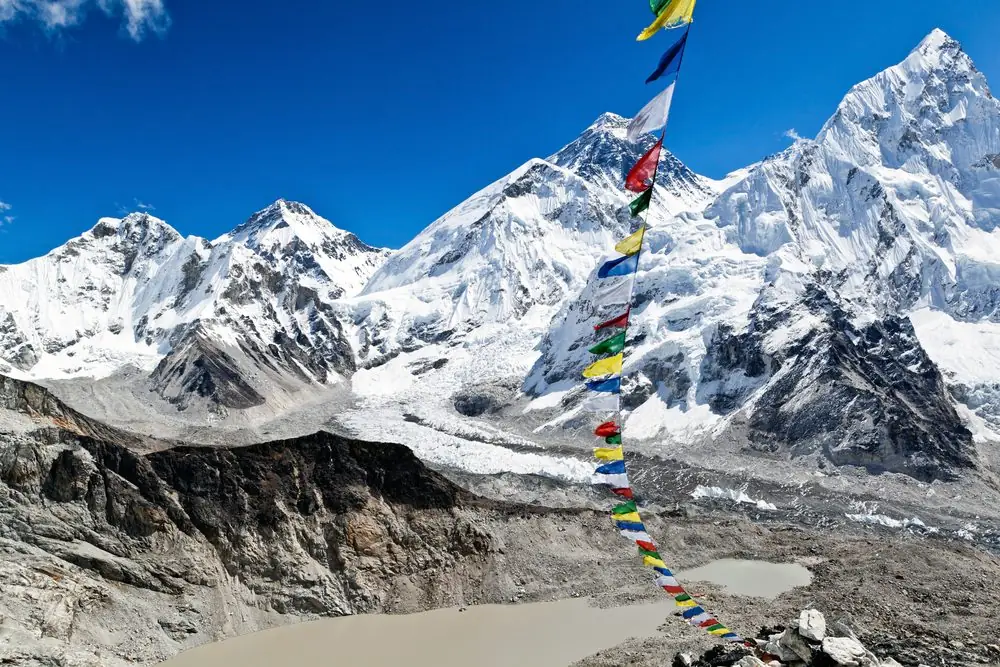
Nuptse is a long Himalayan ridge peak of about 7,861 m beside Everest and Lhotse. It forms the western wall of the Western Cwm and is one of the most impressive sights on the Everest trek.
The great wall of the Khumbu
Nuptse is the long ridge that forms the south wall of the Western Cwm and the dark backdrop to Everest Base Camp. The main summit is 7,861 m, and the ridge has several other summits. The name is usually translated as west peak, since it lies to the west of Everest. Its huge rock and ice face rises in a sweeping line above the Khumbu glacier, and it is one of the most photographed walls in the Himalaya.
Summits and shape
Nuptse has a long summit ridge with a main top and several lower points, including Nuptse II and Lower Nuptse. The south and north faces are steep and complex, with hanging glaciers and rock bands that make climbing difficult. The long ridge shields the Western Cwm from wind.
The first ascent
A British expedition led by Joe Walmsley made the first ascent in May 1961. Dennis Davis and Tashi Sherpa reached the summit by the west ridge. Since then only a small number of climbers have followed.
Why it is rarely climbed
Nuptse is overshadowed by its higher neighbours, and it is difficult. The route faces avalanche risk, rotten rock and steep ice. There are no gentle options, and few climbers want to spend time on a technical peak that is lower than Everest or Lhotse.
For trekkers
Nuptse is a constant companion on the Everest trek. Learn to recognise it from Namche, Tengboche and the upper valley. See the viewpoint guide.
Common questions
- How high is Nuptse? About 7,861 m.
- What does the name mean? West peak.
- Where can I see it? From Namche to Gorak Shep.
Why Nuptse is rarely climbed
Nuptse’s ridge is long, technical and exposed to avalanche. Unlike popular trekking peaks, it needs advanced mountaineering skills, so few attempt it. Most visitors enjoy it as a dramatic backdrop on the Everest trail.
Many summits, one wall
Nuptse has several summits along a long ridge, with the main summit near 7,861 m. The first ascent was in 1961 by a British expedition.


