Frequently Asked Questions
About the Annapurna Panorama trek
What is the Annapurna Panorama trek?
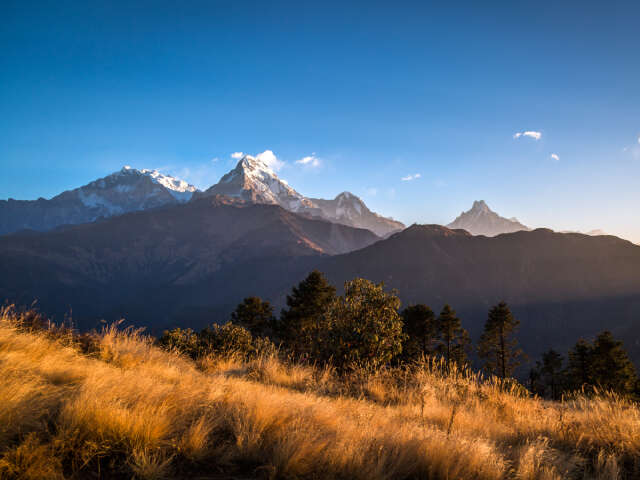
An 11-day loop in the Annapurna foothills that climbs to Poon Hill at about 3,210m for sunrise, then continues through Tadapani, Ghandruk and Jhinu Danda to Pothana and Phedi. It passes Gurung and Magar villages, rhododendron forest and terraced hillsides, with Annapurna, Machhapuchhre and Dhaulagiri in view on many days.
Why do people choose it?
It adds the quiet villages and hot springs of the lower Annapurna Sanctuary route to the Poon Hill sunrise, without going high. It stays below 3,300m, has lodges every few hours and does not backtrack, so it suits a first trek and walkers who want more days than the classic Poon Hill trek.
What is the sunrise climb like?
You start around 4:30am from Ghorepani with a torch, climb about 45 to 60 minutes up stone steps, and wait for sunrise on the viewing tower. It is cold and busy, and clouds can hide the view. We cannot promise a clear morning.
How does it differ from the Ghorepani Poon Hill trek?
The Poon Hill trek ends at Ghandruk and is shorter. The Annapurna Panorama trek continues to Jhinu Danda, Pothana and Phedi, so it adds about two more days, hot springs and a second valley. It still does not go as high as Annapurna Base Camp, at about 4,130m.
What is Jhinu Danda known for?
Jhinu Danda, at about 1,750m, has natural hot springs beside the Modi Khola river, a short walk below the village. Many trekkers soak there on the afternoon of day 7. Water temperature and facilities can change, so ask your guide on the day.
Difficulty and fitness
How difficult is the Annapurna Panorama trek?
Easy to moderate. Most days are 4 to 7 hours of walking, and the Ulleri staircase and the climb to Ghorepani are steep. Several days include long descents that are hard on the knees. You do not need previous trekking experience.
Is it suitable for children and seniors?
Often yes, with a slow pace and rest stops. Tell us the age and health of everyone in your group and we will advise on the plan.
How should I train?
Walk uphill or climb stairs several times a week for six to eight weeks, and practise long downhill sections too. Wear in your boots before you come, and practise with a daypack.
Weather and season
When is the best time for Poon Hill?
March to May and October to November have the best views. Rhododendrons flower in March and April. December and January can be clear but cold with snow at Ghorepani, and the monsoon brings leeches, mud and cloud.
Is altitude sickness a risk?
The risk is low because you stay under about 3,300m, but it is not zero. Tell your guide if you feel unwell. The guide decides whether to continue or descend.
How cold will I be?
At Ghorepani at about 2,700 to 2,900m nights are cool to cold, often near freezing in winter. Bring a warm layer, hat and gloves for the sunrise, and use the blankets or hire a sleeping bag if you feel the cold.
Permits, lodges and costs
What permits are needed?
The Annapurna Conservation Area Permit and a TIMS card. We arrange both once we have your passport scan.
What are the lodges like?
Simple but friendly teahouses with twin rooms, shared bathrooms and a dining hall. Some have hot showers for about INR 200 to 300 and Wi-Fi or charging for a fee.
What do I pay for extra?
Drinks, snacks, showers, charging, tips and any meals not included. USD 200 to 300 (INR 17,000 to 25,000) is a sensible plan. Tipping about 10% of the trip price is customary.
Can I rent a sleeping bag or down jacket?
Yes. Rental costs about INR 100 per item per day, so a sleeping bag and a down jacket together are about INR 200 per day. Tell us when you book and we will have them ready.
Safety and insurance
What insurance do I need?
Insurance is mandatory. It must cover trekking at your highest altitude, emergency medical treatment and helicopter evacuation. Send us a copy before you travel, and see the insurance section of our terms.
What if the weather ruins the sunrise?
Clouds are common and we cannot refund a missed view. If it is a safe option, your guide may suggest a second morning. Extra days cost INR 6,000 per day including stay and three meals.
Money, booking and changes
How do I pay for the Annapurna Panorama trek?
Pay a deposit to book. Indian guests pay by bank transfer or UPI, since we do not take credit cards in India. Guests outside India can pay by transfer or online card (4.5% processing fee). You pay the balance at our Kathmandu office on arrival in INR, USD, EUR, GBP or another major currency, at the NPR conversion rate on the date of payment (local conversion charges apply). Cards used in Nepal add 13%, so cash is cheaper.
Is my deposit refundable?
50% is refundable for 30 days after you book, and after that it is not. The deposit stays valid for 365 days and can be moved to any trek or climb we offer. If you do not contact us and do not arrive, it is forfeited.
Can I change my dates?
Yes. Rescheduling is free as many times as you need with at least 6 weeks' notice. With 2 to 6 weeks' notice a fee of INR 5,000 (Indian guests) or USD 100 (other guests) applies, and any change needs at least 14 days' notice. You pay any price difference between the old and new date.
What if I leave early?
We cannot refund unused days or services, because guides, porters and hotels are paid for the full period. We help you return, but extra nights, meals and transport are your cost. Some insurers reimburse unused days, so check your policy.
Do I pay extra if I travel alone?
There is no single supplement. Rooms are shared by gender, and couples, families and friends share together. In Kathmandu you share a twin room, or get a single room at no charge if no one of your gender is booked on your dates. On the trek, rooms are twin-sharing. If you are the only person booked on a fixed departure, or you are not joining a group, a Solo Support Fee of INR 1,500 per trekking day covers a dedicated porter. If the fee is not paid and you are the only person booked on your dates, there is no separate licensed trek guide, and a porter-cum-guide leads the trek. We tell you at booking, or as soon as it arises.
Who looks after me in Nepal?
Your guide, porters and drivers, and our Kathmandu office staff, are all employed by Himalayan Wonders Adventure Pvt. Ltd., the Nepal operator that runs your trip. Read about them on the team page.
 Most popularEverest Base CampThe classic trek to the foot of Everest

 Not sure which trek suits you?Free, no-obligation advice from Nishes and Anand.+91 932 595 1234 WhatsApp Send an enquiry →
 Most popularIsland PeakA classic first 6,000 m climb
 Short on time?Everest View Heli Trek7 days, trek up and fly back