




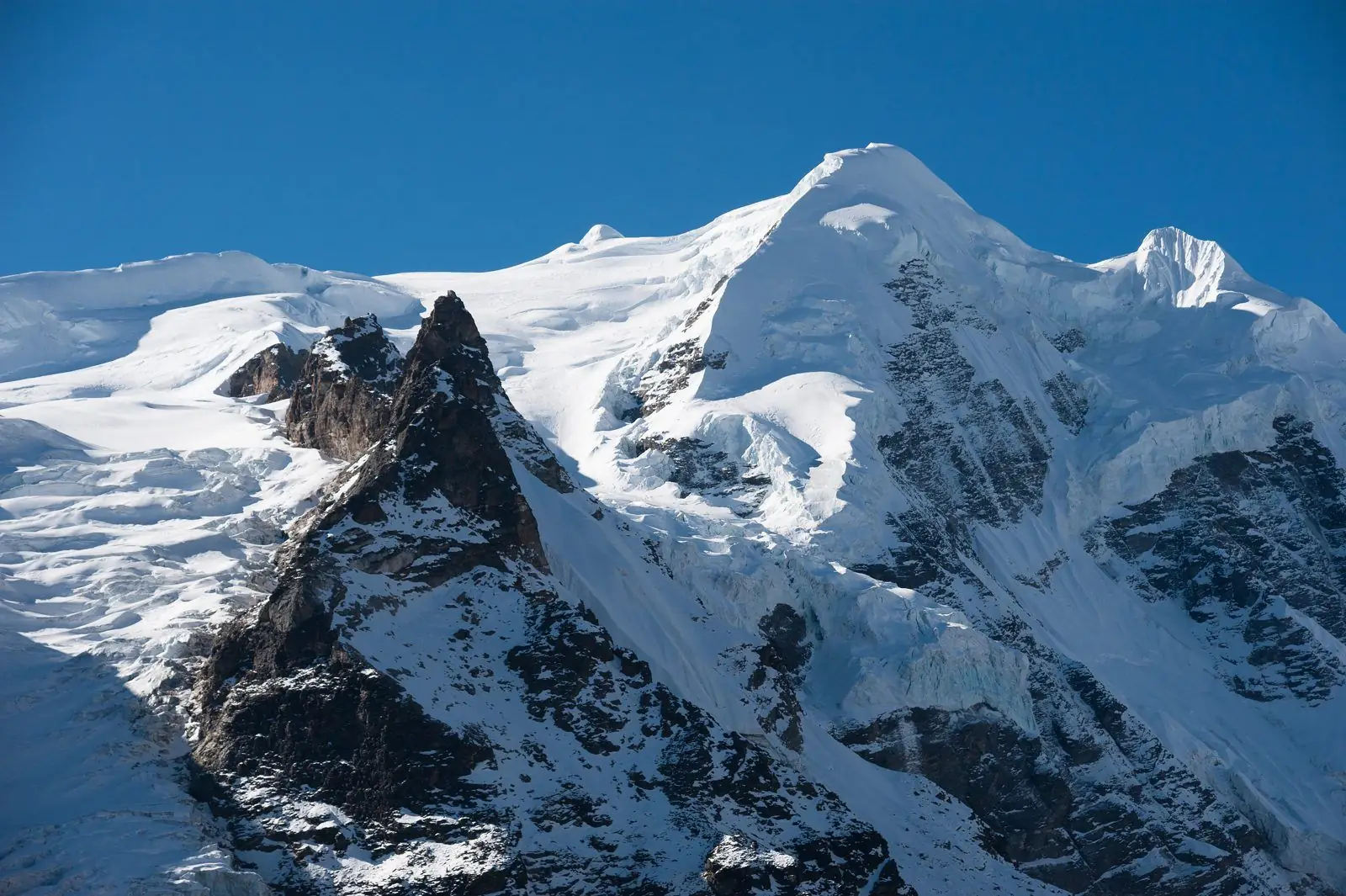
Cholatse, about 6,440 m, and Taboche, about 6,501 m, stand side by side near Dingboche and Dzongla. Taboche is the broader and slightly higher mass, while Cholatse is the sharper, more pointed peak.
Shape
Cholatse is steep and pointed, with a pyramid shape that stands out from the Cho La route. Taboche is a broader mass with a long ridge that links it to Cholatse.
Height
Most sources give about 6,440 m for Cholatse and about 6,501 m for Taboche. The difference is small, and the apparent height depends on your viewpoint. See our Taboche guide.
Where to see them
Both appear from Dingboche, Pheriche, Dzongla and the Cho La route. From the Gokyo side, Cholatse looks more distinct. A guide can point out the difference.
Climbing
Both are serious climbs that need technical experience, and neither is a standard trekking peak. Cholatse is known for steep ice and mixed climbing.
Photography
Early morning light gives the best contrast, with snow glowing on the faces. A telephoto lens compresses distance and makes them look closer.
Cholatse Tso
The lake below Cholatse near Dragnag is a good foreground for photographs.
Why they are confused
The two peaks are joined by a ridge and appear in many of the same photographs. From certain angles Taboche hides part of Cholatse, and from others the order is reversed. If you see a sharp triangle on the left and a broader mass on the right, check with your guide before you caption the picture.
First ascents and history
Both peaks have been climbed, and their routes are known to climbers, but they are not busy objectives. Their reputation among alpinists is for steep, technical climbing at altitude.
For trekkers
You do not need to climb either peak to enjoy them. The Dingboche to Chhukhung walk, the Dzongla ridge and the Cho La crossing give excellent views without leaving the trekking routes.
Plan it
See seeing Cholatse on the Cho La route and what Cholatse is.


