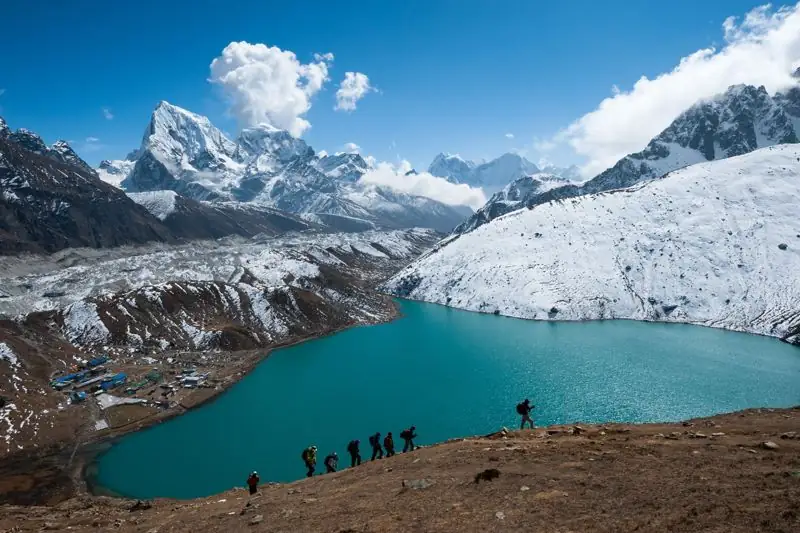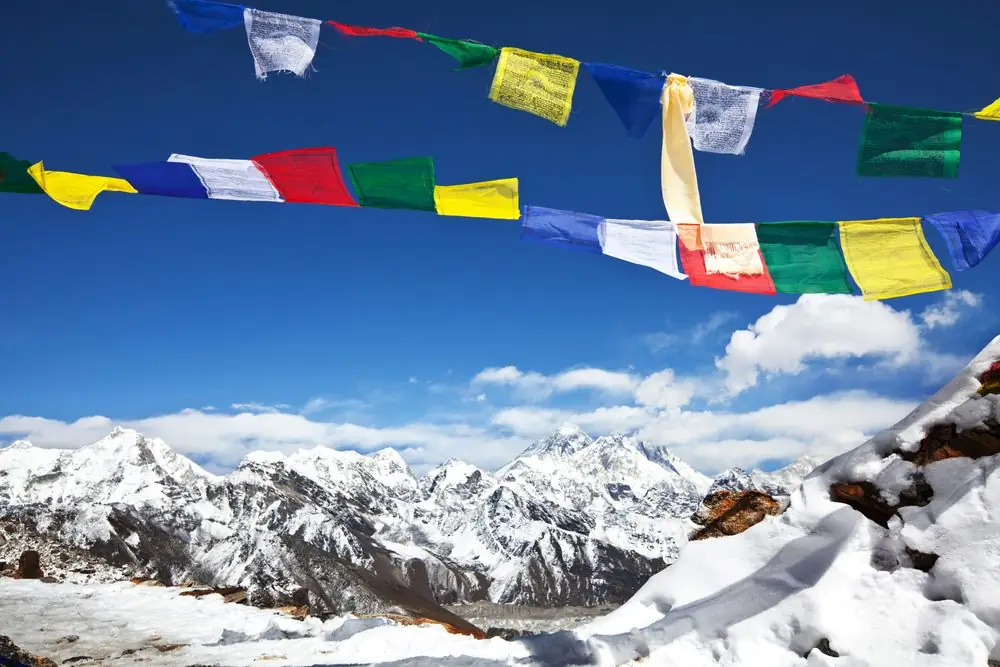
Plan on 12 to 14 days door to door from Kathmandu for the standard Everest Base Camp trek, with 15 or 16 days as a more comfortable and safer window. Fewer than 11 days usually means skipping acclimatisation rest, which is the main reason people turn back with altitude sickness.
Where the days go
- Flight days: one day to fly from Kathmandu to Lukla and start walking, and the return flight at the end. These are fixed, but weather can move them.
- Walking up: about eight days from Lukla to Gorak Shep and the base camp area, including two rest days at Namche Bazaar and Dingboche.
- Walking down: three to four days back to Lukla. You descend much faster than you climbed because the body does not need to adapt on the way down.
- Buffer: one or two days that you hope not to use.
Why not squeeze it into a week
The trail climbs from roughly 2,860 m at Lukla to about 5,364 m at base camp, and the nights above 4,000 m are where problems start. The usual guidance is to gain only about 300 to 500 m of sleeping height per day once you are above 3,000 m, and to take a rest day every few days. Compressed itineraries break that rule, and the people who suffer most are often the fittest ones who feel they can push on.
When to add extra days
Add a day or two if you are travelling in a month when Lukla flights are often delayed, if you have never been above 3,500 m, if you are walking with older family members, or if you want to add Kala Patthar and a side trip such as Chukhung or Gokyo. An extra day at Namche or Dingboche costs little and is the cheapest insurance against turning back.
Shorter options
If you only have a week, a helicopter return from Gorak Shep or Lukla can save two to three days on the way down, but it does nothing for the ascent. Another approach is a lower-altitude Khumbu trek, such as Namche, Tengboche and the Everest View hotel area, which gives mountain scenery without going above 4,000 m.
Booking your return flight home
Do not book an international departure for the day after your planned Lukla return. Leave at least one full day in Kathmandu. Flights out of Lukla are the most weather-sensitive part of the whole trip, and missed connections are far more costly than an extra night in the city.
A sample 14-day shape
Many operators sell a 14-day programme because it balances time on the trail with a small safety margin. A typical outline gives you an arrival day and a briefing in Kathmandu, a flight to Lukla and two or three days of climbing to Namche Bazaar, a full rest day there, then three more days to Dingboche with a second rest day. After that comes the push through Lobuche to Gorak Shep, a morning at base camp or Kala Patthar, and a faster return to Lukla before the flight back to Kathmandu. The exact split changes between operators, but the principle stays the same: a rest day roughly every third night once you are above 3,400 m.
How your own situation changes the number
The "right" number of days is personal. A trekker who lives at altitude or has recently been on another high trek may be comfortable with a tighter plan. A first-timer from sea level, someone who sleeps poorly in unfamiliar places, or anyone travelling with an older relative should lean towards the longer end. Think about what you would do if you caught a cold on day five: a plan with no slack forces you to either push on while unwell or abandon the trek. A plan with a spare day lets you simply rest.
Counting days from home
When you work out leave from your job, count the journey too. Most visitors need a day to reach Kathmandu, at least one night to settle in and meet the guide, the trek itself, and one buffer night in Kathmandu before an international flight. For many people that means asking for between 16 and 18 days away from work, even though the walking is only part of it. If you are travelling from India, the flight to Kathmandu is short, so you can often trim a day compared with long-haul visitors, but the trail days cannot be shortened safely.
Questions to put to an operator
- How many nights are spent above 4,000 m, and how many rest days are included?
- What happens to the schedule if the Lukla flight is delayed by a day or two?
- Is the return by helicopter an option if we fall behind, and who pays?
- Can the itinerary be extended for a slower pace without changing the guide?
What our guests say
Excerpts from guest reviews of Himalayan Wonders, our parent company, on Tripadvisor.
“Garba Rai was the best I could have hoped for.”