Small deposit in India. Balance in Nepal.

Everest Base Camp & Gokyo Lakes 17 Days

  • 17 Days
  • Everest Base Camp & Gokyo Lakes, Nepal
  • Customizable
  • Small deposit to book
  • Local licensed guides
Upcoming departures

Join our Fixed Departure

  • Nov 21, 2026 – Dec 07, 2026
    17 days · Departure guaranteed
    Rs. 105,000
    10 seats
  • Nov 28, 2026 – Dec 14, 2026
    17 days · Departure guaranteed
    Rs. 105,000
    10 seats
  • Mar 06, 2027 – Mar 22, 2027
    17 days · Departure guaranteed
    Rs. 105,000
    10 seats
  • Mar 13, 2027 – Mar 29, 2027
    17 days · Departure guaranteed
    Rs. 105,000
    10 seats
  • Mar 20, 2027 – Apr 05, 2027
    17 days · Departure guaranteed
    Rs. 105,000
    10 seats

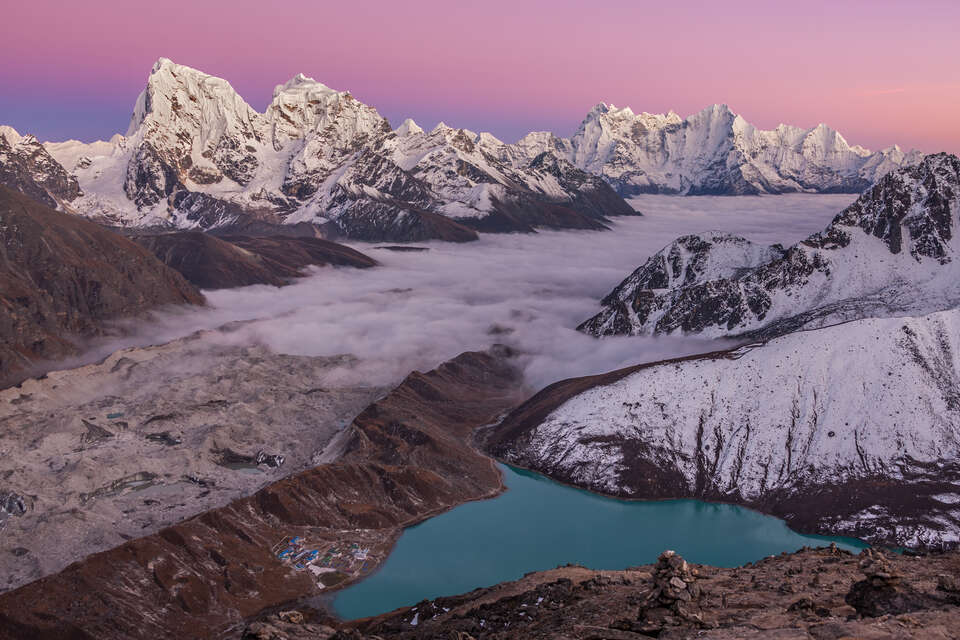
Most Everest treks follow one trail. This one follows two. Walk the classic route to Everest Base Camp, cross the glaciated Cho La Pass, then drop into the Gokyo Valley, a quiet corner of the Khumbu where turquoise lakes sit beneath towering Himalayan giants. In 17 days you see Everest from its base, from its famous sunrise viewpoint and from the far side of the valley.

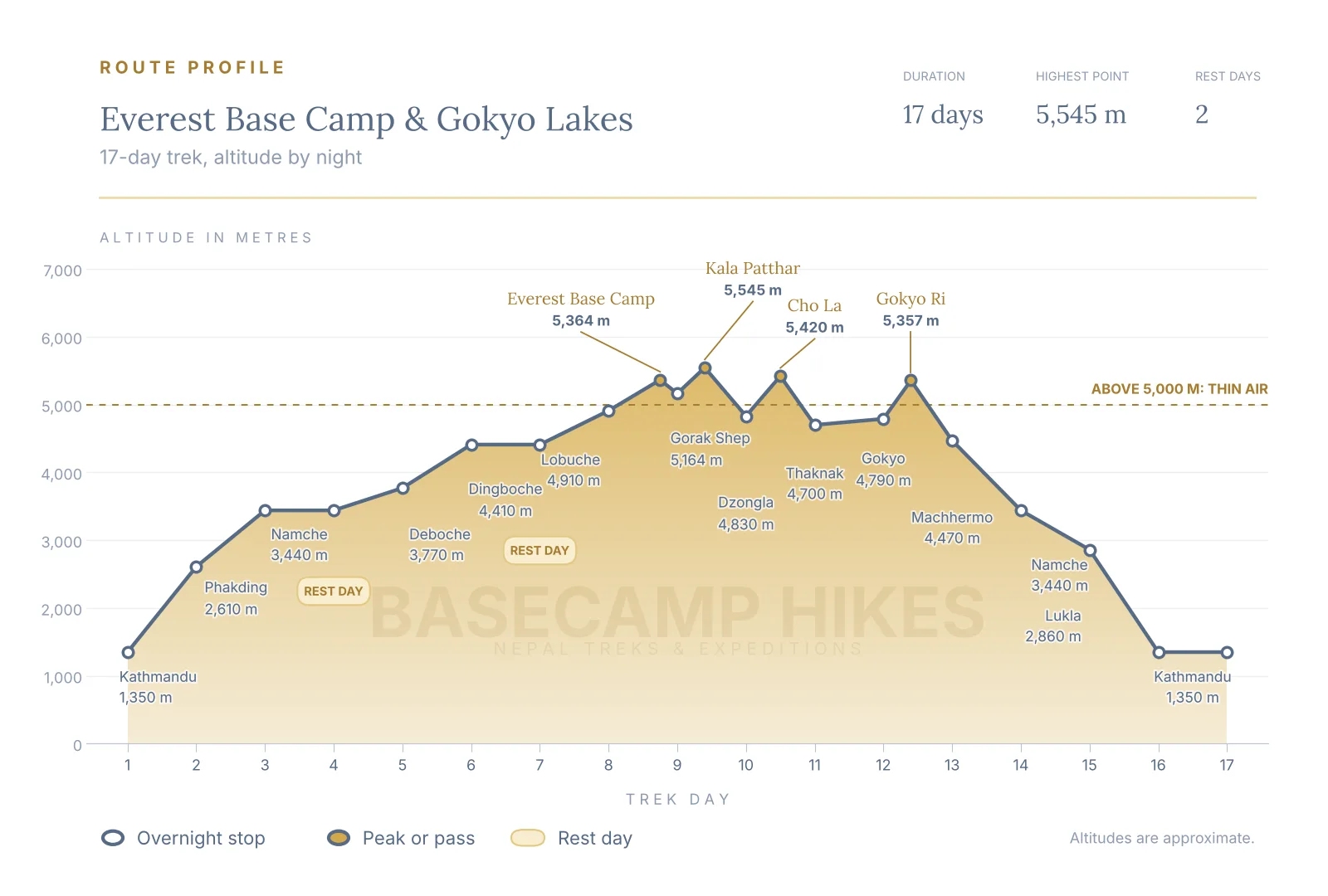
The trek begins with a short mountain flight into Lukla. From there the trail climbs through Sherpa villages, pine forests and high suspension bridges to Namche Bazaar, the gateway to the high Himalayas. Rest days at Namche and Dingboche give your body time to adjust. Then comes the big moment: Everest Base Camp at 5,364m, right beside the Khumbu Glacier and Icefall. The next morning you climb Kala Patthar (5,545m) before dawn and watch the first light turn Everest, Nuptse and Lhotse gold.

The second half is where this route becomes special. You cross the icy Cho La Pass, walk beside the vast Ngozumpa Glacier and arrive at the lakes of Gokyo. A final early-morning climb to Gokyo Ri (5,357m) rewards you with four of the world's highest peaks in one view: Everest, Lhotse, Makalu and Cho Oyu. The way down follows a gentle valley trail back to Namche and Lukla, with far fewer trekkers than the main route.

You are supported every step of the way by licensed local guides and porters, and you stay in friendly teahouses run by mountain families. The trek is fully customizable, so tell us your dates and pace and we will shape it around you.

What's Included?

  • 17-day guided trek, with 3 meals a day on 14 of those days
  • 2 nights in a Kathmandu hotel, breakfast included
  • Flights between Kathmandu or Ramechhap and Lukla *
  • Teahouse accommodation throughout the trek
  • Airport pick-up and drop-off
  • Everest region trekking permit and TIMS card
  • Licensed English-speaking trekking guide
  • Porter service
  • All local and government taxes
  • Farewell dinner in Kathmandu
  • Trek completion certificate
 
* Lukla flights can be delayed: read how we handle delays
* Travel insurance is required on every trek: see what cover you need
* Solo travelers pay no single supplement: see the solo traveler details

Everest Base Camp and Gokyo Lakes 17-day route and altitude profile

Day 1 - Kathmandu: Arrival Day

Altitude: 1,350m/4,428ft

Welcome to Kathmandu, the capital and cultural hub of Nepal! We’ll be waiting with a warm greeting and easy transfer to your hotel. Plan on an evening briefing on last-minute specifics about your trek and an early lights-out: you have a big day ahead.

Day 2 - Kathmandu to Lukla Flight and Phakding

Altitude: 2,800m/9184ft (Lukla) & 2,652m/8,698ft (Phakding)
Walking Distance: 8km (3-4 hours)
*

Flight time: 15 min from Ramecchap
Drive time: 4 hours & 30mins (Kathmandu to Ramecchap)

After a short morning flight to Lukla, you'll be introduced to your guide and porter. Kick off your trek with an easy walk through Chaurikharka village and descent towards Dudhkoshi Ghat (2,530m/8,300ft). The trail follows the bank of the Dudhkoshi River until Phakding (2,652m/8,700ft), where we will be staying for the night to acclimatize. Enjoy your free time in Phakding, a popular stopping point.

Please Read: Lukla Flights are departing and returning to Ramechhap instead of Kathmandu due to ongoing upgrades at Kathmandu Airport. Its about a 4 hour drive to Ramechhap from Kathmandu so we will get started for the airport around 2 am. The return drive at the end of the trek is between 4 and 6 hours depending on traffic.

Day 3 - Phakding to Namche Bazaar

Altitude: 3,440m/11,283ft
Walking Distance: 10-12km (5-6 hours)


We'll have breakfast in Phakding before gearing up for the trek to Namche Bazaar, the biggest sherpa village in Nepal. Our trail takes us first over the Dudhkoshi River via a long suspension bridge, and then through a beautiful pine forest to Monjo, about two hours away. Soon thereafter, we will approach the entrance to Sagarmatha National Park for a brief permit check and then descend to Dudh Kosi River (spotting Mani stones along the way!) en route to Jorsale. Lunch will be served here, and then it's uphill to Namche. Our path along the riverbank is flanked by two crossings, one of which is the Hillary Suspension Bridge. It's a tough climb up the hill to our resting place, but you’ll be rewarded in Namche Bazaar with your first glimpse of Everest in its majesty.

Day 4 - Namche Bazaar: Rest and Acclimatization Day

Altitude: 3,440m/11,283ft

At this point, we take a well-deserved break! Today will be spent resting and allowing our bodies to become acclimatized to the lofty altitude. There’s an optional 2 hour hike to Everest View Point, an uphill walk that will help speed acclimatization. Otherwise, spend the day exploring Namche Bazaar. Check out the Sherpa museum for an overview of the Sherpa culture and history of mountaineering. On Saturdays, the Hatt Bazaar is open for trading and an intimate look at the locals’ marketplace. It is part of the larger Namche Bazaar, a shopping hub filled with all manner of trekking and mountaineering clothing and equipment.

Day 5 - Namche Bazaar to Debouche/Melingo

Altitude: 3,700m/12,139ft
Walking Distance: 10km (6 hours)

Breakfast in Namche Bazaar fuels us for another day of trekking towards Everest Base Camp today! Breathtaking views of the Himalayas - Everest, Nuptse, Lhotse, Ama Dablam, Thamserku and Kwangde - are some of the highlights not to be missed. Our destination, Phortse, is known as one of the most beautiful places in the Everest region. Its views, which include Ama Dablam, are legendary.

Day 6 - Debouche/Melingo to Dingboche

Altitude: 4,400m/14,435ft
Walking Distance: 11km (6 hours)

The trail today parallels the canyon of the raging Imja Khol River with its glacial blue waters. It's a gradual climb up to the village of Pangboche, the biggest settlement of Sherpas in the region. Enjoy a great opportunity to observe a typical Sherpa village and have lunch with the locals! The intrepid can brave a brief hike to the Pangboche monastery, one of the oldest in the area. Our afternoon trek will be a difficult one, as the landscape gives way to dry, deserted mountains and we hike towards Dingboche.

Note: Depending on trail conditions and tea house availability we may take the route on the other side of the river through Phortse. This trail diverges after Namche on Day 5 and basically parallels the trail to Debouche but on the opposite side of the river. The two trails merge back together in Pangboche.

Day 7 - Dingboche: Rest and Acclimatization Day

Altitude: 4,400m/14,435ft (Dingboche)

This is your chance to rest up before the last leg of our adventure! Savor a full day of exploring Dingboche and the surrounding valleys of Chhukung and Imja, the latter of which links with Island Peak, the high passes of Amphu Laptsa, and Makalu Barun National Park. Taking an optional trek to the valleys will pay off in rewarding views, but taking it easy is the most important thing today. You’ll need your rest for the penultimate day of ascent tomorrow.

Day 8 - Dingboche to Lobuche

Altitude: 4,900m/16,076ft (Lobuche)
Walking Distance: 11-12 km (6-7 hours)

From here on forth, the trek will move more gradually be more challenging, due to the higher altitude. We’ll pass Dungla, but not before a tough, steep walk to the top of a high hill. Here are the memorial stupas dedicated to the climbers and trekkers who lost their lives to Everest over the years. The next part of our adventure brings over craggy mountain terrain to Lobuche, a small settlement with amazing views of Mt. Lobuche, Mt. Pumari and the Nuptse. Prepare to snuggle up for a cold night, as we are now almost three miles above sea level and the evenings can be downright chilly!

Day 9 - Lobuche to Gorekshep and Everest Base Camp, EBC to Gorekshep

Altitude: 5180m/16,994ft (Gorekshep) & 5364m/17598 (EBC)
Walking Distance: 15km (6-8 hours)

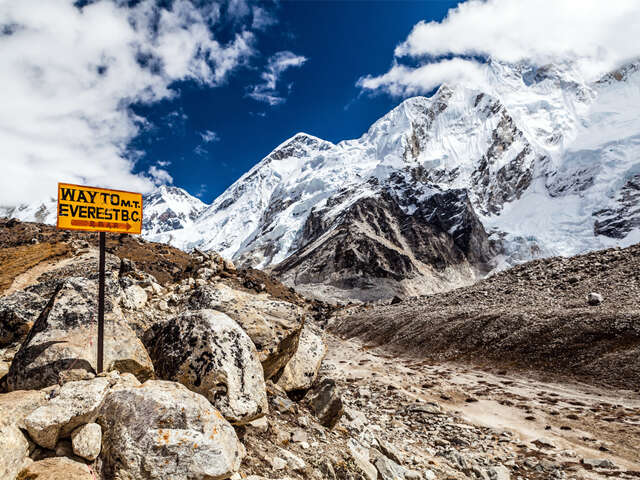
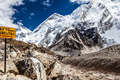
This is it! Our big day kicks off with an initial, relatively easy trek from Lobuche to Gorekshep. The subsequent, straight trail to Everest Base Camp is harder, involving rocky dunes and moraine, formed accumulation of unconsolidated glacial debris. On the way to our destination, we’ll approach the famed Khumbu Glacier and icefall, located on the slopes of Everest. At the Base Camp, our goal, you’ll have the chance (during the spring climbing season) to meet climbers attempting to scale the mountain’s summit. Break out your cameras for unbelievable views of breathtaking beauty. As the afternoon sun starts to wane, we’ll head back to Gorekshep for some much-needed rest and relaxation after a grueling and busy day.

Day 10 - Gorekshep to Kalapathar to Dzongla

Altitude: Kalapathar 5545m/18192ft, Dzonga 4840m/15879ft
Walking Distance: 12km and 6-7 hrs.

We'll wake before dawn today to trek towards Kalapathar (which means "black rock") for a fiery, glorious sunrise over Mt. Everest. The day's first light will illuminate your spectacular view of Nuptse Nup, Changtse and Lhotse.This may be, of the whole journey, your most opportune moment to snap amazing pictures of Everest and its neighboring peaks. Afterwards, it’s back to Gorekshep for breakfast and onwards to Dzongla.

Day 11 - Dzongla to Cho La to Thaknak

Altitude: Cho La 5364m/17598ft, Thaknak 4358m/14298ft
Walking Distance: 12km and 7-8 hrs.

This could be the most challenging day of the trek as you go over the pass. Fortunately, having already visited Everest Base Camp you should be getting used to trekking at the high altitude and feeling stronger. If the weather is bad crossing the pass can be difficult. Crampons are not normally used but microspikes can be helpful if the weather is at all bad. It’s a tough climb to the top but the amazing views more than make up for it.

Day 12 - Thaknak to Gokyo

Altitude: Gokyo 4750m/15584ft
Walking Distance: 9 Km and 4-5 hrs.

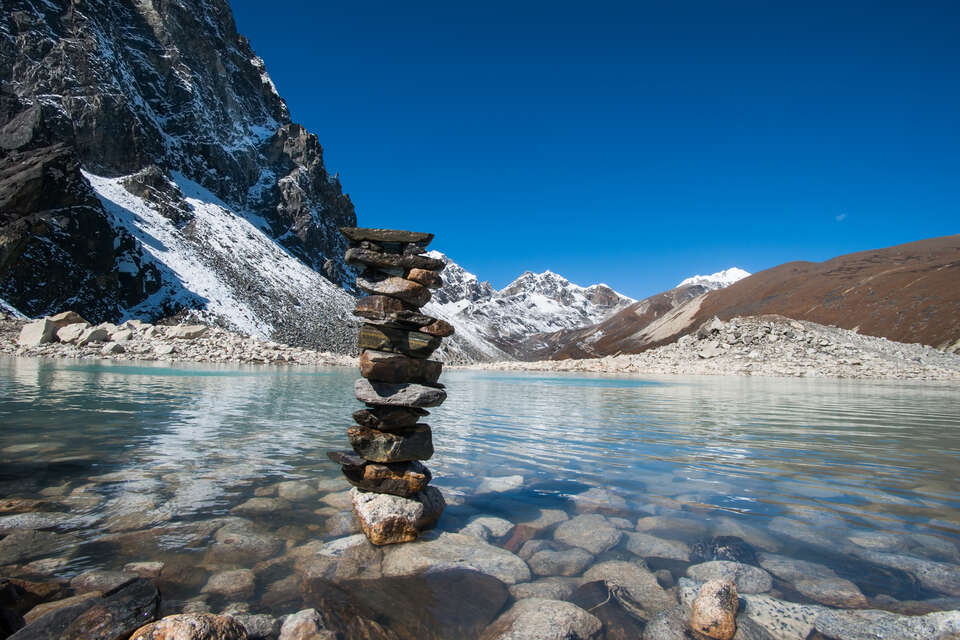
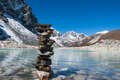
We continue down into the Gokyo Valley and cross the Ngozumpa glacier the longer glacier in this part of the Himalayas and an impressive sight. We should reach Gokyo by lunch. After lunch you should have time to walk up to one of the lakes in the valley and get some great views of the surrounding peaks.

Day 13 - Gokyo - Gokyo Ri to Machermo

Altitude: Gokyo Ri (5,357m)
Walking Distance: 7km (5 or 6 hours)

We will take an early morning hike up to the summit of Gokyo Ri at 5,357m. The views here might even be better than those from Kala Patthar. In front of you are 4 of the 14 tallest peaks in the world, namely, Everest, Lhotse, Makalu and Cho Oyu. Although further away the views of Everest are great and you get to look down on one of the largest glaciers in the Himalayas below you. We will head back to the tea house for breakfast and to start our trek down the Gokyo Valley to Machermo where we will spend the night.

Day 14 - Machermo to Namche

Altitude: 3,440m/11,283ft (Namche)
Walking Distance: 15km (7 to 8 hours).

Today is a relatively long hike but it’s a good trail and all downhill. The lower elevation makes things easier as well. The trek spends most of the day going down the Gokyo Valley with some good views of the peaks before you intersect back with the main route up to Everest Base Camp and head back to Namche. Will spend the night in Namche Bazaar.

Day 15 - Namche to Phakding and Lukla

Altitude: 2,800m/9,184ft
Walking Distance: 16km (6-7 hours)

After breakfast, we trek toward the Hillary Suspension Bridge and then pass through several local villages. Our arrival in Lukla brings an evening in our last Tea House and, traditionally, a party with your trekking crew: you made it! Thanks to great teamwork and perseverance, you’ve accomplished a physical feat of which others only dream. This is your last night on the mountain, which can be bittersweet.

Day 16 - Lukla to Kathmandu

Altitude: 1350m/4428ft
Flight time: 35 min

In the morning, you'll hop a brief flight from Lukla to Kathmandu (See Note), where your journey both began and ends. You'll transfer to your hotel upon landing for some much-needed solo rest and reflection after your trek conquering the Himalayas. We'll reunite in the evening for a farewell dinner at one of the best Nepalese restaurants in town, where we'll be eager to hear your feedback on the trip.

Please Read: Lukla Flights are departing and returning to Ramechhap instead of Kathmandu due to ongoing upgrades at Kathmandu Airport. Its about a 4 to 6 hour drive from Ramechhap back to Kathmandu depending on traffic.

Day 17 - Kathmandu: Departure Day

Altitude: 1,350m/4,428ft

It's your last day in Nepal! Grab some breakfast, and then take in some last-minute shopping in Kathmandu. We’ll make sure you arrive at Kathmandu International Airport with plenty time before your flight home. At this time, we’ll say our goodbyes and bid you farewell, armed with warm memories and gorgeous photos to show your loved ones. END OF OUR SERVICES.

* All distances and time estimates are approximate.

Before you pay a deposit for your Nepal trek, read our booking terms and conditions. They explain what your trek price covers, which costs are extra, and what happens if flights are delayed or your plans change.

These are the sections trekkers check most often:

Not sure about something? Call or WhatsApp us on +91 932 595 1234, or send us a message. We will explain any term before you book.

Our full Everest Base Camp packing checklist covers every item with practical advice. You can also download the packing list as a PDF to print or keep on your phone.

If something is missing when you reach Kathmandu, you can buy or rent almost any trekking gear there at reasonable prices. Buy your hiking boots before you travel, though, and break them in, because a good fit matters more than anything else you carry.

A few practical points before you pack:

  • We give you a duffel bag in Nepal to repack your gear into. Your porter carries it for you.
  • Bring a small day pack for what you need during the walk: water, camera, sunscreen and extra layers.
  • You can leave any extra luggage at your Kathmandu hotel while you trek.
  • The Lukla flight allows 10 kg (22 lbs) of checked luggage plus 5 kg (11 lbs) of carry-on.
  • We offer rental sleeping bags and down jackets at about INR 100 per item per day.
  • Keep your passport, medication and other valuables in your carry-on for the Lukla flight.
Start your adventure here with us!

Frequently Asked Questions

About this trek

What does the 17-day Everest Base Camp and Gokyo Lakes trek cover?

It joins two classic routes into one loop. You visit Everest Base Camp and Kala Patthar first, cross the Cho La pass to the Ngozumpa glacier side, and then reach the turquoise Gokyo Lakes and the summit of Gokyo Ri before descending to Namche and Lukla.

Why do the loop in this direction?

The itinerary goes up the Dingboche side first, so you are well acclimatised before the Cho La pass. You finish in the quieter Gokyo valley with Everest, Lhotse, Makalu and Cho Oyu in view.

How high does the trek go?

Kala Patthar at 5,545m is the highest point. Everest Base Camp is 5,364m, Gokyo Ri is 5,357m, and the Cho La pass is around 5,360m, though surveys differ.

What is the day-by-day order?

Namche Days 3 and 4, Dingboche Days 6 and 7, Lobuche Day 8, Base Camp and Gorakshep Day 9, Kala Patthar then Dzongla Day 10, Cho La to Thaknak Day 11, Gokyo Day 12, Gokyo Ri then Machermo Day 13, Namche Day 14.

The Cho La pass

How hard is the Cho La crossing?

It is the hardest day, with 7 to 8 hours between Dzongla and Thaknak, a steep rocky climb and often snow or ice on top. There is also a stretch over the glacier on the far side. You need steady footing but not climbing skills.

What if the pass is snowed in?

Your guide decides on the morning, and the pass can be closed in or after heavy snow. If it cannot be crossed, you return the way you came and we adjust the plan. Extra days cost INR 6,000 each (stay and three meals).

Do I need crampons or microspikes?

Often microspikes are enough, especially after snow. Your guide will tell you what to bring and what to rent in Namche or Kathmandu.

Is it safe in the pre-dawn start?

The start is in the dark with headlamps, and the guide sets a careful pace. Keep your hands warm and your group together, and tell the guide if you feel unwell.

Gokyo and the lakes

What is special about Gokyo?

The village sits at about 4,750m beside the third Gokyo lake with the Ngozumpa glacier, the longest in the Himalaya, next to it. There are five main lakes, with the fourth and fifth reached by optional walks.

What is the Gokyo Ri climb like?

A steep zigzag of 5 to 6 hours round trip from the village, rewarded by views of Everest, Lhotse, Makalu and Cho Oyu. Go at dawn for clear air, and wear warm layers.

Is the Gokyo side busier or quieter than Base Camp?

Quieter. The Gokyo valley sees fewer trekkers and has fewer lodges, which means simpler facilities but more peaceful evenings.

Altitude, fitness and season

How does the schedule handle altitude?

There are rest days at Namche and Dingboche, and you sleep at 5,180m only once before climbing Kala Patthar. Your guide checks your oxygen saturation each day and has the final say on continuing.

How fit should I be?

Strong. You walk 5 to 8 hours daily for two weeks, with several days above 4,700m. Train for three months with hill hikes and loaded packs.

When is the best time?

March to May and September to November. Winter can close the Cho La, and the monsoon makes the lower trails wet.

Costs and facilities

What is included in the 17 days?

Two nights in Kathmandu with breakfast, Lukla flights from Ramechhap, teahouses, permits and TIMS, a licensed guide, porters and taxes. Three meals a day are included on 14 of the 17 days.

What should I budget for extras?

USD 300 to 400 (INR 25,000 to 40,000). Bottled water costs INR 100 to 300, showers INR 200 to 300, charging INR 100 to 400 and Wi-Fi INR 300 to 500 per hour. Tipping around 10% is customary.

Can I rent a sleeping bag or down jacket?

Yes, about INR 100 per item per day for a sleeping bag or a down jacket. You collect them at the briefing.

What if my Lukla flight is cancelled?

We rebook you on the next flight. A chartered helicopter may be possible from USD 600, and we refund USD 150 of the flight fare if you use it. Extra nights and meals are yours to pay.

Insurance and team

What insurance do I need before I pay the balance?

Insurance is mandatory and we ask for proof before you arrive. Check the altitude clause first, because many standard policies stop at 4,000m and this route goes to 5,545m. The insurance section of our terms has the details.

Who organises a rescue, and who pays?

The guide raises the alarm and our Kathmandu team arranges the helicopter with your insurer. The cost, which can pass USD 5,000, is yours to claim back. Rescue is never delayed over payment.

Who employs the people on my trip?

Himalayan Wonders Adventure Pvt. Ltd. in Nepal employs your guide and porters. You can meet the team on our team page.

Money, booking and changes

How and when do I pay?

A deposit secures your place and the rest is due when you reach our Kathmandu office. Indian guests send the deposit by bank transfer or UPI, and guests abroad may use a transfer or an online card with a 4.5% fee. Pay the balance in INR, USD, EUR, GBP or another major currency, at the NPR conversion rate on the date of payment (local conversion charges apply). Cash saves you the 13% charged on cards in Nepal.

What happens to my deposit if my plans change?

For the first 30 days half of it can be refunded. After that it is not refundable, but it remains valid for a year on any trek or climb we run. A no-show without contact forfeits it.

How flexible are the dates?

Very. You can move your departure as often as you like at no charge if you give 6 weeks' notice. With 2 to 6 weeks' notice a fee of INR 5,000 (Indian guests) or USD 100 (other guests) applies, and changes are not possible with less than 14 days' notice. If the new date costs more, you pay the difference.

Do I get money back if I finish early?

No. Our staff and bookings are paid for the whole schedule, so unused days are not refunded. We will help you get home, and any extra hotel, meals or flights are yours to pay. Your insurer may cover some of it.

Is there a single supplement?

There is no single supplement. Rooms are shared by gender, and couples, families and friends share together. In Kathmandu you share a twin room, or get a single room at no charge if no one of your gender is booked on your dates. On the trek, rooms are twin-sharing. If you are the only person booked on a fixed departure, or you are not joining a group, a Solo Support Fee of INR 1,500 per trekking day covers a dedicated porter. If the fee is not paid and you are the only person booked on your dates, there is no separate licensed trek guide, and a porter-cum-guide leads the trek. We tell you at booking, or as soon as it arises.

Tailor-made
Your trek, your way

Tell us your group, your dates and your budget. We will shape this trek around you.

  • Any group, any size. Families, friends, corporate teams and school groups.
  • Your pace. Add rest days for acclimatization, extend your trek or combine it with another route.
  • Your budget. Share it with us and we will plan around it.
  • Your dates. Reschedule free, as often as you need, with 6 weeks’ notice.
Customise this trek
Why book with us
  • One local team. Your guide, porters and driver are all employed by Himalayan Wonders Adventure Pvt. Ltd., our licensed operator in Nepal.
  • Led by experienced specialists. Our guides know the route, its teahouses and its high passes well.
  • Safety first. Guides are trained in Wilderness First Aid, and they check your oxygen levels every day. Your guide decides whether you continue, rest or descend, and that decision is final.
  • Clear pricing. Our Terms list the extras up front, so there are no surprises on the trail.
  • A deposit that stays flexible. It is 50% refundable for 30 days and valid on any trek or climb for a year.
  • Real people, quick replies. We answer every email within 24 hours. You can also call us on +91 932 595 1234, 9am to 7pm IST.
  • Big group? We can help. We arrange custom group treks at every level.
Trekking Facts
Trek Name:
Everest Base Camp & Gokyo Lakes Trekking
Best Season:
September to November & March to May.
Trek Grade:
Strenuous
Accommodation:
Tea House
Highest Point:
5545m (Kala Patthar)
Trail Access:
Flight
(Kathmandu / Lukla / Kathmandu)
Highlights:
Mt. Everest, Everest Base Camp, Kala Patthar, Gokyo Lakes, Gokyo Ri, Ngozumpa Glacier, Cho Oyu, Lhotse, Nuptse and Ama Dablam.
Trek Duration:
17 Days
Group Size:
Min. 1 to Max. 10 Pax
All inclusiveRs. 105,000 INR
WhatsApp Enquire now