




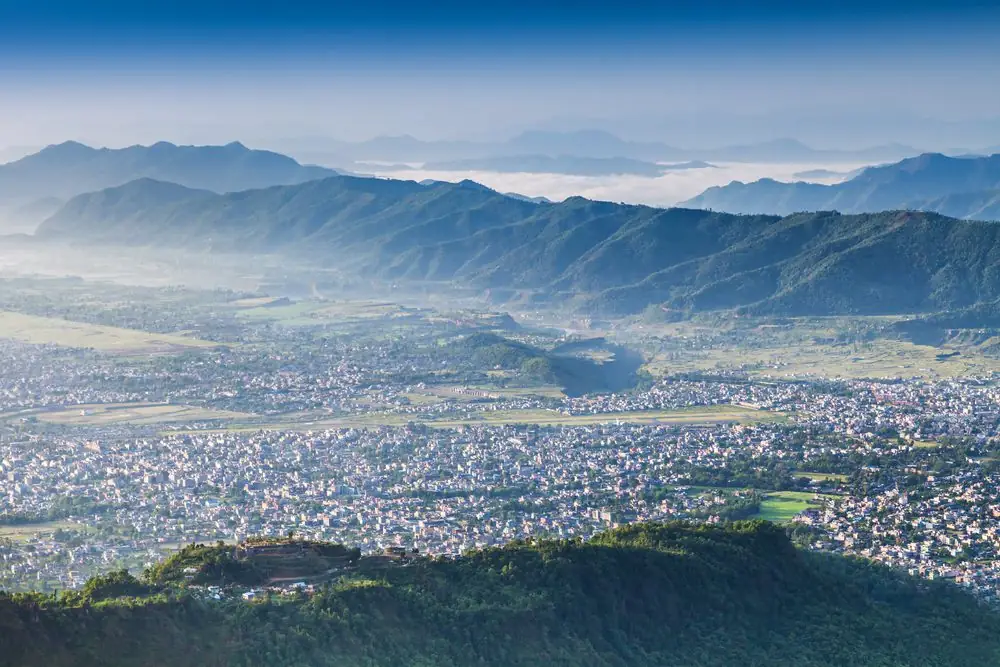
Nepal has a remarkable range of wildlife for its size because it rises from about 60 m to 8,848 m. The lowland parks hold one-horned rhinos, Bengal tigers, elephants and gharial crocodiles; the hill forests hold red pandas and langurs; and the high Himalaya is home to snow leopards, blue sheep, Himalayan tahr, musk deer and yaks.
Why so many animals in a small country
In about 150 to 200 km from south to north, Nepal passes from hot grassland and sal forest through oak and rhododendron, then pine and fir, then alpine meadow, to rock and ice. Each belt has its own animals. The country has twelve national parks along with wildlife reserves and conservation areas, and protected land covers roughly a quarter of its surface.
Lowland animals (the Terai)
- Greater one-horned rhinoceros: the star of Chitwan. Numbers have recovered from under a hundred in the 1960s to more than 700 across Nepal, most of them in Chitwan.
- Bengal tiger: Nepal roughly doubled its wild tigers in about ten years, to around 350 in the 2022 count. Bardia and Chitwan are the main parks. Sightings need luck and patience.
- Asian elephant, sloth bear, leopard, gaur (wild cattle), and spotted, hog, barking and sambar deer.
- Gharial: a long, thin-snouted, fish-eating crocodile, critically endangered and bred at a centre in Chitwan. The broader-snouted mugger crocodile shares the same rivers.
- Ganges river dolphin, in the Karnali and Koshi rivers.
Is there a Himalayan crocodile?
People sometimes search for a "Himalayan crocodile". There are no crocodiles in the mountains. Nepal's two species, the gharial and the mugger, live in the warm lowland rivers such as the Narayani, Rapti, Karnali and Babai, at the foot of the hills. You can see both on a canoe trip in Chitwan.
Forest animals of the middle hills
- Red panda: a shy, tree-living animal of bamboo and rhododendron forest between about 2,200 and 4,000 m. It is found in Langtang, in the east around Ilam and Taplejung, and in parts of the Annapurna region. Seeing one is rare.
- Langur and rhesus monkeys: common on lower trekking trails and at temples.
- Himalayan black bear, yellow-throated marten and barking deer.
- Birds: Nepal has recorded close to 900 species, and the spiny babbler is found nowhere else.
High mountain animals
- Snow leopard: the cat of the high Himalaya, living from about 3,000 to 5,500 m in Dolpo, Mustang, Manang, the Everest region and Kanchenjunga. Nepal's first national estimate, published in 2025, put the number at around 400. Very few trekkers ever see one.
- Blue sheep (bharal, called naur in Nepal): a stocky wild sheep with a slate-blue coat, the snow leopard's main prey. Herds are often seen near Manang, in Dolpo, Nar Phu and the upper Kanchenjunga valleys.
- Himalayan tahr: a shaggy wild goat that grazes on steep slopes. Commonly seen on the Everest trail between Namche and Tengboche and in Langtang.
- Musk deer: small, shy and tusked, living in forest near the tree line. Sometimes seen near Tengboche at dawn and dusk.
- Yak: the working animal of the high valleys. Above about 3,000 m most pack animals are yaks, or the yak and cow crosses called dzo, which are used lower down.
- Pika and marmot, and overhead the lammergeier (bearded vulture) and Himalayan griffon.
The national bird and flower
The danphe, or Himalayan monal, is the national bird: a pheasant whose male shines with green, copper, blue and purple. It is often seen on the Everest trail around Namche and Tengboche. The national flower is the red rhododendron, lali gurans, which colours the hill forests in March and April.
Where to go for wildlife
- Chitwan National Park: the easiest, five to six hours by road from Kathmandu or Pokhara. Two nights give a jeep safari, a canoe trip and a walk.
- Bardia National Park: further away and quieter, for a better chance of tiger.
- Koshi Tappu: wetland birds and wild water buffalo, in the east.
- On trek: Sagarmatha National Park for tahr, musk deer and danphe, and Manang, Nar Phu and Dolpo for blue sheep.
See Sagarmatha National Park facts and wildlife of the Annapurna Conservation Area.
Watching wildlife well
Go with a licensed nature guide in the lowland parks. Walking in rhino country without one is dangerous. Keep your distance, stay quiet, never feed animals and do not ride elephants; jeep and walking safaris are the better choice. On trek, give yak and mule trains room and always stand on the uphill side of the trail when they pass.
Common questions
What animals live in Nepal?
Among many others: one-horned rhino, Bengal tiger, elephant, leopard, gharial, red panda, snow leopard, blue sheep, Himalayan tahr, musk deer and yak, with nearly 900 kinds of bird.
What is the national animal of Nepal?
The cow is the national animal, and the danphe (Himalayan monal) is the national bird.
Where can I see blue sheep in Nepal?
Around Manang and Yak Kharka on the Annapurna Circuit, in Nar Phu, Dolpo and the upper Kanchenjunga valleys, usually on open slopes above 3,500 m.
Are there tigers in the Himalayas?
Tigers live mainly in the lowland forests. Camera traps have recorded them at surprising heights in the hills of Nepal and Bhutan, but for visitors the place to look is Bardia or Chitwan.
Heights, dates, fees and rules are approximate and can change, so confirm the current details with us before you book.


