




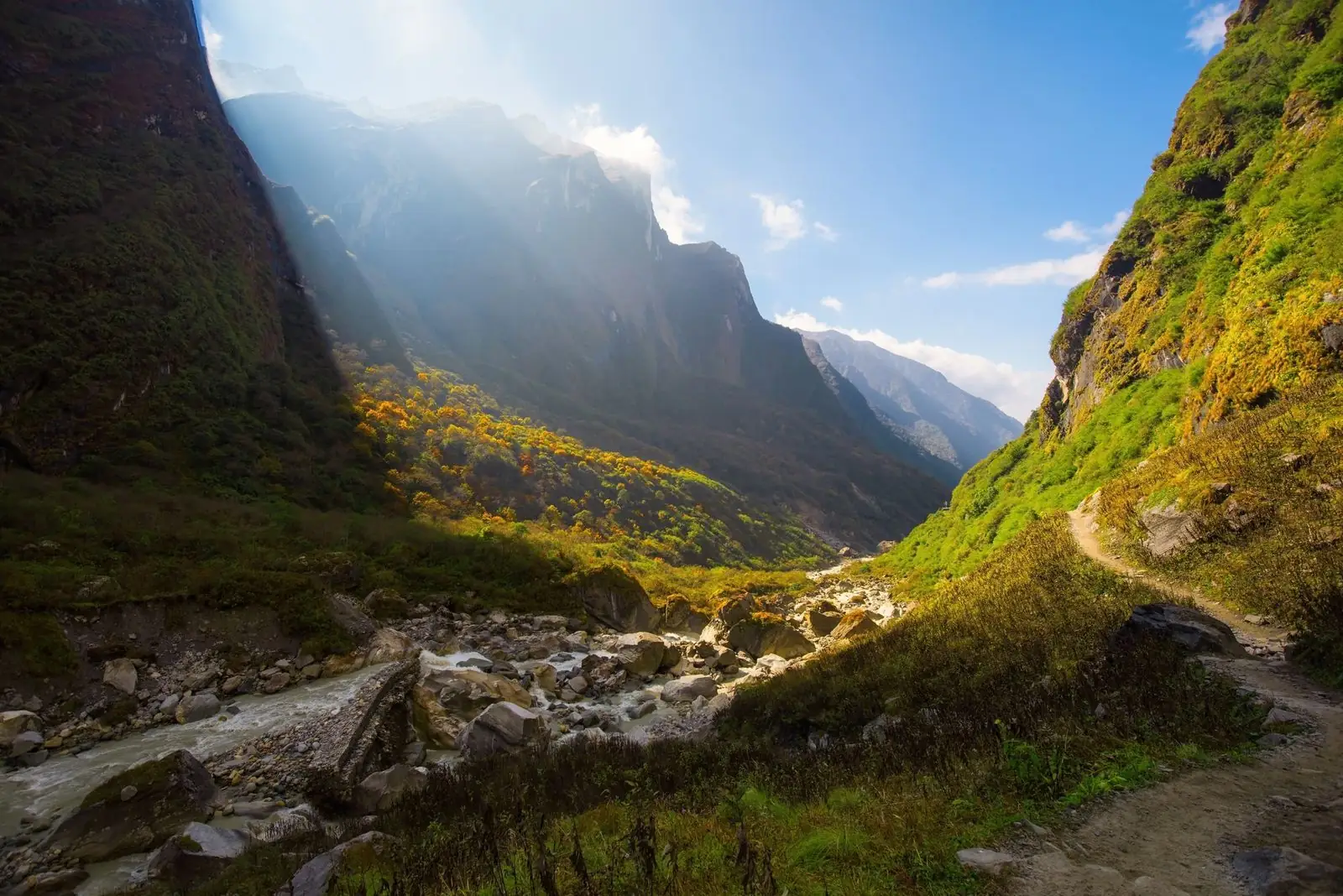
Himalaya is the name of a small lodge cluster on a ridge in the Annapurna Sanctuary valley, at about 2,900 m. This page is about that trekking stop in the Annapurna Base Camp and Poon Hill region, not the mountain range. It lies between Dovan and Deurali on the route to Annapurna Base Camp.
Altitude: about 2,900 m. Heights quoted for villages and camps vary by source, so treat this as a guide.
Where Himalaya is and why trekkers stop
The settlement named Himalaya is reached from Dovan by a steady climb through bamboo and rhododendron, crossing a few streams before it appears on a ridge. Our route pages link it with Sinuwa, Chhomrong, Bamboo, Deurali, Machhapuchhre Base Camp and Annapurna Base Camp. Trekkers stop for lunch or a night because it breaks the long ascent into manageable parts, and because services above Deurali are even simpler. Weather here can be changeable, so a rest also lets you read the sky.
What to expect at Himalaya
Expect a small cluster of lodges with basic rooms and a shared dining space. The setting is more open than the forest below, and the air feels cooler. Trails to and from the village are rocky in parts, and weather can shift quickly, bringing cloud, rain or snow depending on season. Facilities are modest, so plan your food, water and charging around that. It is a practical stop rather than a place to linger, but a good resting point for the climb ahead.
Altitude and how you may feel
At about 2,900 m, Himalaya is higher than Dovan and lower than Deurali. Our guides describe the walk from Dovan as a net gain of roughly 300 to 400 m. You may notice slightly shorter breath on slopes and lighter sleep. Altitude illness can strike on this route, so drink water, rest when needed, and tell your guide about headache, nausea or dizziness. If symptoms worsen, descend. Do not rush the next day just to keep an itinerary.
Lodging, food and practical tips
Menus follow the standard trekking pattern with rice, noodles and soup, and supplies are carried in, so choices narrow as you go up. Carry cash and any medicines you need. Bring a warm layer for the evening and a waterproof jacket for the daytime. In cold seasons, check conditions with your lodge before moving on, because snow and avalanche risk can affect the upper valley. Keep your pace steady and sleep well, since the next days climb higher.
Stage guides that pass through Himalaya
These day-by-day guides start or end at Himalaya, with walking times, ascent and where to sleep.
- Dovan to Himalaya trek: altitude, time and route
- Sinuwa to Himalaya trek: stages, altitude and time
- Chhomrong to Himalaya trek: stages, altitude and time
- Bamboo to Himalaya trek: stages, altitude and time
- Himalaya to Deurali trek: altitude, time and route
- Himalaya to Machhapuchhre Base Camp trek: stages, altitude and time
- Himalaya to Annapurna Base Camp trek: stages, altitude and time
Common questions
Is Himalaya a village or the mountain range here?
On this route it is a small lodge cluster on a ridge in the Annapurna Sanctuary valley. It is a trekking stop named Himalaya, not the mountain range.
How high is Himalaya?
Himalaya is at about 2,900 m, higher than Dovan and lower than Deurali. Sleeping altitude rises as you continue toward Machhapuchhre Base Camp and Annapurna Base Camp.
Where do trekkers go after Himalaya?
The next stop is Deurali, then Machhapuchhre Base Camp and Annapurna Base Camp. Many split the upper stretch over a night at one of these lodges to ease the altitude gain.


