




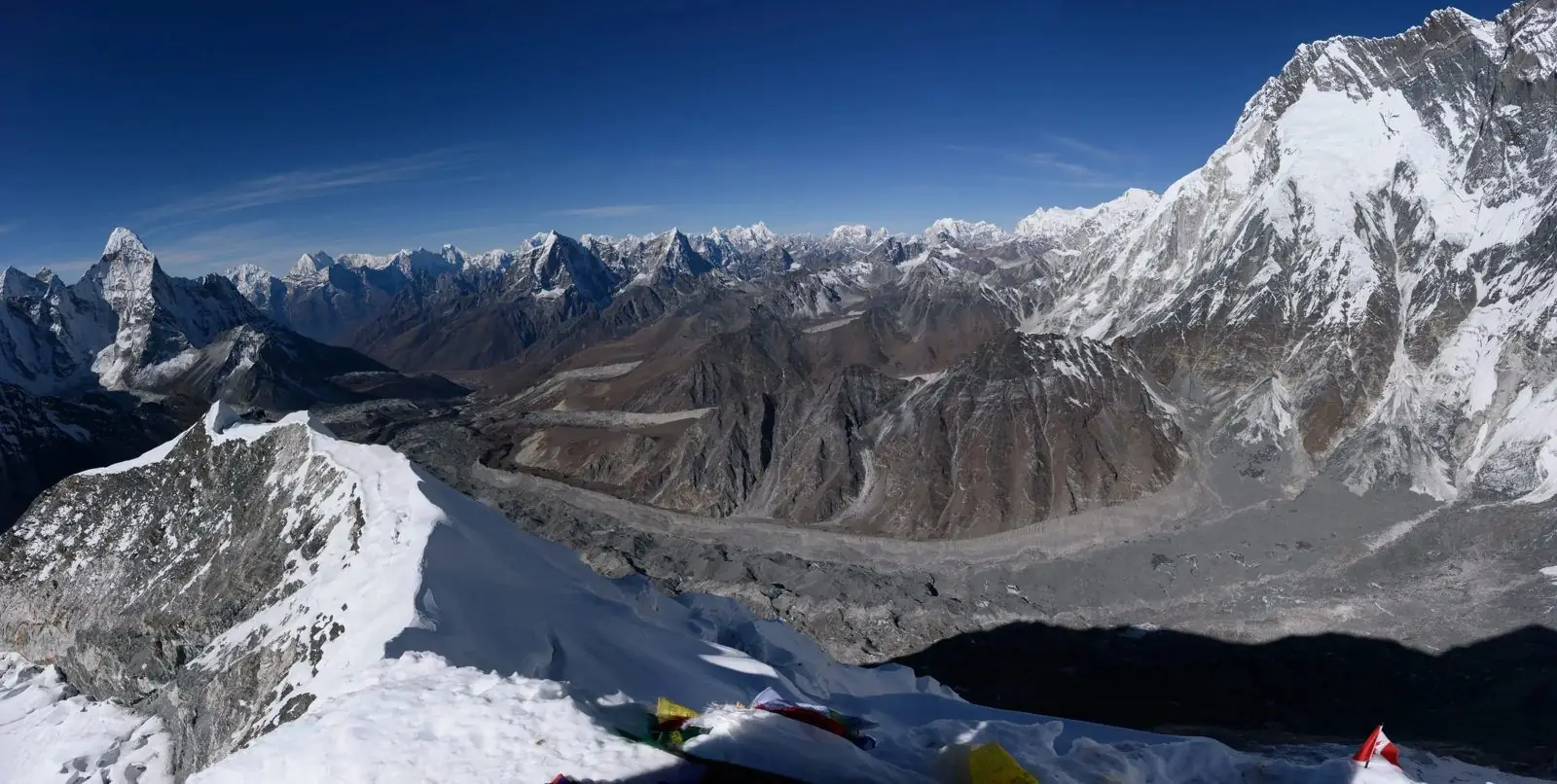
Pumori, about 7,161 m, is the tallest and most distinctive of the three. Lingtren, about 6,749 m, stands between Pumori and Khumbutse, and Khumbutse, about 6,665 m, is the westernmost.
Pumori
Pumori is a steep pyramid with a long ridge. It stands opposite Kala Patthar and is easy to recognise. See the Pumori guide.
Lingtren
Lingtren is a lower, broader peak that sits on the ridge next to Pumori. It is often overlooked because Pumori attracts attention.
Khumbutse
Khumbutse, the first mountain west of Everest, is a snowy dome on the border. See the Khumbutse guide.
Telling them apart
From Gorak Shep, look left of Pumori for Lingtren and then Khumbutse. A guide helps. Morning light shows the ridges best.
Climbing
All three are serious climbs. Pumori is an expedition peak, and Lingtren is rarely attempted.
Viewpoints
Kala Patthar and the ridges near Lobuche give the best angles.
Seen from different places
From Lobuche, the ridge above the village shows Lingtren and Pumori as a pair, with Khumbutse further along. From Kala Patthar you face Pumori and see Lingtren to its right. The skyline changes with every step, so take a few photographs at each viewpoint and ask your guide to name the peaks as you go.
Height and prominence
Pumori is the highest of the three and is a major peak in its own right. Lingtren and Khumbutse are lower and more often mistaken for parts of the wall. Their heights are given as about 6,749 m and 6,665 m, and sources vary slightly.
Why they matter to trekkers
They form the western side of the view from Gorak Shep and help you understand the shape of the valley. Learning to tell them apart makes the trek more satisfying and your photographs more useful.
Climbing history in brief
Pumori has seen many expedition climbs and is a popular objective in the pre-monsoon and post-monsoon seasons. Lingtren and Khumbutse are quieter. All three need full mountaineering skills and permits.
Plan it


