




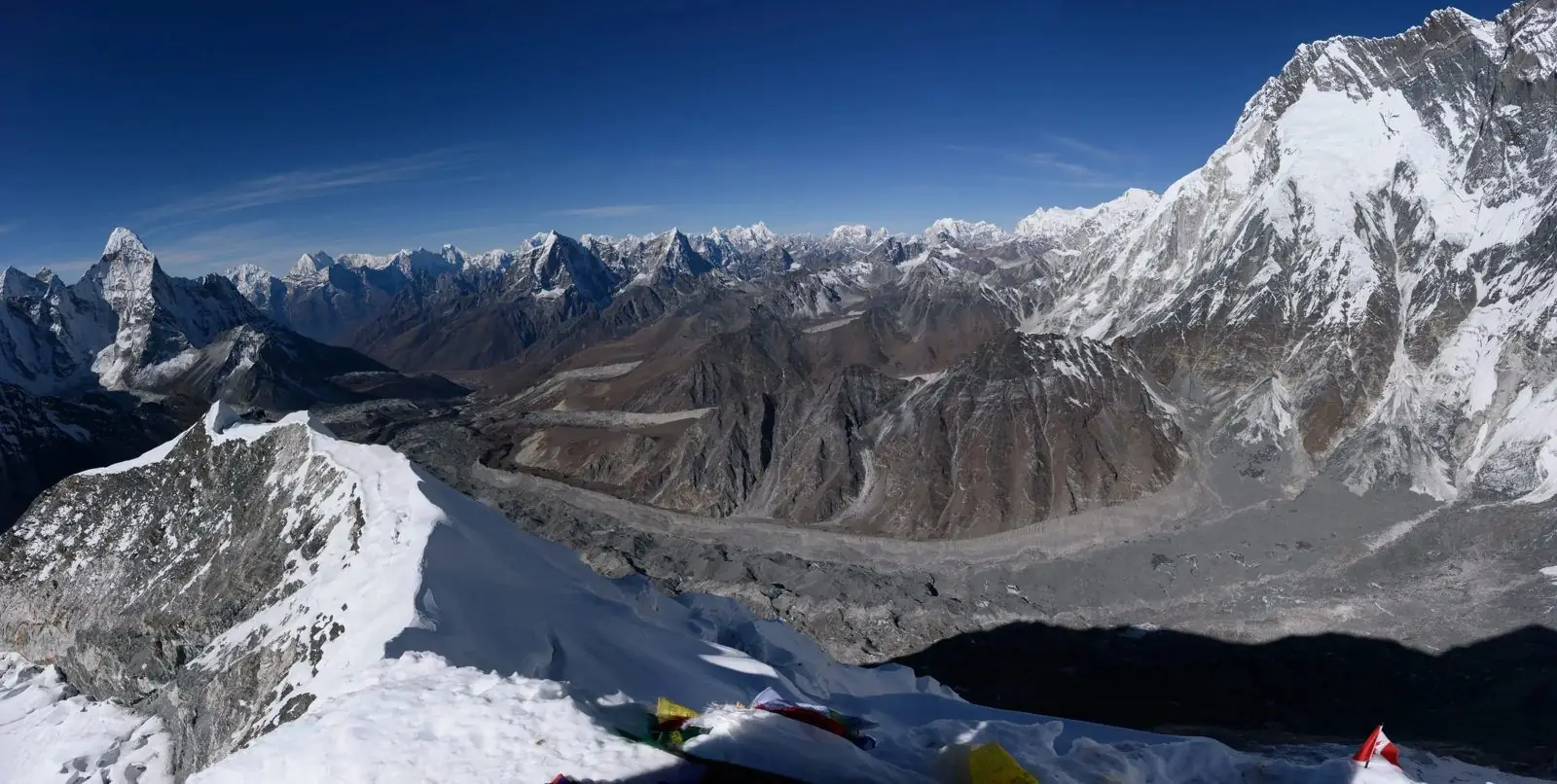
Pumori is a graceful 7,161 m peak on the border of Nepal and Tibet, directly above Gorak Shep and the Everest Base Camp trail. Its clean pyramid shape makes it one of the most photographed mountains in the Khumbu, and it forms the backdrop to the classic view from Kala Patthar.
The pyramid above the trail
Almost everyone who walks to Everest Base Camp ends up looking at Pumori. It stands right above the last village, Gorak Shep, and its steep faces are visible for much of the final two days. Its height is given as 7,161 m (23,494 ft), and it is part of the Mahalangur range.
What the name means
The name is usually explained as daughter mountain, from words used in the Sherpa and Tibetan languages. The story goes that the pyramid stands like a young girl beside its great neighbour. Whether or not that explanation is exact, the name has stuck, and guides use it with affection.
The first ascent
A German expedition made the first ascent in 1962, which makes it one of the earlier big Himalayan peaks to be climbed after the golden era of the 1950s. Since then it has become a favourite objective for climbers who want a technical 7,000 m peak close to the Everest trail.
Climbing Pumori
The peak is steep, with ice, mixed ground and avalanche danger on some lines, and it demands real mountaineering ability. Expedition teams use a base camp on the moraine near the Everest route, then build camps on the ridge. Conditions change with the season and the snow, so a good leader matters more than speed.
Seeing it as a trekker
You see Pumori from Lobuche, Gorak Shep and the Khumbu glacier, and best of all from Kala Patthar, where the mountain rises to your left and Everest appears behind the shoulder of Nuptse. Morning light is warm and the sky is usually still, so start early and bring a warm layer, because the air is cold even in clear weather.
A neighbour with a famous twin
The nearby peak Lingtren is often mistaken for Pumori in photographs because the two sit close together. Your guide will help you tell them apart. Pumori is the taller, more pointed one, while Lingtren is lower and more rounded.
Plan the view
Pumori is on the standard route, so you do not need a special permit to look at it. Read the Everest Base Camp guides for the trek itself, and ask us for a plan that gives you a spare day near Gorak Shep in case cloud hides the mountain.
Common questions
Is Pumori the same as Everest? No, they are neighbours. Is Pumori hard to climb? Yes, it is a technical peak. Can I see it without a long climb? Yes, from Gorak Shep and Kala Patthar on a normal trek.
Pumori and Everest Base Camp history
Pumori has been part of the Everest story for a long time. Because it stands so close to the base camp area, expedition teams have always used it as a reference point, and some have used it for acclimatisation climbs before their main objective. For the trekker it offers a different kind of interest: it is a mountain you can study from several angles over two days, and it never looks the same twice.
Walking beneath the face
On the final day from Lobuche to Gorak Shep the path runs beside the moraine, with Pumori rising steadily above. In the afternoon the face can take on a hard, cold shade, and in the early morning it turns pink and gold. Stop for a few minutes on the stretch near Gorak Shep to look back across the glacier. The scale of the wall becomes clear only when you see people on the trail below it.
A better view than you expect
Visitors often say that Pumori looked more beautiful than Everest itself. The reason is simple: Everest is a dark, distant summit behind other ridges, while Pumori is a sharp white mountain that fills the sky. Use that to plan your photographs, and give Pumori its own frame instead of treating it as background.
Climbing season and conditions
Spring climbing is usually warmer, with long days. Autumn brings clear air and steady cold. Winter and monsoon climbs are rare and hard. Weather can close in quickly, and wind on the upper ridge is a constant concern. All of this shapes how teams plan time at base camp.
Respect on the glacier
The area around Gorak Shep is fragile. Take all rubbish away with you, stay on the marked paths and avoid disturbing memorials on the ridge. These small habits keep the area beautiful for everyone who comes after you.


