




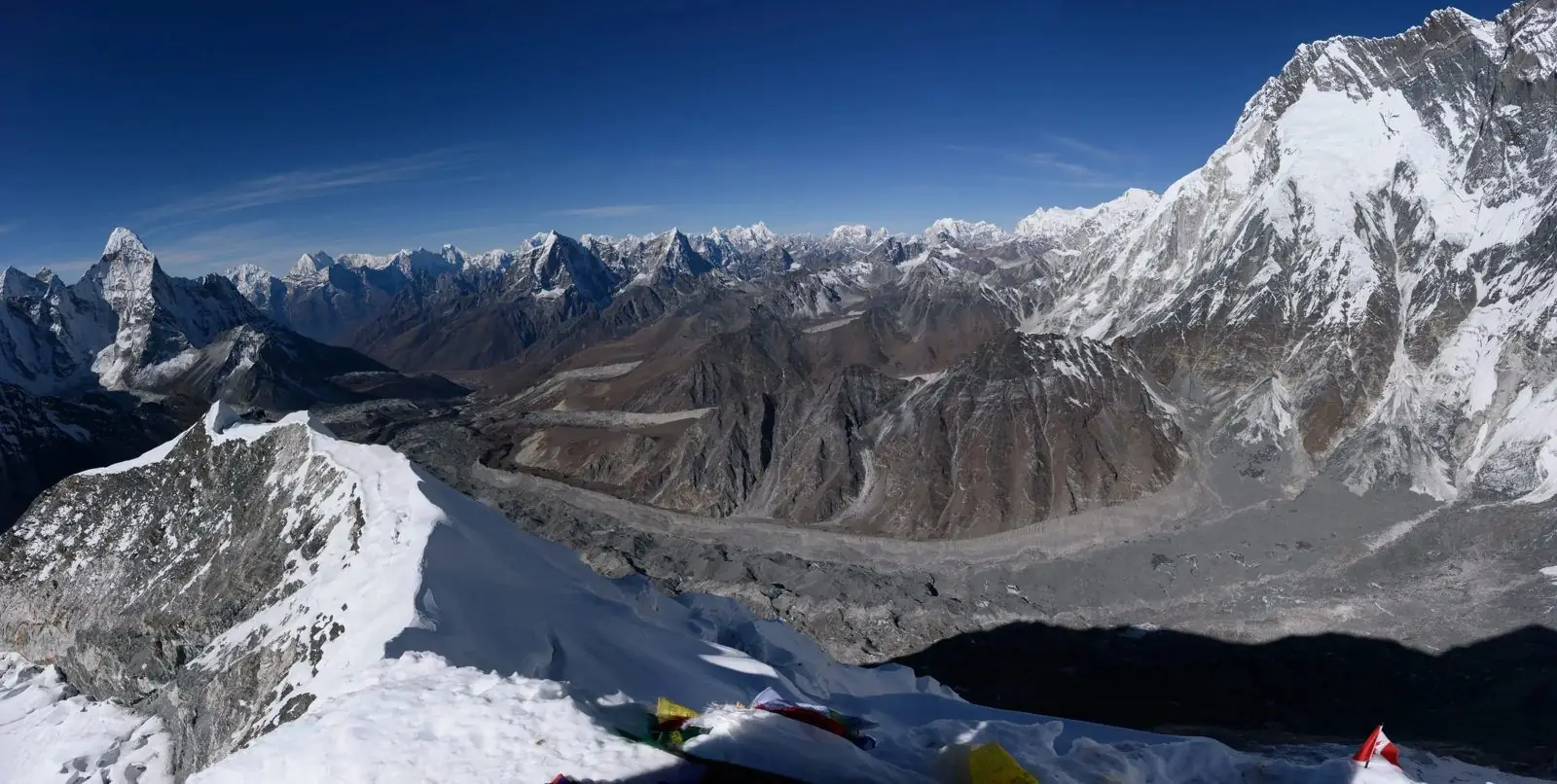
Kala Patthar is a dark, rocky hill of 5,545 m above Gorak Shep. It is not a technical peak. It is a long, steady walk to the best viewpoint for Everest that most trekkers can reach, and for many people it is the real highlight of the Everest Base Camp trek.
A viewpoint, not a summit
The name means black rock, and the hill is exactly that: a ridge of dark stone on the lower slopes of Pumori. Its height is 5,545 m (18,192 ft). It is a walker's peak. There is no climbing, only a rough path, but the altitude makes it harder than the map suggests.
Why people go
From Everest Base Camp itself you cannot see the summit of Everest because Nuptse stands in the way. From Kala Patthar you can. The top of Everest rises above the long wall of Nuptse, with Lhotse beside it, and the whole Khumbu glacier curls below your feet. Few viewpoints in the world put so much high mountain scenery in front of you.
The walk
The climb starts behind Gorak Shep and takes roughly two to three hours up for most people, and one to one and a half hours down. The path is steady but steep in places, and it crosses loose stones and some patches of snow. Take your time, keep a regular breathing rhythm and rest on the flatter sections.
Sunrise or sunset
Sunrise gives soft colour on the peaks and usually clearer air, but it means a very early, cold start. Sunset is warmer to walk but cloud often builds in the afternoon. Many groups go for sunset on the day they arrive at Gorak Shep if the weather is good, and keep sunrise as a second chance.
Cold and altitude
Temperatures at the top can fall far below freezing, with wind. Wear a warm insulated jacket, a hat, gloves and a scarf, and carry water. Altitude problems are possible. Walk slowly, tell your guide if you feel unwell, and turn back if symptoms get worse. Our Everest Base Camp guides cover acclimatisation in detail.
The best place on the hill
The first prominent point is often busy, with a pile of prayer flags. A few minutes' walk further along the ridge you may find a quieter spot with the same view. Do not go beyond what your guide recommends, because the ridge is narrow in places.
Photography
Use a wide lens for the glacier and a zoom for Everest. A tripod is helpful at dawn. Keep spare batteries inside your jacket, because cold drains them quickly. Take a moment to look with your own eyes before you start taking pictures.
Common questions
How high is Kala Patthar? About 5,545 m, higher than Everest Base Camp. Do I need a permit? No special permit is needed beyond the normal Everest trekking permits. How hard is it? It is strenuous because of the height, but it is a walk, not a climb.
Planning your day around the climb
Most groups sleep at Gorak Shep, at about 5,164 m. The route to Kala Patthar begins at the end of the village. If you plan sunrise, wake in the dark, drink something warm, and start moving before the first light. A headtorch with fresh batteries is essential. If you plan sunset, leave after lunch, when the sun is still warm, and give yourself enough time to come down before dark.
What you actually see
Looking east, Everest appears as a dark pyramid behind the ridge of Nuptse, with Lhotse to its right and Changtse to its left. Looking south, Pumori and Lingtren fill the view. Looking down, the Khumbu glacier curves away like a frozen river, and you can pick out the tents of Everest Base Camp in season. On a clear day there is little else in the Himalaya like it.
If the weather is bad
Cloud and wind can hide the view altogether. Do not force the climb in poor conditions. Many groups plan a spare night at Gorak Shep, or use a second attempt the next morning. If the weather is persistent, you can still enjoy the walk to the base camp area and the dramatic glacier scenery, and the trip is still worthwhile.
Pace, food and water
Eat a light breakfast or a warm snack before you start, and carry water in an insulated bottle so it does not freeze. Walk at a pace that lets you speak in short sentences. Your guide may check your oxygen saturation before and after. Altitude affects everyone differently, and age and fitness do not predict it.
Coming down
The descent is quicker but can be slippery. Poles help. Be careful on the loose stone, and give yourself time to rest at Gorak Shep before the walk back down towards Pheriche or Dingboche the next day.


