




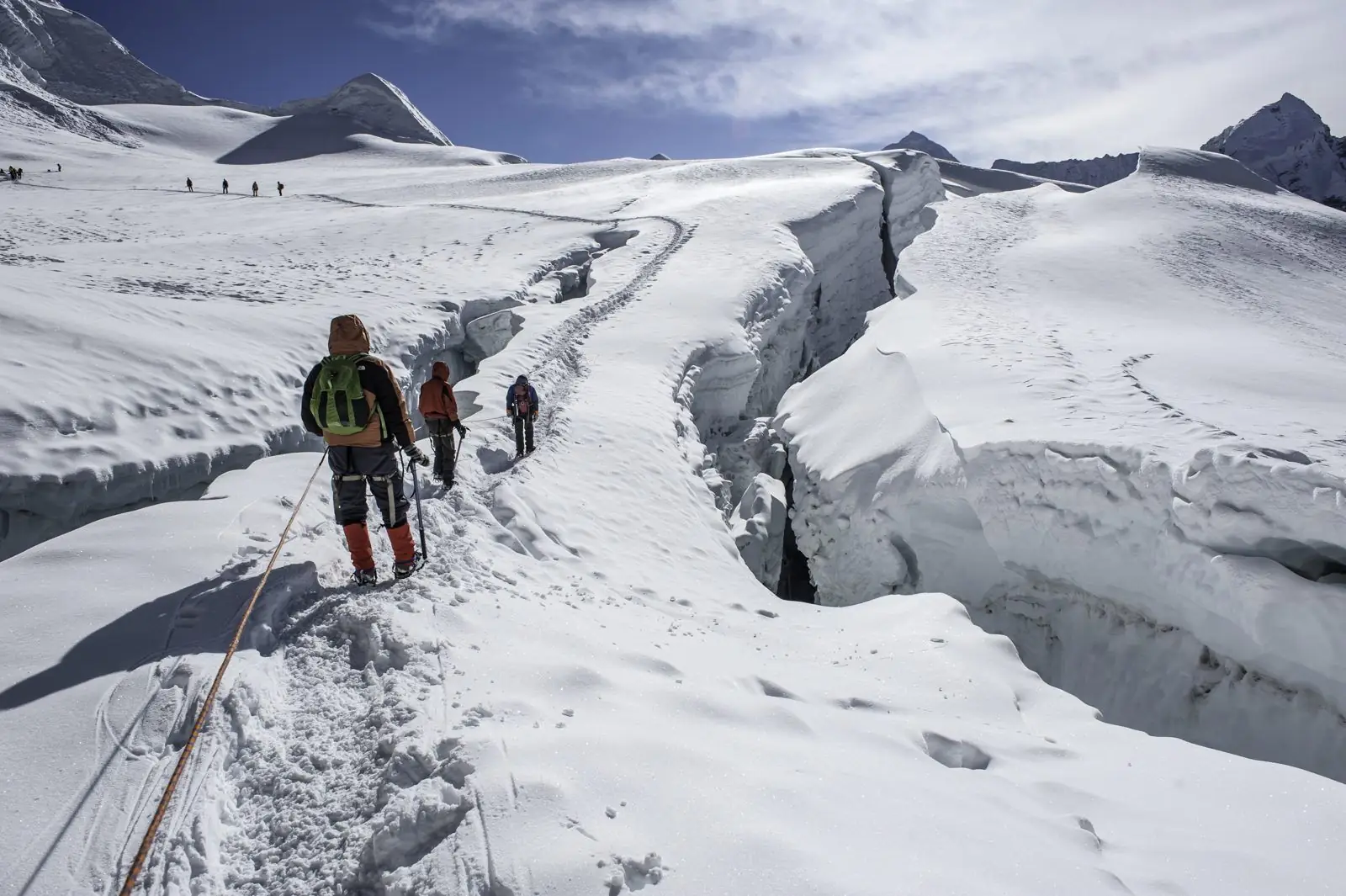
Most commercial Baruntse climbs follow the south-east ridge. Teams reach base camp, at roughly 5,300 m, through the Hunku valley, often after crossing the Mera La or climbing Mera Peak. Above base camp, they use two or three high camps and fixed ropes.
Approach to base camp
A common approach flies to Lukla, crosses the Zatrwa La, and walks to the Hunku valley before turning to Baruntse base camp. Other plans use the Amphu Laptsa from Chukhung, which is a technical pass.
Base camp
Base camp is around 5,300 m on the glacier side. Teams stay several days for acclimatisation and gear checks.
High camps
Above base camp, teams use camps on the ridge, at roughly 5,800 m and 6,200 m, depending on the season and the team, with fixed ropes on steeper snow and ice.
Summit day
The summit day is long, from a high camp up the ridge and back. It involves snow, some steep ice and a final crest. Weather and wind decide the day.
Descent
Teams descend by the same route, and then walk out via Lukla.
Why the approach matters
The approach doubles as acclimatisation. Moving slowly, sleeping higher and resting well all improve your chances at the top. Do not compress the walk-in to save days.
Hazards on the route
Crevasses, loose rock on moraine, avalanche risk after snowfall, and cold wind on the ridge are all real. Teams use ropes, careful timing and clear communication to manage them.
Plan it
Read the itinerary and the best time to go.


