




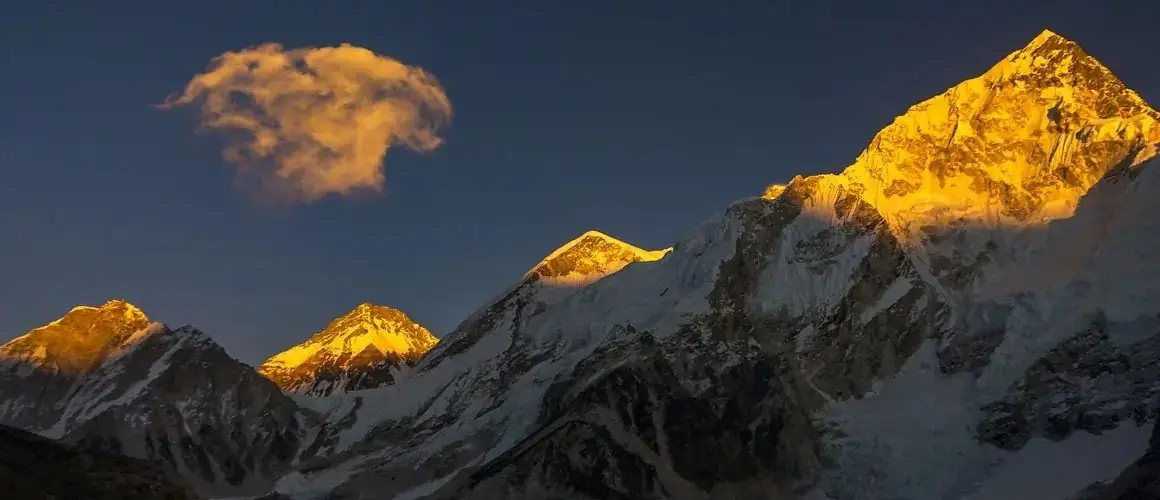
The highest peak of the Himalayas is Mount Everest at 8,848.86 m (29,031.7 ft), on the Nepal and China border. Kanchenjunga (8,586 m) is second in the Himalaya proper and is the highest peak in India. Ten Himalayan peaks rise above 8,000 m.
The ten Himalayan peaks above 8,000 m
- 1. Mount Everest, 8,848.86 m, Nepal and China.
- 2. Kanchenjunga, 8,586 m, Nepal and India (Sikkim).
- 3. Lhotse, 8,516 m, Nepal and China.
- 4. Makalu, 8,485 m, Nepal and China.
- 5. Cho Oyu, 8,188 m, Nepal and China.
- 6. Dhaulagiri I, 8,167 m, Nepal.
- 7. Manaslu, 8,163 m, Nepal.
- 8. Nanga Parbat, 8,126 m, Pakistan.
- 9. Annapurna I, 8,091 m, Nepal.
- 10. Shishapangma, 8,027 m, China (Tibet).
Eight of the ten are in Nepal or on its border. Nepal's 8,000 m peaks covers each of them.
What about K2?
K2 (8,611 m) is the second highest mountain on Earth, but it stands in the Karakoram, the range north-west of the Himalaya, along with Gasherbrum I (8,080 m), Broad Peak (8,051 m) and Gasherbrum II (8,035 m). Together with the ten above, these make up the fourteen "eight-thousanders".
Many lists of "Himalayan peaks" include the Karakoram, so you will often see K2 given as number two. Both ways of counting are in common use; the difference is only where the line between the two ranges is drawn.
The highest peak of the Himalayas in India
Kanchenjunga, 8,586 m, on the border of Sikkim and Nepal, is the highest mountain in India. The highest mountain that stands entirely inside India is Nanda Devi, 7,816 m, in Uttarakhand, followed by Kamet at 7,756 m.
K2 is sometimes named in Indian textbooks as the highest peak in India because it lies in territory India claims; it is administered by Pakistan. For the mountain itself see Kanchenjunga height and rank.
Famous peaks below 8,000 m
Some of the best-known Himalayan mountains are not the highest. Height is only part of what makes a peak famous; shape, legend and how visible it is from a trail count for a lot.
- Nuptse, 7,861 m, the long wall beside Everest.
- Nanda Devi, 7,816 m, the sacred peak of Uttarakhand.
- Namcha Barwa, 7,782 m, the eastern anchor of the range.
- Gangkhar Puensum, 7,570 m, the highest point of Bhutan and often called the highest unclimbed mountain.
- Langtang Lirung, 7,227 m, the peak above the Langtang valley.
- Machapuchare, 6,993 m, the "fishtail" above Pokhara, never officially climbed.
- Ama Dablam, 6,812 m, the pyramid above the Everest trail.
- Mount Kailash, 6,638 m, the holiest mountain in the range.
Highest peak in each Himalayan country
- Nepal: Mount Everest, 8,848.86 m (shared with China).
- China: Mount Everest, 8,848.86 m (shared with Nepal).
- India: Kanchenjunga, 8,586 m (shared with Nepal).
- Pakistan (Himalaya): Nanga Parbat, 8,126 m; the country's highest overall is K2 in the Karakoram.
- Bhutan: Gangkhar Puensum, 7,570 m.
How the heights are measured
Heights are measured above mean sea level. The current figure for Everest, 8,848.86 m, was announced jointly by Nepal and China in December 2020 after new surveys. Older sources give 8,848 m or 8,850 m. Figures for other peaks also differ by a few metres from one map to another, because snow depth changes and surveys use different methods.
On this site we use one figure per peak so that pages agree with each other. Treat any height as accurate to within a few metres, not to the last digit.
Which of these can a trekker see?
A surprising number. On the Everest Base Camp trek you see Everest, Lhotse, Makalu and Cho Oyu, four of the six highest mountains on Earth, with the best single view from Kala Patthar at 5,545 m. From Poon Hill you see Dhaulagiri and Annapurna. The Manaslu Circuit walks round Manaslu, and the Kanchenjunga trek reaches both base camps of the third highest peak.
See Everest Base Camp, Poon Hill, the Manaslu Circuit and the Kanchenjunga Base Camp trek.
Highest peaks by region
- Western Himalaya (Kashmir, Himachal, Uttarakhand): Nanga Parbat 8,126 m, Nanda Devi 7,816 m, Kamet 7,756 m, Nun 7,135 m.
- Central Himalaya (Nepal): Everest 8,848.86 m, Lhotse 8,516 m, Makalu 8,485 m, Cho Oyu 8,188 m, Dhaulagiri 8,167 m, Manaslu 8,163 m, Annapurna I 8,091 m.
- Eastern Himalaya (Sikkim, Bhutan, Arunachal): Kanchenjunga 8,586 m, Jomolhari about 7,326 m, Gangkhar Puensum 7,570 m, Namcha Barwa 7,782 m.
First ascents in brief
The 8,000 m peaks were all first climbed in a short period. Annapurna I came first, in 1950, by a French team. Everest followed on 29 May 1953, climbed by Edmund Hillary and Tenzing Norgay. Nanga Parbat was climbed in 1953, Cho Oyu in 1954, Kanchenjunga and Makalu in 1955, Lhotse and Manaslu in 1956, Dhaulagiri in 1960 and Shishapangma in 1964. Reinhold Messner became the first person to climb all fourteen eight-thousanders, finishing in 1986.
Common questions
Which is the highest peak of the Himalayas?
Mount Everest, 8,848.86 m (29,031.7 ft), on the Nepal and China border. It is called Sagarmatha in Nepali and Chomolungma in Tibetan.
Which is the highest peak of the Himalayas in India?
Kanchenjunga, 8,586 m, on the Sikkim and Nepal border. The highest peak fully within India is Nanda Devi, 7,816 m.
What is the second highest peak in the Himalayas?
Kanchenjunga, 8,586 m, if the Karakoram is counted separately. If the Karakoram is included, K2 at 8,611 m is second and Kanchenjunga third.
How many peaks in the Himalayas are above 8,000 m?
Ten in the Himalaya proper and fourteen when the four Karakoram giants are included.
Heights, dates, fees and rules are approximate and can change, so confirm the current details with us before you book.


