




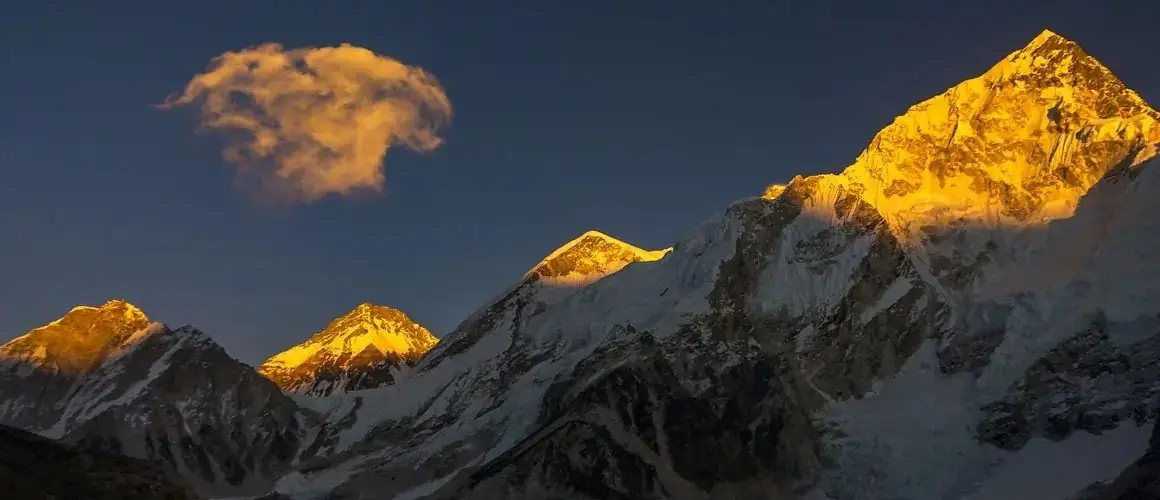
Most Himalayan mountain names come from Sanskrit, Nepali or Tibetan and describe what people saw or believed: Annapurna is "full of food", Dhaulagiri is "white mountain", Machapuchare is "fish tail" and Kanchenjunga is "five treasures of the great snow".
The name Himalaya itself
Himalaya joins two Sanskrit words, hima (snow) and alaya (abode). The same idea appears in older Indian texts as Himavat or Himavan, the snowy one, who is also the father of the goddess Parvati. In Nepali a single group of snow peaks is called a himal, as in Annapurna Himal or Ganesh Himal.
The 8,000 m peaks
- Everest: named in 1865 after George Everest, a former Surveyor General of India. The Nepali name Sagarmatha is usually explained as "forehead of the sky", and the Tibetan name Chomolungma as "goddess mother of the world".
- Kanchenjunga: from Tibetan, "five treasures of the great snow", for its five summits.
- Lhotse: Tibetan for "south peak", because it stands south of Everest.
- Makalu: thought to come from Maha Kala, a name of Shiva, "the great black one".
- Cho Oyu: Tibetan, often translated as "turquoise goddess".
- Dhaulagiri: Sanskrit dhavala giri, "white mountain".
- Manaslu: from Sanskrit manasa, mind or spirit, so "mountain of the spirit".
- Annapurna: Sanskrit for "full of food", the goddess of harvest and nourishment.
- Nanga Parbat: "naked mountain", for its bare rock faces.
- Shishapangma: Tibetan, usually given as "crest above the grassy plains".
Famous peaks of Nepal
- Machapuchare: Nepali for "fish tail", after the double summit seen from the west.
- Ama Dablam: "mother's necklace"; the hanging glacier is the dablam, the charm box Sherpa women wear.
- Nuptse: Tibetan for "west peak".
- Pumori: "unmarried daughter" or "daughter peak", a name given by George Mallory.
- Gaurishankar: the goddess Gauri and the god Shankar (Shiva), one for each summit.
- Langtang Lirung: Lirung is the local name of the peak that guards the Langtang valley.
- Ganesh Himal: named for the elephant-headed god; one face is said to look like an elephant's trunk.
- Nilgiri: "blue mountain".
- Kala Patthar: "black rock", the dark viewpoint ridge above Gorak Shep.
Famous peaks of India, Bhutan and Tibet
- Nanda Devi: "bliss-giving goddess", the patron goddess of Kumaon and Garhwal.
- Trisul: "trident", after Shiva's three-pronged weapon and the peak's three summits.
- Kamet: thought to come from a Tibetan name linked to "glacier fire".
- Shivling: the lingam of Shiva.
- Kailash: from Sanskrit kelasa, crystal; Tibetans call it Kang Rinpoche, "precious jewel of snow".
- Jomolhari: "goddess of the mountain pass" or "bride of Kanchenjunga".
- Gangkhar Puensum: "white peak of the three spiritual brothers".
- Namcha Barwa: Tibetan, often given as "lightning burning in the sky".
Common words inside the names
Once you know a few words, new names start to explain themselves.
- Ri (Tibetan): peak or hill, as in Gokyo Ri and Tserko Ri.
- La: pass, as in Thorong La and Cho La.
- Tse: summit, as in Lhotse, Nuptse and Changtse (north peak).
- Kang or Gang: snow or snow mountain.
- Tsho or Cho: lake.
- Chuli (Nepali): peak, as in Hiunchuli and Tharpu Chuli.
- Giri and Parbat (Sanskrit, Hindi, Nepali): mountain.
- Kunda, Tal and Pokhari: lake or pond.
- Danda: ridge. Deurali: a pass or saddle on a hill trail.
Why spellings differ
Himalayan names are written in Devanagari or Tibetan script, so every English spelling is an approximation. That is why you meet Kanchenjunga and Kangchenjunga, Machapuchare and Machhapuchhre, Gaurishankar and Gauri Sankar, Cho La and Chola, Kala Patthar and Kala Pattar. They are the same places. On this site we keep one spelling per place and mention the common variants once.
Which names are sacred?
Many are. Machapuchare is sacred to Shiva and has been closed to climbers since the 1960s. Khumbila above Namche is the home of the Sherpa protector deity and is not climbed. Kailash has never been climbed and pilgrims walk round it instead. When the first climbers reached the top of Kanchenjunga in 1955 they stopped a few steps short of the summit to honour a promise to the ruler of Sikkim. Read sacred mountains of Nepal.
Names of famous passes, lakes and places
- Thorong La: the 5,416 m pass on the Annapurna Circuit; la is pass.
- Gokyo: the lakes and village west of Everest, below Gokyo Ri.
- Gosaikunda: the lake of the Gosain, a holy man; a pilgrimage lake sacred to Shiva.
- Tilicho: the high lake at 4,919 m below Tilicho Peak.
- Namche Bazaar: the Sherpa market town; bazaar is market.
- Muktinath: "lord of liberation", the temple at 3,710 m in Mustang.
- Pokhara: from pokhari, pond or lake.
- Khumbu: the Sherpa homeland below Everest, which gives its name to the Khumbu Glacier and Icefall.
How peaks get English names
A few Himalayan peaks carry names given by outsiders. Everest is the best known. Island Peak was named in 1953 because it looks like an island in a sea of ice; its local name is Imja Tse. Fishtail is simply a translation of Machapuchare, and Tent Peak is the old climbers' name for Tharpu Chuli. In the Karakoram, K2 keeps a surveyor's label: K for Karakoram and 2 for the second peak listed. Nepal now prefers local names on its official lists, and many trekking maps print both.
Common questions
What does Himalaya mean?
"Abode of snow", from the Sanskrit words hima (snow) and alaya (home).
What is Mount Everest called in Nepal and Tibet?
Sagarmatha in Nepali and Chomolungma (also written Qomolangma) in Tibetan.
What does Annapurna mean?
"Full of food". Annapurna is the Hindu goddess of food and nourishment, and the name fits a range whose rivers water the farms below.
Why is Machapuchare called Fishtail?
Its summit is split into two points, and from the Annapurna Sanctuary side they look like the tail of a fish. See the Machapuchare guide.
Heights, dates, fees and rules are approximate and can change, so confirm the current details with us before you book.


