




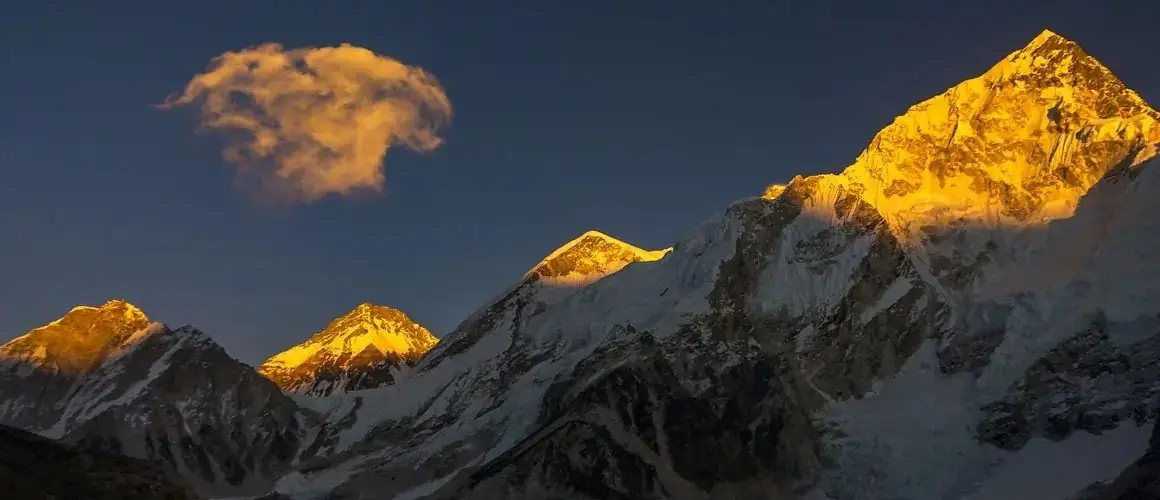
The Himalayas are the highest mountain range on Earth, an arc about 2,400 km long and 200 to 400 km wide that runs across northern India, Nepal, Bhutan, southern Tibet (China) and northern Pakistan. The highest point is Mount Everest, 8,848.86 m, on the Nepal and China border.
The short version
The word Himalaya comes from Sanskrit: hima means snow and alaya means home or abode, so the name is simply "the home of snow". People write both "Himalaya" and "Himalayas", and both are accepted in English.
The range forms a wall between the plains of the Indian subcontinent and the high, dry Tibetan Plateau. It is young in geological terms, it is still rising, and it holds most of the highest summits on the planet.
Key facts at a glance
- Length: about 2,400 km from west to east.
- Width: roughly 200 to 400 km from south to north.
- Highest point: Mount Everest, 8,848.86 m (29,031.7 ft).
- Countries: India, Nepal, Bhutan, China (Tibet) and Pakistan.
- Peaks above 8,000 m in the Himalaya proper: ten, with four more in the neighbouring Karakoram.
- Western end: Nanga Parbat (8,126 m) near the Indus river.
- Eastern end: Namcha Barwa (7,782 m) near the great bend of the Brahmaputra.
- Major rivers that rise in or near the range: Indus, Ganges and Brahmaputra.
The three parallel belts
From south to north the range is usually described as three belts. The Siwalik or outer hills are the low front range, mostly under 1,500 m, covered in forest. Behind them the Lesser Himalaya, also called the Mahabharat range in Nepal, rises to between about 2,000 and 4,500 m, and this is where hill towns, terraced farms and many short treks are found.
The Great Himalaya is the third belt and the one people picture: a line of snow peaks with an average crest height above 6,000 m. North of it lies a drier zone often called the Trans-Himalaya, which includes places such as Upper Mustang and Dolpo in Nepal and Ladakh in India.
How high are the Himalayas?
The average height of the main crest is above 6,000 m, and more than a hundred summits pass 7,200 m. For comparison, the highest mountain outside Asia, Aconcagua in Argentina, is 6,961 m. That means the Himalaya and its neighbours hold every one of the world's mountains above 7,000 m.
For a walker the numbers that matter are lower. Most classic treks in Nepal sleep between 2,500 and 5,000 m and touch a high point between 4,000 and 5,500 m. Read the highest peaks of the Himalayas for the full list of the giants.
Who lives in the Himalayas?
Tens of millions of people live in the Himalayan hills and valleys. In Nepal the high villages are home to Sherpa, Tamang, Gurung, Magar, Thakali, Rai and Limbu communities, among many others, and each region has its own language, dress and festivals. Buddhism is strongest in the high valleys near Tibet, and Hinduism in the middle hills and the plains, and in many places the two are practised side by side.
Trekking routes follow old trade and pilgrimage paths between these villages, which is why a Himalayan trek is as much about people as about peaks.
Why the range matters
The Himalaya is sometimes called the water tower of Asia. Snow and glaciers feed rivers that supply water to a very large share of the people of South Asia. The range also shapes the climate: it blocks cold, dry air from the north in winter and forces the summer monsoon to drop its rain on the southern slopes, which is why the south side is green and the north side is close to desert.
Many peaks are sacred. Mount Kailash in Tibet is holy to Hindus, Buddhists, Jains and Bon followers, and in Nepal mountains such as Machapuchare and Khumbila are not climbed out of respect. See the sacred mountains of Nepal for more.
Himalaya, Karakoram and Hindu Kush
Maps and books do not always agree on where the Himalaya stops. In the strict sense the range ends at the Indus in the west, and the mountains beyond it, including K2 (8,611 m), belong to the Karakoram. In everyday use many people include the Karakoram and the Hindu Kush in "the Himalayas", and scientists often speak of the Hindu Kush Himalaya as one region.
This is why you will see two answers to a simple question such as "what is the second highest Himalayan peak". In the strict sense it is Kanchenjunga; in the wider sense it is K2.
How to see the Himalayas yourself
You do not need to be a climber. From Nepal the easiest views are from hill viewpoints such as Nagarkot near Kathmandu and Sarangkot above Pokhara, which need no trekking at all. A short trek such as Poon Hill gives a sunrise over Dhaulagiri and Annapurna in four or five days, and the longer routes to Everest Base Camp and Annapurna Base Camp walk right in among the highest peaks.
If you are new to the idea, start with trekking in the Himalayas for beginners.
Common questions
Is it Himalaya or Himalayas?
Both are correct. "Himalaya" is closer to the Sanskrit original and is common in India and Nepal, and "Himalayas" is the usual English plural. They mean the same range.
How long are the Himalayas?
The range is about 2,400 km long from Nanga Parbat in the west to Namcha Barwa in the east, and between about 200 and 400 km wide.
Which country has most of the Himalayas?
The range is shared. India has the longest stretch, and Nepal, in the centre, has the greatest concentration of the highest peaks, with eight of the fourteen mountains above 8,000 m on or inside its borders.
What is the highest mountain in the Himalayas?
Mount Everest, 8,848.86 m, on the border of Nepal and China. See how tall Mount Everest is.
Heights, dates, fees and rules are approximate and can change, so confirm the current details with us before you book.


