




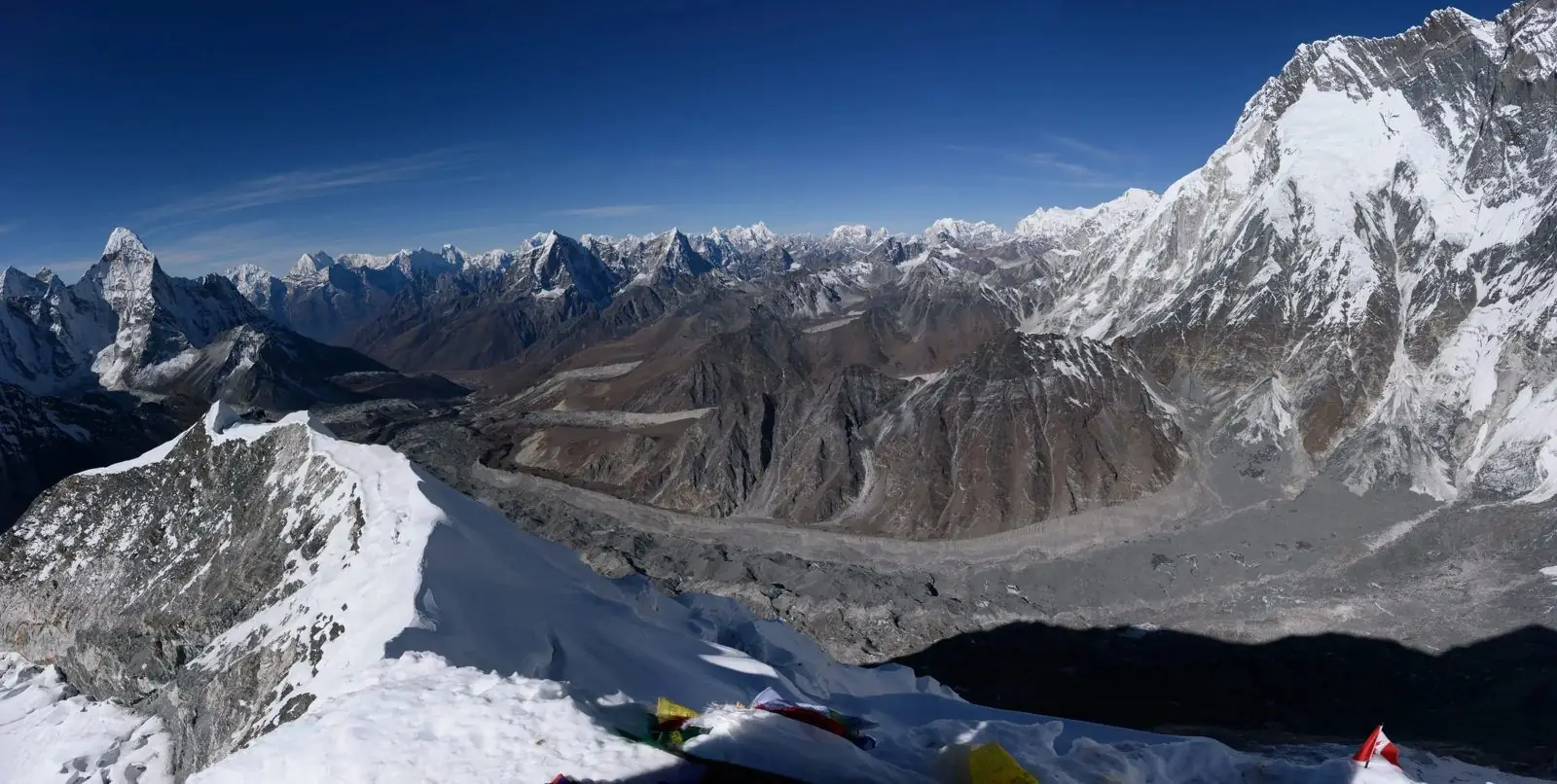
Gaurishankar is a 7,134 m sacred mountain in the Rolwaling Himal, on the border of Nepal and Tibet. It has two summits, and its steep faces rise above the Rolwaling valley. The peak is revered by local people as the home of a divine couple.
A sacred mountain
The name is linked to the Hindu deities Shiva and Parvati, and the mountain is sacred to Hindus and Buddhists. The main summit is 7,134 m (23,406 ft).
Two summits
The mountain has a higher peak and a lower one, linked by a ridge. Local tradition regards the peaks as the home of the divine couple.
The first ascent
The first ascent was in 1979. Climbing rules around the peak can be restrictive, so ask before planning.
Seeing it
The Rolwaling valley, around Beding and Na, gives the best views. See the Rolwaling and Tashi Lapcha guide.
Season
October to November.
Common questions
Is Gaurishankar visible from Kathmandu? In rare clear conditions it can be seen. Is it the same as Mount Everest? No.
The Rolwaling valley
The Rolwaling valley is a remote, beautiful valley that lies between the Everest region and Langtang. It is the home of Sherpa people and has a strong connection to Buddhism. The valley is known as a place of pilgrimage.
Tashi Lapcha and Na
The trek from Rolwaling to Khumbu crosses the Tashi Lapcha, a high glacier pass. The village of Na gives views of Gaurishankar. Doing the crossing requires experience, a guide and suitable gear.
Sacred and restricted
Because the mountain is regarded as sacred, and because of its position near the border, climbing is controlled. Ask us for the current rules before you plan a trip.
When to go
Autumn and spring are the best seasons. Monsoon rains make the trails slippery.
More questions
Can I see Gaurishankar from the Everest region? In rare conditions, from high ridges. Is the trek to Rolwaling hard? It is demanding and remote. Can I cross to the Khumbu? Yes, over the Tashi Lapcha, with a guide and the right equipment.
Treating the mountain with respect
Local people regard the mountain as the home of gods. Visitors are asked to behave respectfully, avoid loud behaviour near sacred sites and follow the instructions of their guide. These small courtesies are part of what keeps the valley welcoming.


