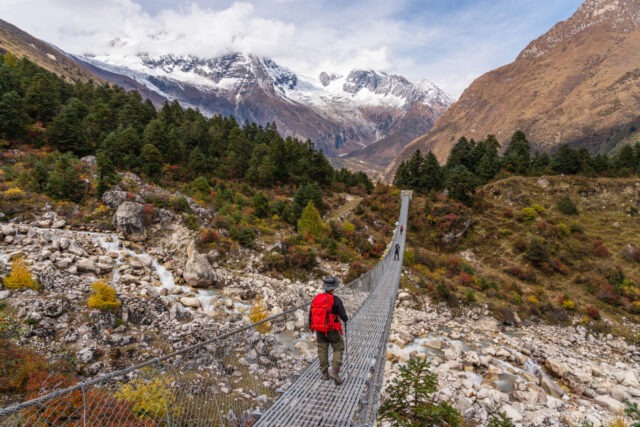
 By
The Tsum Valley trek is a 13-day walk into a Buddhist valley that sits behind Manaslu, and foreigners may enter only with a restricted-area permit and a licensed guide. The valley is quiet and rich in culture, and it stays lower than most Himalayan routes. Its highest stop, Mu Gompa, is still about 3,700 m (ours), which is high enough for altitude sickness. It suits fit trekkers who want something other than Everest or Annapurna, provided they acclimatise properly. The permit costs US$40 for the first week in autumn, then US$7 a day. This guide covers our route day by day, the fees, the best months and how Tsum compares with the Manaslu Circuit.
Tsum Valley trek at a glance
- Length: 13 days from Kathmandu to Kathmandu, with one spare day (ours).
- Highest point: Mu Gompa, about 3,700 m (ours). There is no high pass.
- Restricted-area permit: September to November, US$40 for week 1, then US$7 per day. December to August, US$30 for week 1, then US$7 per day.
- TIMS: NPR 1,000 for SAARC nationals, NPR 2,000 for others, issued through a registered agency.
- Guide: a licensed guide is compulsory on this route.
- Best months: March to May and September to November, according to the Nepal Tourism Board for the Manaslu Conservation Area.
- Stay: teahouses or camping.
Last checked: 10 November 2026. The permit fee, TIMS and guide rules, wildlife counts, season and road access come from Nepal Tourism Board pages. Government pages say little about Tsum’s villages and monasteries, so we describe those from our own guiding and mark them “(ours)”. Altitudes marked (ours) are rounded and can differ by tens of metres between sources. Fees change by government notice, so confirm before you pay.
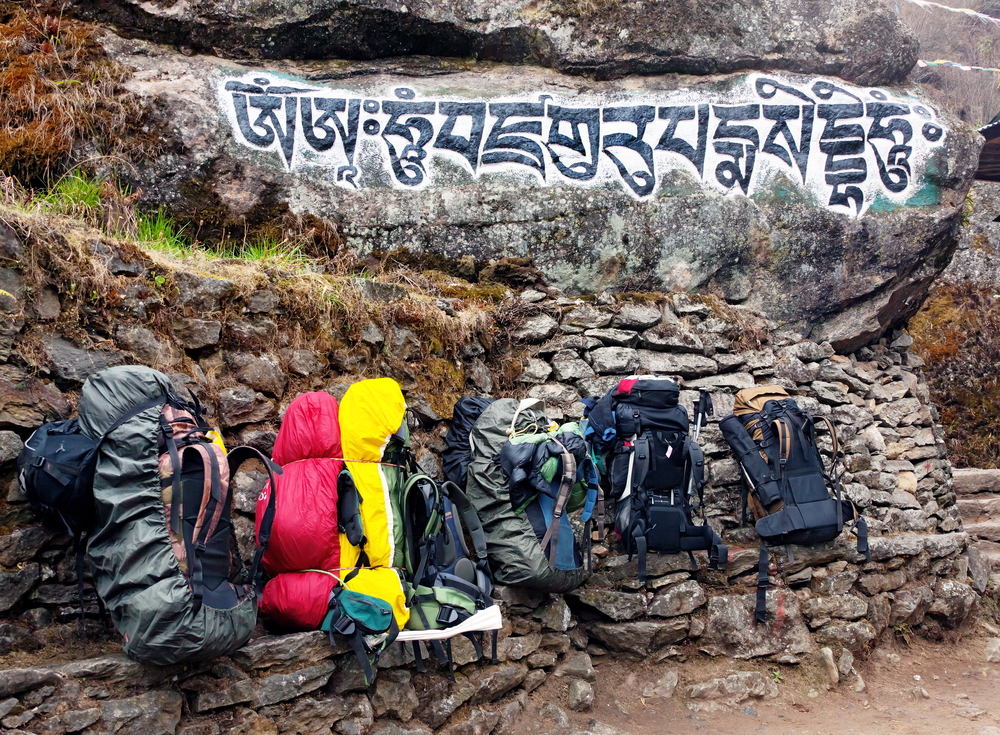
Carved mani stones like this line the trails of Buddhist valleys such as Tsum. Keep them on your left as you pass (ours).
In this guide: What is Tsum Valley | 13-day route | Permit and fees | Best time | Tsum vs Manaslu Circuit | Who it suits | Getting there | Nature | FAQ
What is the Tsum Valley?
Tsum Valley lies in Gorkha district, north-west of Kathmandu, beside the Budhi Gandaki river and close to the Tibetan border. The Nepal Tourism Board lists it as its own restricted region, named “Gorkha Tsum Valley”. The board’s area runs from Sirdibas through Lokpa, Chumling and Chekampar to Nile and Chule, across Chumnubri wards 3, 6 and 7.
Culture is the reason to go. People here keep Tibetan Buddhist customs and a Tibetan dialect, and the valley is dotted with monasteries, mani walls and kani gates (ours). The Gandaki tourism office lists Tsum Valley among Gorkha’s attractions, and the Nepal Tourism Board’s Gorkha page describes the district’s Buddhist heritage, including Milarepa’s caves. Villages are small, trails are narrow and the pace is slow. That is why we call it the hidden valley.
Tsum Valley trek route: our 13-day plan
This is the route our guides use for a Tsum-only trek. Altitudes are rounded and the times are for an average walker (ours).
| Day | Route | Sleep altitude | Walk time |
|---|---|---|---|
| 1 | Drive Kathmandu to Soti Khola | about 700 m | 8 to 9 hours by road |
| 2 | Soti Khola to Machha Khola | about 870 m | 5 to 6 hours |
| 3 | Machha Khola to Jagat | about 1,400 m | 6 hours |
| 4 | Jagat to Lokpa, via Philim | about 2,240 m | 6 to 7 hours |
| 5 | Lokpa to Chumling | about 2,400 m | 5 hours |
| 6 | Chumling to Chhokhangparo | about 3,000 m | 5 hours |
| 7 | Chhokhangparo to Nile, past Rachen Gompa | about 3,360 m | 5 to 6 hours |
| 8 | Nile to Mu Gompa and back to Nile | Mu Gompa about 3,700 m | 6 hours return |
| 9 | Nile to Chhokhangparo or Chumling | about 3,000 m | 5 to 6 hours |
| 10 | Down to Lokpa | about 2,240 m | 5 to 6 hours |
| 11 | Lokpa to Jagat | about 1,400 m | 6 hours |
| 12 | Jagat to Soti Khola | about 700 m | 6 hours |
| 13 | Drive Soti Khola to Kathmandu | about 1,350 m | 8 to 9 hours by road |
We add one spare day for landslides on the road, which are common in monsoon and shortly after (ours). Many trekkers also use that day to rest at Nile.
Highlights on the way
- Rachen Gompa (ours). A nunnery between Chhokhangparo and Nile, set on a slope above the valley floor.
- Mu Gompa (ours). The highest monastery on the route, close to the Tibetan border, with views of the Ganesh Himal and Boudha Himal ranges.
- Chhokhangparo (ours). A village on a plateau, popular for its mountain views and lodges.
- Mani walls and kani gates (ours). Long carved stone walls and arched entry gates, which mark the start of each village.
Do you want to add Manaslu? A Manaslu and Tsum combination usually takes 18 to 20 days (ours). Our Manaslu Circuit preparation guide covers that side, including Larkya La.
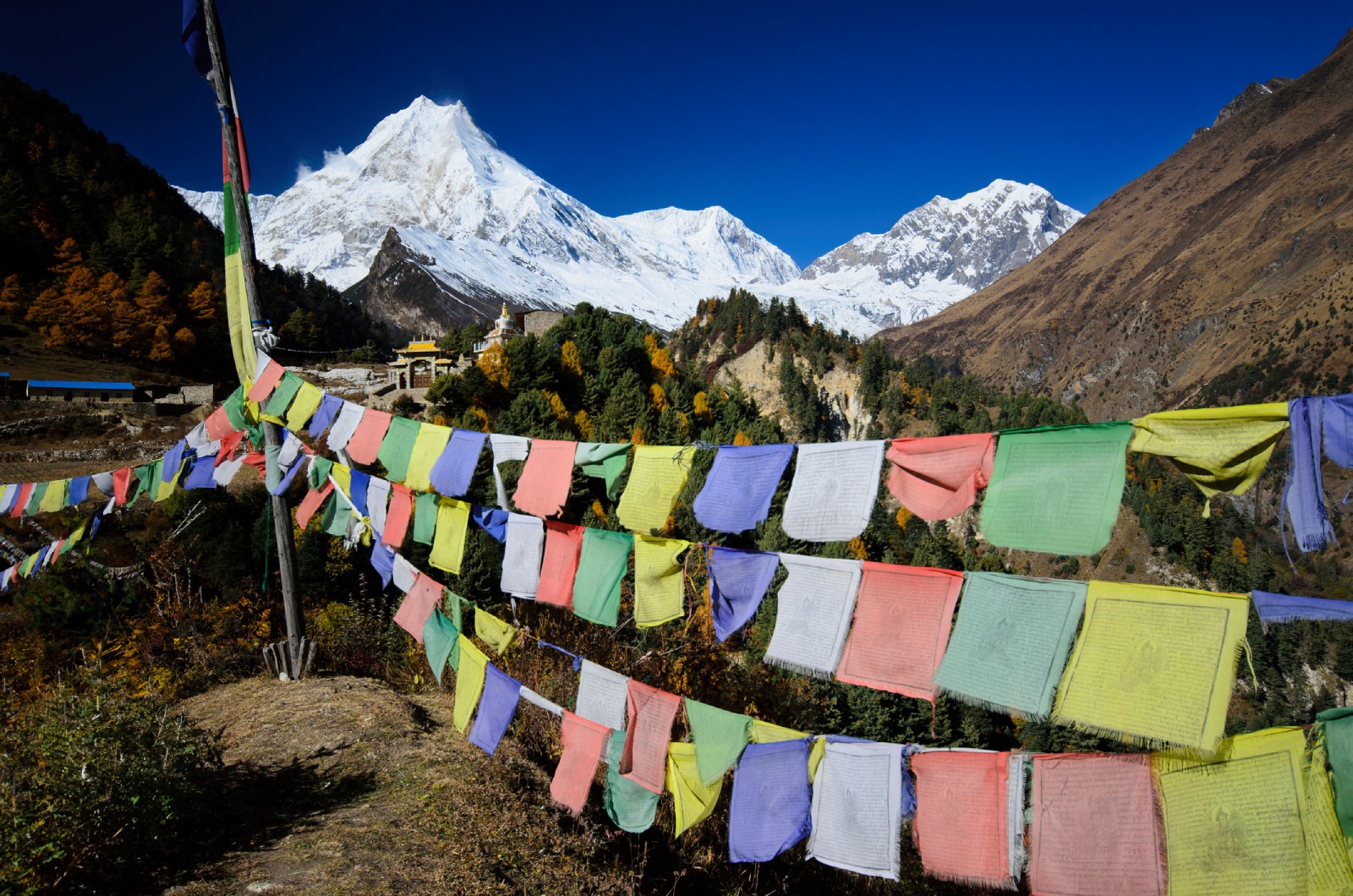
Prayer flags mark Buddhist trails across the Himalaya, and Tsum has many of them (ours).
Tsum Valley permit and fees
Three things are required: a restricted-area permit, a TIMS card and a licensed guide. The Department of Immigration in Kalikasthan, Kathmandu, issues the restricted-area permit, according to the Nepal Tourism Board. We apply for you.
| Item | Fee or rule |
|---|---|
| Restricted-area permit, September to November | US$40 for week 1, then US$7 per day |
| Restricted-area permit, December to August | US$30 for week 1, then US$7 per day |
| TIMS card | NPR 1,000 for SAARC nationals, NPR 2,000 for others |
| Guide | Licensed guide required on Tsum Valley and Manaslu-Tsum routes (effective 31 March 2023) |
| Conservation area entry | The Manaslu Conservation Area charges NPR 2,000 per entry for foreigners and NPR 200 for SAARC nationals, per its Nepal Tourism Board page. Confirm the figure when you book. |
Here is how that adds up. We assume the permit clock starts at Lokpa and counts each day inside the area. We confirm the ward boundaries when we apply (ours).
| Days inside the area | September to November | December to August |
|---|---|---|
| 7 days | US$40 | US$30 |
| 8 days | US$47 | US$37 |
| 10 days | US$61 | US$51 |
| 14 days | US$89 | US$79 |
Tsum is cheap compared with other restricted areas. Upper Mustang costs US$350 for the same week. See our restricted area permit guide for all 15 regions. If you combine Tsum with Manaslu, the board lists them as two separate regions, so ask us how the days are counted before you plan the budget.
Best time for the Tsum Valley trek
The Nepal Tourism Board gives March to May and September to November as the best seasons for the Manaslu Conservation Area, which includes this valley (ours). Our own notes by season:
| Season | What to expect (ours) | Permit week 1 |
|---|---|---|
| March to May | Rhododendrons in the lower forest, warm days, some afternoon cloud | US$30 |
| June to August | Monsoon rain, leeches in the lower forest and landslide risk on the road. Not our first choice. | US$30 |
| September to November | Clear skies and the steadiest views. This is the busiest season, though still quiet. | US$40 |
| December to February | Cold nights at Nile and Mu Gompa, with snow possible. Some lodges close. | US$30 |
Autumn costs US$10 more for the permit, which is small. Our autumn treks guide compares the other autumn routes.
Tsum Valley vs Manaslu Circuit
| Tsum Valley | Manaslu Circuit | |
|---|---|---|
| Highest point | About 3,700 m at Mu Gompa (ours) | About 5,100 m at Larkya La (published figures run 5,106 to 5,160 m) |
| Typical length | 13 days (ours) | 14 to 16 days (ours) |
| Permit, 10 days in Sep to Nov | US$61 | US$145 |
| Main appeal | Monasteries, culture and quiet trails | A mountain circuit with a high pass and Manaslu views |
| Effort | Moderate, no pass, but 3,700 m needs acclimatisation | Hard, one long pass day |
In short, choose Tsum for culture and a lower altitude. Choose the Circuit for the pass and the full mountain loop. If you cannot decide, read Manaslu vs Annapurna Circuit and our high passes guide. Or combine them in one longer trek.
Who is the Tsum Valley trek for?
- Fit trekkers with some multi-day walking experience who want a lower altitude profile than Everest or Manaslu (ours). It is not a risk-free first Himalayan trek.
- Culture lovers who prefer monasteries and village life over summit views.
- Repeat trekkers who have done Everest or Annapurna and want somewhere quiet.
- Not ideal for: anyone who wants a high pass, a luxury lodge or fast mobile data.
Remember that 3,700 m is high enough for altitude sickness. Sleeping altitude rises about 300 to 650 m a day on our route (ours). Walk slowly, drink plenty of water, tell your guide at once if you get a headache or feel dizzy, and do not climb higher with symptoms. A rest day does not make a fast ascent safe.
How to reach the Tsum Valley trailhead
Most trekkers drive from Kathmandu to Soti Khola, about 8 to 9 hours (ours). The Nepal Tourism Board describes road access to the Manaslu region by bus to Dhading, which lies 87 km from Kathmandu, and then onward by road. The road beyond is rough, and in monsoon it can close. We use a private jeep so that the drive does not depend on the public bus timetable (ours).
Wildlife and nature on the route
The trek runs through the Manaslu Conservation Area. According to the Nepal Tourism Board, the area has 33 mammal species, including snow leopard, musk deer and Himalayan tahr, along with 110 bird species and 1,500 to 2,000 flowering plant species. Snow leopards are very rare to see, so do not plan around one. Birds, langurs and tahr on the cliffs are far more likely (ours).
FAQ
How long is the Tsum Valley trek? Our plan takes 13 days from Kathmandu to Kathmandu, including two driving days and one spare day.
How difficult is the Tsum Valley trek? It is moderate. Most days are 5 to 6 hours of walking on steep, uneven trails, and the highest point is about 3,700 m, with no high pass.
How much is the Tsum Valley permit? From September to November, US$40 for the first week and US$7 per day after. From December to August, US$30 for the first week, then US$7 per day.
Can I trek the Tsum Valley without a guide? No. The Nepal Tourism Board lists Tsum Valley and Manaslu-Tsum Valley among the routes that need a licensed trekking guide.
Do I need a TIMS card for Tsum Valley? Yes. TIMS costs NPR 1,000 for SAARC nationals and NPR 2,000 for others, and the card comes through a government-registered agency.
What is the best month for the Tsum Valley trek? March to May and September to November are the best seasons for the Manaslu Conservation Area, according to the Nepal Tourism Board.
How high is Mu Gompa? About 3,700 m by our guides’ notes. Published figures vary slightly, so treat it as approximate.
Can I combine Tsum Valley with the Manaslu Circuit? Yes. A combined trek usually takes 18 to 20 days (ours). The board lists the two as separate regions, so we confirm the permit days before you book.
Is Tsum Valley cheaper than Manaslu? The permit is. For ten days in autumn it is US$61 for Tsum against US$145 for Manaslu.
Are there teahouses in the Tsum Valley? Yes. Teahouses are simple, with shared bathrooms in most places, and the Nepal Tourism Board says the Manaslu area has teahouses or camping.
Do I need acclimatisation? Our route gains height slowly and spends time near 3,000 m before Mu Gompa. We still add a rest day at Nile when the group needs it (ours).
Can Base Camp Hikes arrange the Tsum Valley trek? Yes. We apply for your permit and TIMS card, arrange a licensed guide and transport, and plan the days with you.
Plan your Tsum Valley trek with Base Camp Hikes
Tell us your dates and nationality, and we will send a day-by-day plan with the permit costs. Message the team on WhatsApp or phone at +91 932 595 1234 (9 am to 7 pm IST), write to info@basecamphikes.com, or use our enquiry form.
Sources
- Nepal Tourism Board: Trekking permit (Gorkha Tsum Valley area and fees; permits issued by the Department of Immigration)
- Nepal Tourism Board: TIMS card (TIMS fees and licensed-guide routes)
- Nepal Tourism Board: Manaslu Conservation Area (wildlife, season, access, entry)
- Nepal Tourism Board: Gorkha (district overview)
- Gandaki Province Tourism: Gorkha district (attractions list)