
 By
The walk down from Everest Base Camp is the part many trekkers dread: three more days on the same trail, tired legs, and a Lukla flight that may or may not leave on time. A helicopter return replaces that descent with one short flight from Gorak Shep to Lukla. It saves about two days and removes the long walk, but it adds cost, depends on weather and does not work as a rescue. This guide explains how a planned helicopter return works, what it costs and what drives the price, the rules and limits that apply, and who it actually suits.
The short answer
- What it is: you trek up to Base Camp and Kala Patthar on foot, then fly down in a helicopter, usually from Gorak Shep to Lukla.
- What it saves: about two days. A 14-day Everest Base Camp schedule becomes 12 days.
- What it costs: more than walking down and taking the Lukla flight. On the Base Camp Hikes site, a 12-day heli-return trek is listed at Rs 160,000 (all-inclusive, based on a group of at least two). One traveller pays an additional cost. The helicopter is shared, and the price can vary with the season and global conditions. Confirm the current price.
- What can stop it: weather. Keep a spare day and never fix an international flight to the hoped-for return day.
- What it is not: an emergency evacuation. A planned return is bought in advance. A rescue is arranged by the guide, a doctor and the insurer.
Last checked: 23 October 2026. Prices, landing points and aviation rules change, so confirm them for your travel dates.
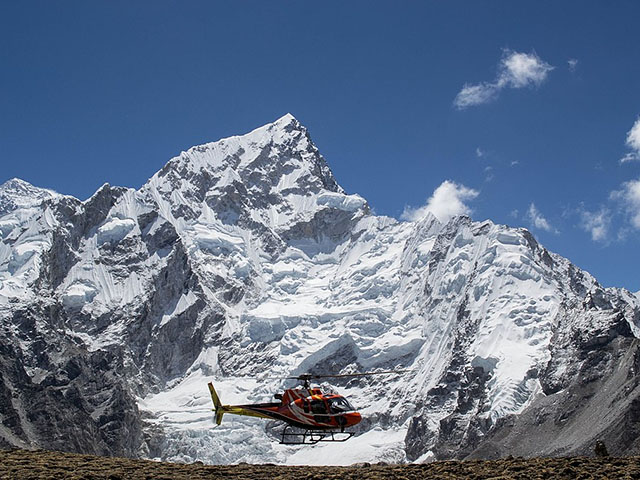
A helicopter departing the Everest Base Camp area. A planned return turns the three-day walk down into one short flight.
In this guide: Planned return or rescue? | How it works | Days saved | Where it lands | Weather | Cost | Rules and permits | Altitude and health | Who it suits | Other options | Questions to ask | Mistakes | FAQ
Planned helicopter return or emergency evacuation?
These two are often confused. They are different services with different rules.
| Point | Planned helicopter return | Emergency evacuation |
|---|---|---|
| Purpose | Skip the walk down, save time, reduce fatigue | Get a sick or injured trekker to medical care |
| Who arranges it | The trekker, as part of the trip, before departure | The guide, a doctor and the insurer, on the day |
| Who pays | The trekker, as part of the trip price | Usually the insurer, if the policy covers it |
| Priority on the day | Normal booking, subject to weather and seat availability | Medical need decides, not the booking |
| Where it flies | Usually Gorak Shep to Lukla or Kathmandu | Wherever the patient can be reached and treated |
| Can it replace a rescue plan? | No. Keep insurance with evacuation cover. | It is the rescue plan |
The Nepal Tourism Board (NTB) says helicopter services are available if a trekker falls sick or has an accident, and warns that such rescue is expensive. For evacuation it tells visitors to contact their agency. Details are in the insurance and evacuation guide.
How a planned helicopter return works
The usual order of events on a trek that ends with a helicopter flight.
| Step | What happens |
|---|---|
| 1. Walk up | The group treks on foot through Namche Bazaar and Dingboche to Lobuche, with two rest days for acclimatisation. |
| 2. Base Camp | Day to Gorak Shep, then Everest Base Camp (5,364 m) and back to Gorak Shep. |
| 3. Kala Patthar | Pre-dawn climb to Kala Patthar (5,545 m) for the sunrise view of Everest. |
| 4. Fly down | The helicopter collects the group at Gorak Shep and flies to Lukla. The flight is well under an hour. |
| 5. Onward flight | A scheduled flight from Lukla to Kathmandu or Ramechhap, usually the next day, as on the site’s 12-day heli-return trek. |
The ascent is still done entirely on foot. That matters, because the helicopter does not shorten the time the body needs to adapt on the way up. Only the descent changes.
How many days does it save?
Trip days from the Kathmandu arrival to departure. Based on the 14-day walk-down schedule and the 12-day heli-return schedule listed on the Base Camp Hikes site.
| Plan | Trip days | Length |
|---|---|---|
| Walk down, then fly Lukla to Kathmandu | 14 days |
|
| Fly down from Gorak Shep | 12 days |
|
The walk down normally takes three days: Gorak Shep to Pheriche, then Namche Bazaar, then Lukla. The helicopter replaces all three with one flight. The two days saved are useful for people with a fixed leave allowance, and they also move the Lukla flight earlier in the trip, which gives more room if the flight is delayed.
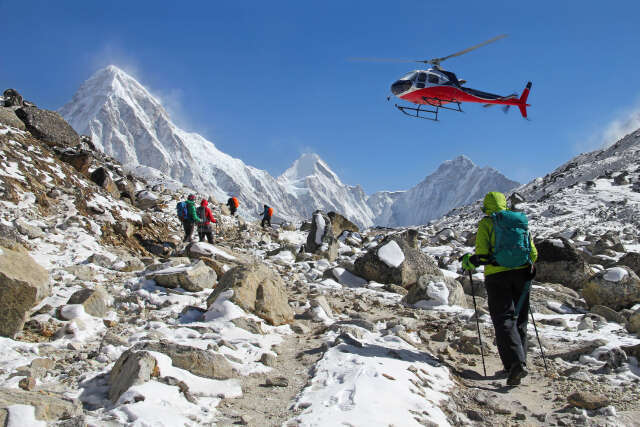
The helicopter shortens the descent only. The climb up to Base Camp is still done on foot.
Where the helicopter lands
The Base Camp Hikes guide says the pickup is near Gorak Shep or another suitable point. The site’s helicopter day-tour page adds that helicopters are currently not allowed to land at Kala Patthar or Everest Base Camp itself, and may land at Gorak Shep instead, subject to change. For a planned return, Gorak Shep is therefore the realistic pickup, and the trek is built so that Kala Patthar and Base Camp are walked first.
Landing permissions are set by the aviation and local authorities, not by the trekking operator, so they can change between seasons. Confirm the pickup point for your date before you pay.
Weather, timing and the spare day
Helicopters need suitable visibility, and operators usually fly in the morning. A flight can still be delayed or cancelled for hours or days, in the same way as a Lukla flight.
What to do if the flight does not leave.
| Situation | Usual response |
|---|---|
| Flight delayed a few hours | Wait at Gorak Shep with the group. The guide watches the weather and the radio. |
| Flight cancelled for the day | Stay another night. At Gorak Shep, sleeping altitude is 5,180 m, so the guide checks everyone’s health first. |
| Weather stays closed for several days | The fallback is walking down, which is why the walk-down time must fit your plans. |
| Helicopter flies but Lukla flight to Kathmandu is cancelled | Use the spare day in Kathmandu. See the Lukla delay plan. |
Two habits protect the return. Keep at least one spare day at the end of the trip. And do not fix an international departure on the first day the schedule would allow. The Lukla vs Ramechhap guide explains the buffer-day logic in more detail.
What a helicopter return costs
A planned return costs more than walking down and taking the scheduled Lukla flight. That is the only general comparison that holds across operators. The final figure depends on a handful of drivers, and the price is usually fixed per helicopter or per shared seat.
What moves the price, and what the Base Camp Hikes site lists. Figures were checked on 23 October 2026. Confirm them before booking.
| Cost driver | Why it matters |
|---|---|
| Shared helicopter | Helicopters on these trips operate on a sharing basis, which splits the cost between travellers. A private charter costs much more for a small group. |
| Season | Cost varies by season. Shared seats are easier in the main trekking months. On the site’s heli-return trek, off-season dates (15 November to 1 March and 15 May to 15 September) can need a private helicopter, with a listed supplement of US$300 per person for groups under three and US$1,300 for a solo traveller. The supplement is waived if a shared helicopter is available. |
| Global conditions | Fuel prices and wider aviation costs can move helicopter prices, so a listed price can change between enquiry and booking. |
| Group size | The package is priced for a group of at least two. One traveller pays an additional cost. More people sharing the helicopter lowers the cost per person, and the site’s heli-return trek takes up to 10. |
| Pickup and landing point | Gorak Shep to Lukla is the standard. A longer flight, such as to Kathmandu, costs more. |
| Days saved | Two fewer days of guide, porter and lodge cost partly offset the flight. |
| Extras if a Lukla flight is delayed | The site lists a charter helicopter from US$500 for a delayed Lukla flight, plus extra hotel nights (about INR 3,000 a night in Kathmandu). |
Listed prices on the Base Camp Hikes site (October 2026):
- 12-day Everest heli-return trek: Rs 160,000, all-inclusive, for a group of at least two (one traveller pays an additional cost; the helicopter is shared). It includes the one-way Gorak Shep to Lukla helicopter, the Lukla flights, permits, guide and porter.
- One-day Everest Base Camp helicopter tour: Rs 150,000, with no trekking. Confirm whether the price is per person or per helicopter.
Not included on the heli-return trek: travel insurance (mandatory), the Nepal visa, gear rental, showers, Wi-Fi and charging, snacks, bottled water, tips and personal spending. A cash reserve for extras is wise. The extra costs guide breaks these down.
Rules, permits and limits
The NTB pages checked for this guide do not publish a helicopter-return rulebook. What follows is what the government pages say, and what operators and aviation conditions impose.
| Item | What applies |
|---|---|
| Sagarmatha National Park entry | NPR 3,000 for foreigners and NPR 1,500 for SAARC nationals, per entry. Children under 10 enter free (NTB park fees page). |
| Khumbu local permit | NTB’s trekking permit page lists the Khumbu Pasang Lhamu Rural Municipality at US$20 per person per week for the first four weeks, issued by the Department of Immigration. |
| TIMS card | NTB’s FAQ says trekkers need a TIMS card: US$20 equivalent for free individual trekkers and US$10 for group trekkers through a registered agency. |
| Guide | NTB advises against trekking alone and says trekking with a guide from a registered agency is the best security. |
| Insurance | NTB advises comprehensive travel insurance that covers helicopter rescue and medical treatment. Check that it also covers trekking at altitude. |
| Landing points | Set by the authorities and the operator. They can change. Do not assume Base Camp or Kala Patthar landings. |
| Seats, luggage and weight | Set by the operator and pilot. Ask for the seat count and the baggage limit in writing, because a duffel bag can exceed it. |
A helicopter return does not remove any permit. All the same permits are needed for the walk up. Always check the current fee on the NTB pages for your dates, because they change. Read the permits guide for the checklist.
Altitude, health and why a helicopter is not a cure
NTB warns that acute mountain sickness can develop and become fatal above 3,000 m, and asks trekkers not to drink alcohol at that height. Its advice for altitude sickness and medical help is to contact the Himalayan Rescue Association (HRA), which runs aid posts at Pheriche and Everest Base Camp.
Three points follow for a helicopter-return plan.
- Ascent still follows the NTB rule. Above 2,500 m, sleeping altitude should rise by no more than 300 to 500 m a day, with a rest day after every 1,000 m of climbing. The rest days stay in the plan.
- Sickness on the way up is handled by going down. A trekker with worsening symptoms is not held for a booked flight. The guide decides, and an emergency evacuation follows the insurer’s process. See the altitude sickness guide.
- Flying down is fast, but not a treatment plan. A trekker who is unwell at Gorak Shep should be assessed, not simply moved to the front of a queue for the planned flight.
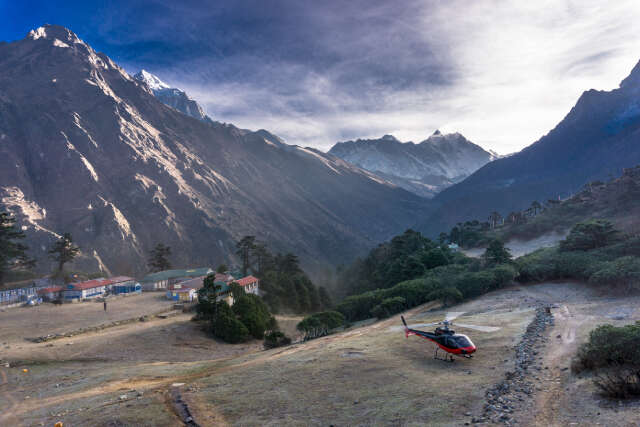
Helicopter Landing In Remote Himalayan Village Surrounded By Mountains In Nepal
Who a helicopter return suits
Match the row that describes you.
| If this describes you | Verdict |
|---|---|
| You have a fixed number of leave days and the walk down would break them | Suits you. It saves about two days. |
| You worry about knees, old injuries or fatigue on the long descent | Suits you. Check with a doctor that you can reach Gorak Shep first. |
| You have a tight onward or return flight | Suits you, with a spare day. It moves the Lukla flight earlier but is still weather-dependent. |
| You want the full trail experience, including the lower valley on the way down | Walk down. The lower villages and forests are part of the trip. |
| You hope the helicopter will rescue you if you feel unwell | Not the right plan. Rely on insurance with evacuation cover and an unhurried schedule. |
| You want to avoid the trek and only see Everest from the air | See the day-tour option below. |
| You are on a tight budget | Walk down. The flight is an added cost. |
For first-time trekkers, the more useful question is not “can I fly down?” but “is my schedule safe going up?”. The first-timer guide covers readiness and altitude.
Helicopter return compared with other ways down
General comparison of how people return from Base Camp.
| Option | Time from Gorak Shep | Trade-off |
|---|---|---|
| Walk down, then fly Lukla to Kathmandu | 3 walking days, then the flight | Cheapest and scenic. Needs spare days for flight delays. |
| Helicopter Gorak Shep to Lukla, then scheduled flight | One short flight, then the flight next day | Saves about two days. Costs more and depends on weather. |
| Helicopter all the way to Kathmandu | A longer helicopter flight the same day | Fastest. Highest cost. |
| Helicopter day tour, no trekking | One day from Kathmandu | For people who cannot trek. Landing points are not guaranteed, per the site. Altitude is reached in hours, so it is not suitable for everyone. |
The helicopter day tour goes from Kathmandu to the Khumbu in one morning and returns. It reaches a high altitude with no acclimatisation, so people who are unwell or who have heart or lung conditions should take medical advice first. Details are on the helicopter tour page.
Trekkers who prefer to avoid the Lukla runway on the way up can also look at the Lukla flight alternatives.
Questions to ask before you pay
- Where is the pickup, and has the operator confirmed it for my dates?
- Is my seat guaranteed? The helicopter is shared, so who else is on it?
- What is the baggage and weight limit for the helicopter, and is it lower than for the Lukla flight?
- What happens if weather stops the flight? Who pays for extra nights at Gorak Shep, Lukla or Kathmandu?
- If I walk down instead, what is refunded?
- Is the price per person for a group of at least two, and what is the additional cost for one traveller?
- Does my insurance cover helicopter evacuation at altitude, and what documents does it need?
- Is the operator the licensed Nepal company that holds the legal responsibility for the trek?
Common mistakes
- Booking the international flight for the first possible day. Keep a spare day.
- Treating the helicopter as an insurance policy. It is a booked flight. Evacuation needs a rescue process and cover.
- Skipping rest days to save money. The flight is for the descent. The ascent still needs its rest days.
- Not asking about weight limits. Helicopter baggage limits are set by the operator and pilot and may differ from the Lukla flight.
- Assuming Base Camp or Kala Patthar landings. The landing point is Gorak Shep on current conditions.
- Not reading the cancellation terms. Understand what happens to the price if the flight does not run.
FAQ
Can you take a helicopter back from Everest Base Camp? Yes. A planned helicopter return is available on many itineraries. The usual pickup is Gorak Shep, and the flight goes to Lukla or Kathmandu. It depends on weather and landing conditions, so it is never guaranteed.
How much does a helicopter return from Everest Base Camp cost? It costs more than walking down and taking the scheduled Lukla flight. On the Base Camp Hikes site, a 12-day heli-return trek is listed at Rs 160,000 (all-inclusive, for a group of at least two), checked on 23 October 2026. One traveller pays an additional cost. The helicopter is shared, and the price can vary with the season and global conditions, so confirm the current figure.
How many days does a helicopter return save? About two. The walk from Gorak Shep to Lukla usually takes three days, and the helicopter replaces it with one flight.
Where does the helicopter pick you up? Near Gorak Shep. The site’s day-tour page says helicopters are currently not allowed to land at Kala Patthar or Everest Base Camp, so Base Camp itself is not a pickup point. This can change.
Is a helicopter return the same as a helicopter rescue? No. A planned return is booked in advance and paid for by the trekker. A rescue is arranged by the guide, a doctor and the insurer for illness or injury. NTB says rescue helicopters are available but expensive, and advises insurance that covers them.
What if the helicopter is cancelled for weather? The group waits at Gorak Shep, and if the weather stays closed the fallback is walking down. Keep spare days and do not fix an international flight to the hoped-for day.
Do I still need rest days if I fly down? Yes, on the way up. The helicopter changes only the descent. Sleeping altitude above 2,500 m should rise by 300 to 500 m a day at most, with a rest day after every 1,000 m.
Is a helicopter return safe for altitude sickness? It is not a treatment. A trekker with worsening symptoms should descend as the guide advises, and a medical evacuation follows the insurer’s process. NTB asks trekkers to contact the Himalayan Rescue Association for altitude sickness and medical help.
Who should not take a helicopter return? Trekkers who want the full trail experience on the way down, who are on a tight budget, or who hope the flight will act as a rescue are better served by walking down with good insurance.
What permits do I need if I fly down? The same as for the walk up. NTB lists Sagarmatha National Park entry at NPR 3,000 for foreigners and NPR 1,500 for SAARC nationals, the Khumbu local permit at US$20 per person per week, and a TIMS card. Check the NTB pages for current fees.
Is a guide required? NTB advises not trekking alone and says trekking with a guide from a registered agency is the best security. A planned helicopter return is arranged through the operator, so a guide is part of the package.
Do I need travel insurance? Yes. The Base Camp Hikes site makes insurance covering high-altitude trekking and helicopter evacuation mandatory, and NTB advises comprehensive cover for helicopter rescue and medical treatment.
Can I fly down all the way to Kathmandu? Some operators offer it, at a higher cost, in good weather. The common plan is Gorak Shep to Lukla, then a scheduled flight to Kathmandu or Ramechhap.
Is the helicopter day tour a good alternative to the trek? It suits people who cannot trek. It reaches the high Khumbu in hours with no acclimatisation, so take medical advice if you have a health condition. It does not replace the experience of walking to Base Camp.
Should I decide on the helicopter return before I leave? Yes. Deciding before departure lets the operator confirm the seat, the price and the weather plan, and lets you check that your insurance covers it.
Plan your helicopter return
For help choosing between walking down and flying down, or checking a date, message the Base Camp Hikes team on WhatsApp or phone at +91 932 595 1234 (9 am to 7 pm IST), write to info@basecamphikes.com, or use the enquiry form. See also the luxury heli-return trek and the helicopter return guide.
Sources
- Nepal Tourism Board: park entry fees
- Nepal Tourism Board: trekking permit
- Nepal Tourism Board: FAQ
- Nepal Tourism Board: crisis and emergency
- Nepal Tourism Board: health guide