
 By
The Everest Base Camp trek ends in Lukla, but the trip does not end there. Weather can hold the Lukla flights, and many trekkers also keep a few free days before the flight home. How those days are spent decides whether the end of the trip feels rested or rushed. This guide shows what to do in Kathmandu with one, two or three spare days after the trek, what to do before it, which add-on trips fit which gap, and what the government lists as entry fees.
The short answer
- Put spare days after the trek, not before. A delayed Lukla flight then cannot make you miss your international flight.
- One spare day: rest in the morning and see the four classic Kathmandu sights (Swayambhunath, Boudhanath, Pashupatinath, Durbar Square) on a single guided day, or ride the cable car at Chandragiri Hills for mountain views.
- Two spare days: one day of recovery, then the Kathmandu sights, or a heritage town such as Patan or Bhaktapur.
- Three spare days: room for the 3-day, 2-night Chitwan National Park tour, if the Lukla flights ran on time.
- Entry fees: the four Kathmandu sights add up to about NPR 2,600 for foreigners and about NPR 650 for Indian nationals, per the Nepal Tourism Board (NTB) list.
Last checked: 24 October 2026. Fees and tour details change, so confirm them for your dates.

Boudhanath at sunset. A gentle evening here suits legs that have just come down from the mountain.
In this guide: Before or after? | Before the trek | Which plan fits | Recovery | 1, 2 and 3 day plans | Entry fees | Chandragiri Hills | Pokhara | Adventure day | Chitwan | Other add-ons | If the flight is delayed | Practical tips | FAQ
Before the trek or after it?
Most itineraries put an arrival day in Kathmandu first, then the Lukla flight the next day. Spare days are better spent at the end. The reason is flight risk: if the Lukla flight home is delayed, a free day or two absorbs the delay. Free days before the trek protect nothing, because the trek starts on a fixed day.
Where to put free days.
| Time | What it is for | What not to do |
|---|---|---|
| Before the trek | Arrival, briefing, gear, cash and a SIM card | Do not pack in long sightseeing days. Save legs and energy for the walk. |
| After the trek | Buffer for flight delays, recovery, sightseeing and add-on trips | Do not fix a non-refundable add-on date until you know the Lukla flight ran. |
What to do before the trek
The Kathmandu stay before the trek is a working stay, not a holiday. Plan these jobs in order.
- Arrival: a representative meets you at the airport and takes you to the hotel. Indian nationals do not need a visa. Most other visitors get a visa on arrival.
- Gear: rent or buy gear on the first day, not the evening before the flight. A sleeping bag and down jacket can be rented in Kathmandu. See the gear buying guide.
- Briefing: the team usually holds a briefing the evening before the Lukla flight. Use it to ask about weather, flights and the duffel bag.
- Cash and SIM: withdraw rupees from a machine in Kathmandu, noting daily limits and fees. A local SIM with a few gigabytes is cheap, and needs a passport and a photo.
- Luggage: leave bags you will not carry at the hotel. Ask in advance whether storage is charged.
- One gentle sight: if time allows, an evening at Boudhanath is a calm way to adjust. Leave the full tour for the end.
Which plan fits your spare days?
Match the number of free days after you land back from Lukla.
| Spare days | Best fit | Size |
|---|---|---|
| 1 day | Kathmandu day tour, a half day at Chandragiri Hills, or an adventure day trip |
|
| 2 days | Recovery day plus the Kathmandu sights, Patan, Bhaktapur or Pokhara |
|
| 3 days | Chitwan National Park, 3 days and 2 nights |
|
| Several days | Longer add-ons, such as the 7-day rafting and jungle safari package |
|
These days are counted after the Lukla flight lands. A three-day Chitwan trip that ends on the evening of the third day only fits if your international flight is the day after, and only if the Lukla flight ran on time. Add the buffer days on top.
Rest and recovery after the trek
Expect tired legs, dry or sunburnt skin and mild dehydration in the first days. A spare day is the right time to sleep, shower, wash clothes and eat well. A few habits help.
- Drink water and go easy on alcohol. Both feel different after days at altitude.
- Eat in busy restaurants with fresh, hot food, and drink bottled or filtered water. Your stomach may have changed after the trek.
- Return rented gear and settle any balance and tips as agreed. Tipping is covered in the tipping guide.
- Reconfirm your onward flight a day or two before leaving, and arrange the airport transfer.
- Take it slowly. Sort your photos, write notes and keep the first afternoon free.
Anyone who wants a structured rest can look at the 6-day yoga package.
One, two and three day plans
Day-by-day plans for the free days after landing back from Lukla.
| Free days | Day | Plan |
|---|---|---|
| 1 day | Day 1 | Late breakfast and laundry. Then the Kathmandu day tour: Swayambhunath in the morning (a short hike with city views), Boudhanath, Pashupatinath and Durbar Square. |
| 2 days | Day 1 | Rest, laundry, return rented gear, a gentle meal. An evening walk around Boudhanath. |
| Day 2 | The Kathmandu sights, Patan or Bhaktapur Durbar Square, Chandragiri Hills, a Pokhara day tour, or an adventure day at The Last Resort. | |
| 3 days | Day 1 | Travel to Sauraha for Chitwan. Tharu village visit, park visitor centre, Rapti River sunset and a cultural dance. |
| Day 2 | Canoe ride on the Rapti River, jungle walk, elephant bathing and wildlife viewing. Cultural evening at the lodge. | |
| Day 3 | Elephant breeding centre, then the road back to Kathmandu. |
The two-day plan can also be a Kathmandu day tour on the first day, if the legs feel good, and a rest day on the second. Keep the day before the flight light, so a delayed schedule never lands on a crowded day.
For deeper detail on each sight, see the posts on six day trips around Kathmandu, the temple of monkeys and Bhaktapur.

Swayambhunath, usually the first stop of a Kathmandu day tour, with a short climb and city views.
Entry fees for Kathmandu’s classic sights
The Kathmandu day tour on the Base Camp Hikes site includes the vehicle, hotel pick-up and drop-off and an English-speaking guide, but not entrance fees or lunch. Budget the fees separately. These are the NTB figures.
Entry fees as listed by the Nepal Tourism Board. The page has no update date, so confirm current fees.
| Site | Foreign nationals (NPR) | SAARC nationals (NPR) | Note |
|---|---|---|---|
| Kathmandu Durbar Square | 1,000 | 500 | Includes Tribhuvan Museum. Under 10 free. |
| Swayambhunath | 200 | 50 | Under 10 free. |
| Boudhanath | 400 | 100 | Under 10 free. |
| Pashupatinath Temple | 1,000 per day per entry | 1,000, free for Indian nationals | Tourists can view the temple from the back premises. |
| Patan Durbar Square | 1,000 | 500 | Includes Patan Museum. |
| Bhaktapur Durbar Square | US$18 or NPR 1,800 | 500 | Under 10 free. |
| Changu Narayan Temple | 300 | 100 |
The four sights of the Kathmandu day tour (Durbar Square, Swayambhunath, Boudhanath and Pashupatinath) add up to NPR 2,600 for foreigners. For Indian nationals, using the SAARC rates and the Pashupatinath exemption, they add up to NPR 650. Add Patan or Bhaktapur if you plan to see them on another day.
At Pashupatinath, access rules differ by area. Non-Hindus can usually see the complex from certain points but not enter the main temple, so ask the guide where to stand.
Chandragiri Hills: a half-day mountain view
Chandragiri Hills is a cable-car viewpoint on the western rim of the Kathmandu Valley, a good choice for trekkers who want a last look at the Himalaya without walking. It is not part of the Base Camp Hikes day tour, so it is arranged separately by taxi, by your hotel or with help from the team.
| Item | Detail (from the operator’s pages) |
|---|---|
| Where | Chandragiri Hills, Thankot, Kathmandu. The cable car bottom station is 13.3 km from Thamel and 17.2 km from the airport. |
| Cable car | Rises from 1,550 m to 2,551 m. The ride takes about 9 to 13 minutes. |
| Views | A 360-degree observatory deck with telescopes, with views of the Himalaya that include Everest, Manaslu, Ganesh and Gaurishankar in clear weather. |
| Also there | A temple, restaurants and food courts, and a small amusement park. |
| Tickets and hours | Not published on the pages checked. Confirm the price and the opening hours before you go. |
The cable car does the climbing, so it suits tired legs after the trek, and 2,551 m is well below the heights of the trek. The view depends on weather, so choose a clear morning and keep a second option, such as the Kathmandu sights, for a hazy day. Allow extra time for city traffic on the way out. The operator’s how-to-reach page lists the distances and the booking contact.
Pokhara: a side tour for two spare days
Pokhara is the lakeside town below the Annapurna range, and the Nepal Tourism Board (NTB) says travellers can fly directly into it from Kathmandu. NTB notes that mountains above 6,000 m can be seen unobstructed from an altitude of about 800 m, within 28 km of the town. Its listed sights include Phewa Lake and the cluster of lakes around it, the Seti River, Davis Falls, Gupteshwar and Mahendra caves, the World Peace Pagoda and the Old Bazaar.
| Way to do it | Free days needed | How it works |
|---|---|---|
| Pokhara hiking day tour | 2 (one to travel there and back) | A one-day tour of the World Peace Pagoda (a roughly one-hour climb), the bat caves, David’s Falls, Gupteswar cave and the Old Bazaar. It includes the vehicle, a guide, lunch, water and entrance fees. Ask the team how to fit the journey to Pokhara. |
| Self-arranged lakeside stay | 2 or 3 | Fly or drive in, rest by the lake, see the pagoda and the caves, and return |
NTB also lists paragliding, ziplining, boating and kayaking among Pokhara’s activities, so an adventure day is possible there as well. Pokhara works best when you have two clear spare days and the Lukla flight ran on time. The flights and the road both depend on conditions, so keep a buffer day before the international flight, and book no fixed-date Pokhara trip until you know you are back in Kathmandu.
Adventure day trip: The Last Resort
For trekkers who want a burst of adrenaline on the last free day, The Last Resort near the Tibet border runs bungy and canyon-swing day trips from Kathmandu. NTB lists its bungee as a 160 m plunge towards the Bhote Kosi river from a steel suspension bridge, along the Arniko Highway, and says the resort also offers rafting, canyoning and rock climbing. NTB describes the drive from Kathmandu as about three hours, while the operator’s day-trip page says about four hours with tea breaks. Plan for three to four hours each way.
| Item | Detail (from the operator’s day-trip page) |
|---|---|
| Departure | 6:00 am from Thamel, by bus |
| Bungy jump | 160 m above the Bhote Kosi river. Listed at US$108 for the day trip. |
| Canyon swing | Listed at US$108 for the day trip, or US$55 more added to the bungy trip |
| Bungy and canyoning | Listed at US$150 |
| Spectator “go and see” trip | Listed at US$35 |
| Overnight stay | US$39 extra, with lunch, dinner and breakfast |
| Transport | The page says transport runs only on Saturdays at the moment. Confirm the days. |
Prices are in US dollars on the operator’s page and may change. Safety rules matter more than the price. The pages checked do not list age, weight or health limits, only that jumpers are weighed on arrival, so ask the operator before you book. Check that your travel insurance covers adventure sports, because many policies exclude them. Tired legs, sunburn and dehydration after the trek are good reasons to leave the jump for a later spare day, not the first one.
The trip is not part of the Base Camp Hikes day tours, so book it directly or ask the team for help. A day on the road of seven to eight hours plus the activity is long, so do not put it on the day before the international flight. For the safer end of the same road, the rafting and jungle safari package covers Trishuli rafting.
Chitwan National Park: the three-day add-on
Chitwan is in the Terai lowlands. NTB lists it at 146 km from Kathmandu by road, or about 20 minutes by air to Bharatpur. The park holds 56 mammal species, including the one-horned rhinoceros, Royal Bengal tiger and leopard, plus the long-snouted gharial and marsh mugger crocodile, and 525 bird species. NTB gives October to March as the best season, with average temperatures around 25 degrees Celsius. April to June is hot, up to 43 degrees, and July to September is the rainy season.

Chitwan National Park, a three-day trip that suits trekkers who want a gentle end to the journey.
The 3-day, 2-night Chitwan National Park tour includes two nights at the lodge, the meals and activities in the itinerary, a return bus between Kathmandu and Chitwan and a licensed English-speaking guide. Park entry fees, beverages and government taxes are not included. The tour’s price is for Indian nationals and is given on request.
Chitwan National Park entry, as listed by NTB, per person per day.
| Nationality | Fee per day per entry |
|---|---|
| Foreigners | NPR 2,000, plus 13% VAT on the heritage fees page |
| SAARC nationals | NPR 1,000, plus 13% VAT on the heritage fees page |
Another NTB page lists the same base fees without VAT, so confirm the final amount with the park or the operator.
Fitting it in: a trekker who lands back from Lukla needs three clear days for Chitwan, plus a buffer day before the international flight. If the Lukla flights were late, skip Chitwan and keep the Kathmandu plan. The wildlife overview in the Nepal wildlife post helps set expectations.
Other add-ons
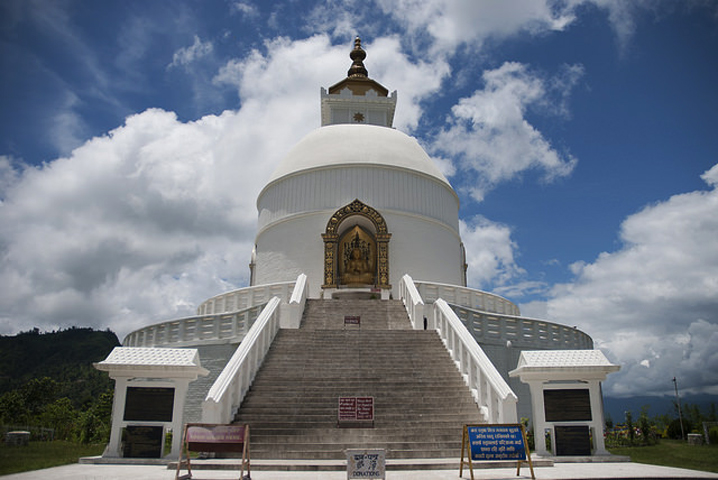
The World Peace Pagoda above Pokhara is one of the stops on the Pokhara hiking day tour.
| Add-on | What it is | Best for |
|---|---|---|
| Chandragiri Hills (not a Base Camp Hikes tour) | A cable-car ride to a Himalayan viewpoint above Kathmandu | A half day with little walking |
| Pokhara hiking day tour | A one-day tour: a roughly one-hour climb to the World Peace Pagoda, the bat caves, David’s Falls, Gupteswar cave and the Old Bazaar. It includes lunch, water and all entrance fees. | Trekkers with two free days who like gentle walks. Ask the team how to fit the journey to Pokhara. |
| The Last Resort (not a Base Camp Hikes tour) | A bungy or canyon-swing day trip from Thamel on the Bhote Kosi river | Adventure seekers with a free day that is not the last one |
| Rafting and jungle safari | A 7-day package: Kathmandu sights, Trishuli rafting, then two Chitwan days. Priced for Indian nationals. | Travellers adding days to the trip, not just filling gaps |
| Everest mountain flight | A flight along the Himalayas | Those who want one more view of Everest |
| 6-day yoga package | A structured rest and wellness stay | Travellers who want to recover rather than sightsee |
If the Lukla flight is delayed
Lukla flights depend on weather, and a delay uses spare days first. Do this when the schedule slips:
- Protect the flight home first. Drop optional add-ons before you drop the buffer.
- Do not prepay a fixed-date add-on until you are back in Kathmandu.
- Use the delay as the rest day. A delay in Kathmandu is the right moment for laundry and sleep.
- Know the cost. Extra hotel nights and meals during a delay are the guest’s cost. See the delay costs guide and the Lukla delay plan.
If the flights run from Ramechhap, the day starts with a pick-up in the middle of the night. Pack and eat dinner early, and see the Lukla vs Ramechhap guide for how the buffer days work.
Practical tips for the Kathmandu days
- Book a guide or a day tour for the heritage sites. It saves time and gives the history.
- Carry small notes for entry tickets and tips.
- Dress modestly at temples. Cover shoulders and knees.
- Carry your passport or ID. Concession rates are by nationality, so be ready to show proof.
- Buy gifts at fixed-price shops if you dislike bargaining.
- Keep the last day free. Reconfirm the flight and the airport transfer.
Common mistakes
- Booking the international flight for the first possible day after the trek.
- Prepaying a Chitwan or Pokhara date before the Lukla flight is confirmed.
- Doing a full sightseeing day before the trek. It spends energy the walk needs.
- Forgetting entry fees. Day tours often exclude them.
- Planning a hard activity right after the trek, such as rafting on the next day.
FAQ
Should I add Kathmandu days before or after the Everest Base Camp trek? After. Spare days at the end absorb a delayed Lukla flight, while days before the trek protect nothing.
How many spare days should I keep after the trek? At least one or two. The Base Camp Hikes team recommends spare days at the end of the trip, and more in the monsoon shoulder months.
What can I do in Kathmandu with one spare day? The classic day tour: Swayambhunath, Boudhanath, Pashupatinath and Durbar Square, with a late start and a rest afternoon.
Can I visit Chandragiri Hills on a spare day? Yes. It is a half-day trip by cable car from Thankot, 13.3 km from Thamel. The cable car rises from 1,550 m to 2,551 m in about 9 to 13 minutes, and the view depends on clear weather. Confirm tickets and hours with the operator.
What can I do with two spare days? Take one day to rest, wash clothes and return rented gear, and use the other for the Kathmandu sights or for Patan or Bhaktapur.
Can I go to Pokhara on a spare day? Yes, with two free days. NTB says you can fly directly to Pokhara from Kathmandu, and the Pokhara hiking day tour covers the World Peace Pagoda, the caves, David’s Falls and the Old Bazaar. Keep a buffer before the international flight.
Is there an adventure day trip from Kathmandu? Yes. The Last Resort runs bungy and canyon-swing day trips from Thamel. NTB describes the drive as about three hours, the operator says about four, and the bungy is 160 m. Check the operating days, the health limits and your insurance cover first.
Is bungee jumping safe right after the trek? Tired legs, dehydration and sunburn are common after the trek, so leave a day of rest first. Ask the operator about health and weight limits, which the pages checked do not list.
What can I do with three spare days? The 3-day, 2-night Chitwan National Park tour fits, provided the Lukla flights ran on time and you keep a buffer before the international flight.
How much are the entry fees for Kathmandu’s sights? NTB lists Kathmandu Durbar Square at NPR 1,000 for foreigners and NPR 500 for SAARC nationals, Swayambhunath at NPR 200 and NPR 50, Boudhanath at NPR 400 and NPR 100, and Pashupatinath at NPR 1,000, which is free for Indian nationals.
Does the Kathmandu day tour include entry fees? No. It includes the vehicle, hotel pick-up and drop-off and an English-speaking guide. Entrance fees and lunch are extra.
How far is Chitwan from Kathmandu? NTB lists it at 146 km by road, or about 20 minutes by air to Bharatpur.
When is the best time to visit Chitwan? NTB gives October to March as the best season. April to June is hot, and July to September is the rainy season.
What does Chitwan National Park charge for entry? NTB lists NPR 2,000 per day for foreigners and NPR 1,000 for SAARC nationals. The heritage fees page adds 13% VAT, so confirm the final amount.
Can I see Pashupatinath as a non-Hindu? Tourists can view the temple from the back premises, according to NTB. The main temple has access limits for non-Hindus.
What if my Lukla flight is delayed? The delay uses the spare days first. Protect the flight home, drop optional add-ons and do not prepay a fixed-date trip until you are back in Kathmandu.
Is it better to rest or sightsee right after the trek? Rest first. Tired legs, dry skin and dehydration are common, so a quiet first day makes the sightseeing day more enjoyable.
Should I fly to Pokhara after the trek? It works as a one-day add-on if the schedule allows, but the journey takes time. Ask the team how the Pokhara hiking day tour fits your dates.
Do I need a visa for the extra days? Indian nationals do not need a visa for Nepal. Other nationalities should check the length of their visa against the extra days.
Plan the end of your trek
To fit a Kathmandu day tour or a Chitwan trip around your dates, message the Base Camp Hikes team on WhatsApp or phone at +91 932 595 1234 (9 am to 7 pm IST), write to info@basecamphikes.com, or use the enquiry form. Planning the trek itself? See the 14-day Everest Base Camp trek, the cost guide for Indian trekkers and the Kathmandu before and after guide.
Sources
- Nepal Tourism Board: heritage site entry fees
- Nepal Tourism Board: Chitwan National Park
- Nepal Tourism Board: Kathmandu Valley
- Nepal Tourism Board: Pokhara
- Nepal Tourism Board: bungee jumping
- Chandragiri Hills, operator page: how to reach
- The Last Resort, operator page: bungy day trip