 By
Annapurna Base Camp (ABC) is one of the most affordable Himalayan treks for an Indian first-timer. It reaches 4,130 m with no flights, a short road transfer from Pokhara and lodges all the way. This guide sets out what the trek costs from India, what the package covers, what you pay on top, the day-by-day itinerary for the 10-day and 14-day versions, and the permits that apply to Indian citizens.
The short answer
- Package price: Rs 60,000 for the 10-day trek from Pokhara and Rs 75,000 for the 14-day trek from Kathmandu, both per person based on two sharing, with permits, guide, porter, lodges and meals on the trail.
- Realistic total: about Rs 90,000 to Rs 113,500 for the 14-day trek once city meals, extras, tips and weather days are added. This excludes your journey to Kathmandu and travel insurance.
- High point: Annapurna Base Camp, 4,130 m. The route has no high pass and no flight.
- Permits for Indian citizens: Annapurna Conservation Area entry Rs 1,000 and TIMS card Rs 1,000 (SAARC rate), both included in the package.
- Best seasons: March to May and September to November.
Last checked: 26 October 2026. Prices, permit fees and trail conditions change, so confirm them for your dates. The budget scenarios below are planning figures, not quotes.

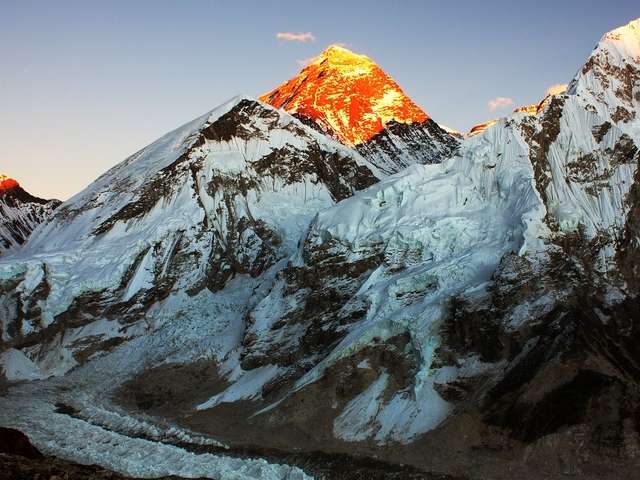
Annapurna Base Camp, at 4,130 m, the end point of the trek.
In this guide: Cost | Budget scenarios | Extras | 14-day itinerary | 10-day itinerary | Permits | Season | Why it suits first-timers | FAQ
How much does the Annapurna Base Camp trek cost from India?
Two itineraries are offered from India. The 10-day trek starts and ends in Pokhara, so you reach Pokhara yourself. The 14-day trek starts and ends in Kathmandu, and adds the tourist-bus journey to Pokhara and two hotel nights in each city.
| 10-day trek | 14-day trek | |
|---|---|---|
| Price (two sharing) | Rs 60,000 per person | Rs 75,000 per person |
| Starts and ends | Pokhara | Kathmandu |
| Kathmandu and Pokhara hotels | Not included | Two nights in each city, deluxe |
| Kathmandu to Pokhara bus | Not included | Included, tourist class, both ways |
| Pokhara to Nayapul transfer | Private, included | Private, included |
| Guide and porter | English-speaking licensed guide, porter service | English-speaking licensed guide, one porter, 15 kg a person |
| Permits and TIMS | Included | Included |
| Meals on the trek | Lodge stay and three meals a day | Lodge stay and three meals a day |
| Meals in cities | Not applicable | Not included |
| Solo support fee | Rs 1,500 a day if you are the only booking on a fixed departure | Same |
The 14-day trek costs Rs 15,000 more because it adds four hotel nights, two long bus journeys and four more days, including an easier pace on the way up and down. Both versions follow the same route to Base Camp. The extra days on the longer trek give a little more time for altitude, which is useful for first-timers.
What you actually pay: three budget scenarios (14-day trek)
The package is the biggest cost, but it is not the whole bill. The table adds the usual extras on top of the Rs 75,000 package. All figures are per person and are planning allowances.
| Scenario | Package | City meals | Trail extras | Tips | Weather days | Total |
|---|---|---|---|---|---|---|
| Lean | Rs 75,000 | Rs 5,000 | Rs 5,000 | Rs 5,000 | – | Rs 90,000 |
| Typical | Rs 75,000 | Rs 7,000 | Rs 8,000 | Rs 7,500 | – | Rs 97,500 |
| Cautious | Rs 75,000 | Rs 9,000 | Rs 10,000 | Rs 7,500 | Rs 12,000 | Rs 113,500 |
Not included in any scenario: your journey from home to Kathmandu, travel insurance, and any personal purchases. Insurance is mandatory, and it must cover your highest altitude, emergency treatment and helicopter evacuation, which can cost USD 5,000 or more without cover. Check the altitude clause, because many standard policies stop at 4,000 m and this route reaches 4,130 m.

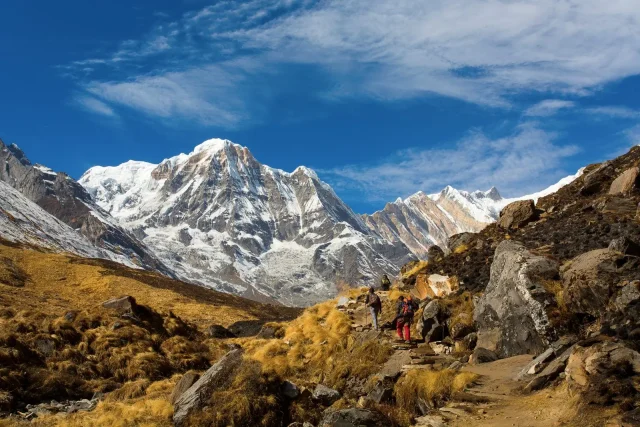
The Annapurna range, the backdrop of the whole route.
Extras to budget for
| Item | Typical cost | Notes |
|---|---|---|
| Hot shower | Rs 200 to 300 | Usually paid per shower, and the price rises with altitude |
| Device charging | Rs 100 to 400 | Usually paid per device, often at the dining-room socket |
| Bottled or boiled water | Rs 100 to 300 a bottle | Cheaper to carry a bottle and a purification method |
| Meals in Kathmandu and Pokhara | Your choice | Not included on the 14-day trek |
| Tips | About Rs 1,000 a day, or about 10% of the trip price | Shared between guide and porter, usually given at the end |
| Extra trekking day if weather holds you | Rs 6,000 a day | Applies if landslides or weather close the route |
| Card payments in Nepal | 13% added | Paying in cash avoids it |
| Gear rental in Kathmandu | Varies | A warm sleeping bag and down jacket can be rented. See buying gear in Kathmandu |
The balance is paid at the Kathmandu office, in rupees or another major currency. A small deposit secures the booking from India, by bank transfer or UPI.
14-day itinerary: Kathmandu to Annapurna Base Camp and back
This is the full itinerary with the Poon Hill sunrise and a return via Ghandruk. Distances and times are approximate.
| Day | Route | Altitude | Time | Night |
|---|---|---|---|---|
| 1 | Arrive in Kathmandu | 1,400 m | – | Kathmandu hotel |
| 2 | Tourist bus to Pokhara | 1,000 m | 6 to 8 hrs by road | Pokhara hotel |
| 3 | Drive to Nayapul, trek to Tikhe Dhunga | 1,050 m to 1,540 m | 45 min drive, 3 to 4 hrs walking, 7 km | Tikhe Dhunga |
| 4 | Tikhe Dhunga to Ghorepani | 1,540 m to 2,750 m | 5 to 6 hrs, 10 km | Ghorepani |
| 5 | Poon Hill sunrise, then to Tadapani | Poon Hill 3,210 m, Tadapani 2,590 m | 1 hr up, then 5 to 6 hrs, 12 km | Tadapani |
| 6 | Tadapani to Chhomrong | 2,590 m to 2,340 m | 5 to 6 hrs, 8 km | Chhomrong |
| 7 | Chhomrong to Himalaya Hotel | 2,340 m to 2,870 m | 5 to 6 hrs, 10 km | Himalaya Hotel |
| 8 | Himalaya Hotel to Annapurna Base Camp | 2,870 m to 4,130 m | 7 to 8 hrs, 13 km | Annapurna Base Camp |
| 9 | Base Camp to Bamboo | 4,130 m to 2,400 m | 5 to 6 hrs, 10 km | Bamboo |
| 10 | Bamboo to Chhomrong | 2,400 m to 2,340 m | 6 to 7 hrs, 10 km | Chhomrong |
| 11 | Chhomrong to Ghandruk | 2,340 m to 2,000 m | 5 to 6 hrs, 10 km | Ghandruk |
| 12 | Ghandruk to Nayapul, drive to Pokhara | 2,000 m to 1,050 m | 7 to 8 hrs, 10 km | Pokhara hotel |
| 13 | Tourist bus to Kathmandu | 1,400 m | 6 to 8 hrs by road | Kathmandu hotel |
| 14 | Departure | – | – | – |
The hard days: Day 4 climbs about 1,200 m on stone steps to Ghorepani. Day 8 is the biggest altitude gain of the trek, about 1,260 m to Base Camp, and passes Machhapuchhre Base Camp on the way. Report headache, nausea or poor sleep to the guide, who checks every trekker daily and decides whether to continue, rest or descend. Read the altitude sickness guide for the symptoms to watch.

Prayer flags at Annapurna Base Camp.
10-day itinerary: Pokhara to Annapurna Base Camp and back
The 10-day trek covers the same route in less time, starting from Pokhara.
| Day | Route | Night |
|---|---|---|
| 1 | Drive Pokhara to Nayapul, trek through the Modi Khola valley to Tikhe Dhunga | Tikhe Dhunga |
| 2 | Tikhe Dhunga to Ghorepani via Ulleri | Ghorepani |
| 3 | Poon Hill sunrise, then down to Bathanti and Tadapani | Tadapani |
| 4 | Tadapani to Chhomrong | Chhomrong |
| 5 | Chhomrong to Himalaya Hotel or Deurali | Himalaya Hotel or Deurali |
| 6 | To Annapurna Base Camp over the lateral moraine, with free time at Base Camp | Annapurna Base Camp |
| 7 | Base Camp to Bamboo | Bamboo |
| 8 | Bamboo to Chhomrong | Chhomrong |
| 9 | Chhomrong to Ghandruk via Taglung and Kummu | Ghandruk |
| 10 | Ghandruk to Nayapul and Pokhara | Pokhara hotel |
The 10-day version has fewer rest days, so it suits fit trekkers. A first-timer with no altitude experience should lean towards the 14-day trek. Read how many days the trek needs and the day-by-day guide for more detail.
Permits for Indian citizens
Two permits apply to the Annapurna Base Camp trek, and both are included in the package prices above. Fees are charged at the SAARC rate for Indian citizens.
| Permit | Indian (SAARC) citizens | Foreign nationals | Who issues it |
|---|---|---|---|
| Annapurna Conservation Area entry | NPR 1,000 per entry | NPR 3,000 per entry | Conservation area entry fee, with children under 10 free |
| TIMS card | NPR 1,000 | NPR 2,000 | Issued by a registered trekking agency through the TIMS system, with a QR e-card |
The Nepal Tourism Board (NTB) says that on routes in protected areas such as Annapurna, trekkers are required to travel with a licensed guide and an agency-issued TIMS card. The Annapurna Base Camp trek does not need a special restricted-area permit. Carry a valid passport and confirm entry documents with Nepal’s Department of Immigration before you travel. See also ABC permits and entry and the Indian travellers’ guide.
Best time to trek
NTB lists March to May and September to November as the best seasons for the Annapurna Conservation Area. Spring brings rhododendron blooms on the lower trail, and autumn brings the clearest mountain views. December to February is cold with snow near the top, and June to September is monsoon, with rain, leeches and the chance of landslides blocking the road. Read the best time for the ABC trek.

Sunrise from Poon Hill, on day 5 of the 14-day trek.
Why Annapurna Base Camp suits first-time Indian trekkers
- No flight: the trailhead is reached by road, so a missed flight from bad weather is not a risk, unlike the flight to Lukla for Everest.
- Lower: 4,130 m is well below the 5,364 m of Everest Base Camp.
- Lodges all the way: comfortable teahouses with dal bhat and a heated dining room. See what to expect in a teahouse.
- Close to Pokhara: a city with a lake, hospitals and good road links.
- Beautiful and varied: forests of rhododendron and bamboo, Gurung villages and a ring of snow peaks, with Annapurna I at 8,091 m, the tenth highest mountain in the world according to NTB.
For a side-by-side look at the two big base camp treks, read Everest Base Camp vs Annapurna Base Camp. For other routes in the region, see trekking options in the Annapurna region.
FAQ
How much does the Annapurna Base Camp trek cost from India? Rs 60,000 for the 10-day trek and Rs 75,000 for the 14-day trek, per person based on two sharing. A realistic total with extras is about Rs 90,000 to Rs 113,500 for the 14-day trek.
What is included in the price? Permits and TIMS, a licensed guide, porter service, lodges, three meals a day on the trek and the Pokhara to Nayapul transfer. The 14-day trek adds Kathmandu and Pokhara hotels and the tourist bus.
What is not included? Meals in cities, bottled water, tips, personal expenses, insurance and your journey to Kathmandu.
How many days do I need? Ten days from Pokhara or fourteen days from Kathmandu. The longer trek has more time for altitude.
How high is Annapurna Base Camp? 4,130 m.
Is it harder than Everest Base Camp? It is lower and shorter, but the steep stone steps and the big climb on the way to Base Camp make it a demanding trek. Fitness still matters.
Do Indians need a visa? Confirm entry requirements with Nepal’s Department of Immigration before you travel, and carry a valid passport.
What permits do I need? An Annapurna Conservation Area permit (NPR 1,000 for Indian citizens) and a TIMS card (NPR 1,000). Both are included in the package.
When is the best time? March to May and September to November.
Is it safe for first-timers? Yes, with a licensed guide and daily health checks. Report altitude symptoms early.
What if the weather delays us? Extra trekking days cost Rs 6,000 a day, so keep a spare day or two in your plan.
Is a porter included? Yes, with a luggage allowance of about 15 kg a person on the 14-day trek.
Can I pay by UPI? Yes, a small deposit can be paid by bank transfer or UPI from India, and the balance is paid in Kathmandu.
Can children go? Many families trek it, especially on the 14-day version. Children under 10 enter the conservation area free.
Book the Annapurna Base Camp trek
For dates and a quote, see the 14-day Annapurna Base Camp trek or the 10-day trek, or message the team on WhatsApp or phone at +91 932 595 1234 (9 am to 7 pm IST), write to info@basecamphikes.com, or use the enquiry form.
Sources
- Nepal Tourism Board: park entry fees
- Nepal Tourism Board: TIMS card
- Nepal Tourism Board: Annapurna Conservation Area