
 By
Everest Base Camp (EBC) and Annapurna Base Camp (ABC) are Nepal’s two best-known base camp treks, and the usual advice is that EBC is “harder” because it is higher. That is only half the story. The two treks differ in how they climb, how long they stay high, what they pass through and what the finish looks like. This guide sets those differences out with the actual altitude profile of each trek, measured against the Nepal Tourism Board’s (NTB) own rules for safe ascent.
The short answer
- EBC is higher and longer, but it is paced. It sleeps as high as 5,180 m and spends 5 nights above 4,000 m, yet each big climb is followed by a rest day.
- ABC is lower but abrupt. It sleeps above 3,000 m only once, at 4,130 m, but the final climb gains about 1,260 m in a single day, far more than NTB’s guidance allows.
- Choose by what you want: sustained high-altitude Himalaya and Sherpa culture (EBC), or a shorter trek through Gurung and Magar villages ending in a ring of peaks (ABC).

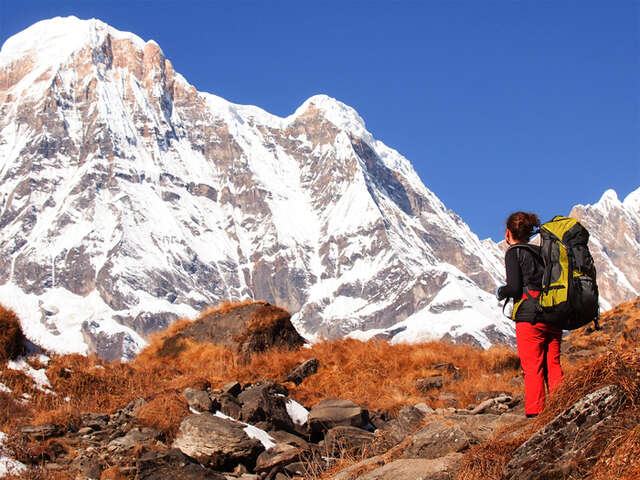
Annapurna Base Camp, at 4,130 m (about 13,550 ft), sits inside a ring of high peaks.
EBC vs ABC at a glance
| Item | Everest Base Camp | Annapurna Base Camp |
|---|---|---|
| Region | Khumbu, inside Sagarmatha National Park | Annapurna Conservation Area |
| People along the trail | Sherpa | Gurung and Magar in the south |
| Base camp altitude | 5,364 m | 4,130 m (about 13,550 ft) |
| Highest viewpoint | Kala Patthar, 5,545 m | Annapurna Base Camp (Poon Hill, about 3,200 m, on the way) |
| Typical length from Kathmandu | About two weeks, plus spare days for flights | About 10 to 14 days, depending on the route |
| Difficulty | Strenuous | Moderate |
| Trailhead | Lukla, by flight | Nayapul, near Pokhara, by road |
| Best seasons (NTB) | October to November, March to May | March to May, September to November |
| Guide and TIMS card | Required | Required |
The route profile: what the numbers say
These figures are measured from the standard 14-day schedule of each trek, counting from the first night on the trail.
| Measure | Everest Base Camp | Annapurna Base Camp |
|---|---|---|
| Highest sleeping altitude | 5,180 m (Gorak Shep) | 4,130 m (base camp) |
| Nights above 3,000 m | 9 | 1 |
| Nights above 4,000 m | 5 | 1 |
| Rest days built in | 2 (Namche Bazaar and Dingboche) | None on the way up |
| Largest one-night gain on foot | +788 m (Phakding to Namche Bazaar) | +1,260 m (Himalaya Hotel to base camp) |
| Walking days | 9 | 10 |
| Distance walked | About 106 to 112 km | About 100 km |
| Walking hours | About 50 to 58 | About 54 to 64 |
Two points stand out. EBC demands far more time at altitude. ABC, despite the lower altitude, involves slightly more walking hours, because the route climbs and drops repeatedly and passes Chhomrong twice.
How each trek handles altitude
NTB’s safety page sets two simple rules. Above 2,500 m, the altitude you sleep at should rise by no more than 300 to 500 m a day, measured from the previous night. And you should take a rest day after every 1,000 m of altitude gain. The tables below apply those rules to each trek’s standard schedule. Green means within the guidance, amber means above it, and blue marks a rest day.
Everest Base Camp
| Night | Sleeping altitude | Change from previous night | NTB guidance (300 to 500 m a day above 2,500 m) | Profile |
|---|---|---|---|---|
| Day 2, Phakding | 2,652 m | +1,302 m (after the Lukla flight) | Within (152 m above 2,500 m) |
|
| Day 3, Namche Bazaar | 3,440 m | +788 m | Above (288 m over the top of the range) |
|
| Day 4, Namche Bazaar | 3,440 m | 0 m | Rest day acclimatisation day |
|
| Day 5, Deboche | 3,700 m | +260 m | Within |
|
| Day 6, Dingboche | 4,400 m | +700 m | Above (200 m over the top of the range) |
|
| Day 7, Dingboche | 4,400 m | 0 m | Rest day acclimatisation day |
|
| Day 8, Lobuche | 4,900 m | +500 m | Within (at the limit) |
|
| Day 9, Gorak Shep | 5,180 m | +280 m | Within |
|
| Day 10, Pheriche | 4,320 m | -860 m | Descent |
|
| Day 11, Namche Bazaar | 3,440 m | -880 m | Descent |
|
EBC breaks NTB’s daily limit twice, at Namche Bazaar (+788 m) and Dingboche (+700 m), and the schedule places a rest day immediately after both. That is the logic of the Everest itinerary: take the big steps early, rest, then climb in smaller steps of 260, 500 and 280 m. The first move, from Kathmandu to Phakding, is about +1,300 m, most of it by a 15-minute flight, and the first night is at Phakding, lower than Lukla itself.
Annapurna Base Camp
| Night | Sleeping altitude | Change from previous night | NTB guidance (300 to 500 m a day above 2,500 m) | Profile |
|---|---|---|---|---|
| Day 3, Tikhe Dhunga | 1,540 m | +540 m | Below 2,500 m |
|
| Day 4, Ghorepani | 2,750 m | +1,210 m | Within (250 m of it above 2,500 m) |
|
| Day 5, Tadapani | 2,590 m | -160 m | Descent |
|
| Day 6, Chhomrong | 2,340 m | -250 m | Descent |
|
| Day 7, Himalaya Hotel | 2,870 m | +530 m | Within (370 m of it above 2,500 m) |
|
| Day 8, Annapurna Base Camp | 4,130 m | +1,260 m | Above (760 m over the top of the range, no rest day before it) |
|
| Day 9, Bamboo | 2,400 m | -1,730 m | Descent |
|
ABC stays low for most of the trek, which is why it feels gentler. The exception is the last day: the climb from Himalaya Hotel to base camp is +1,260 m, about 760 m beyond NTB’s range, and the schedule has no rest day before it. From Chhomrong (2,340 m) that is 1,790 m of gain in two days. The route recovers by descending the next day, to Bamboo at 2,400 m, which is a sound way to manage altitude. It does not remove the risk on the night at 4,130 m.
A common precaution is to split the climb with an extra night at Deurali or Machhapuchhre Base Camp. The 10-day itinerary already lists Deurali as an alternative to Himalaya Hotel, so ask the operator to include one of them.
What this means in practice
- EBC tests endurance at altitude. The challenge is time spent high, cold nights and thin air from Dingboche upward.
- ABC tests how you cope with a sudden gain. The challenge is one steep, long day and a single high night.
- Neither is risk-free. NTB advises treating headache, nausea, loss of appetite, dizziness or unusual fatigue above 2,500 m as altitude sickness until proven otherwise. Do not go higher, and if symptoms worsen, descend. NTB’s wording is “Descend! Descend! Descend!”.

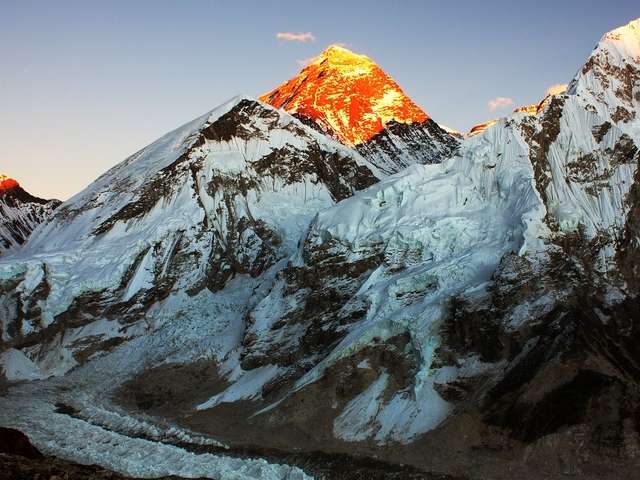
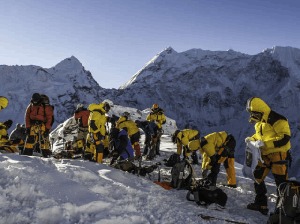
Sunrise from Kala Patthar at 5,545 m, the standard viewpoint for Everest.
Terrain and trail character
Everest Base Camp: a valley that opens into glacier country
The trail follows the Dudh Kosi valley from Lukla through Sherpa villages to Namche Bazaar, then climbs to the monastery ridge at Tengboche. Above about 3,500 m the forest, dominated by silver fir, birch, rhododendron and juniper according to NTB, gives way to open ground. The final stretch to Base Camp crosses glacier moraine, which NTB calls “treacherous ground”. The walking is long and steady rather than steep: about 106 to 112 km over nine walking days.

Everest Base Camp at 5,364 m, the end point of the longer, higher trek.
Annapurna Base Camp: stone steps, terraces and repeated climbs
The ABC route is a series of ridges and gorges. It climbs stone staircases to Ghorepani and Ghandruk, drops to the river valleys and climbs again, passing Chhomrong twice. The package ABC page describes long staircases at Ghandruk and Chhomrong and a steady climb on the final days. The effort is in the knees and the repeated climbs more than in the altitude, which is why the walking hours match or exceed EBC’s.

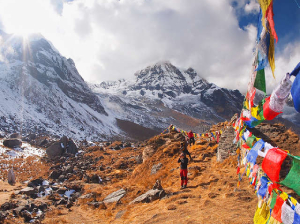
Tea houses on the Annapurna route, with the peaks behind.
People, culture and landscape
| Aspect | Everest Base Camp | Annapurna Base Camp |
|---|---|---|
| Protected area | Sagarmatha National Park: 1,148 sq km, World Heritage Site since 1979 (NTB) | Annapurna Conservation Area: 7,629 sq km, launched in 1986 and gazetted in 1992 (National Trust for Nature Conservation, NTNC) |
| People | Sherpa settlements, with Namche Bazaar as the staging point for expeditions | Gurung and Magar communities in the south, with Ghandruk where the conservation project began |
| Spiritual heritage | Tengboche Monastery, the leading Buddhist centre in Khumbu. The Mani Rimdu festival is held there every October. | Hill villages and terraced farmland. NTNC collects the entry fees and reinvests them in the region. |
| Wildlife | Musk deer, tahr, serow and pheasants (NTB) | Across the conservation area: 105 mammal species, 523 birds and 1,226 flowering plants (NTNC) |
| Lodging | Lodges and tea houses, with camping sites (NTB) | More than 1,000 lodges and teashops across the conservation area (NTNC) |
| Medical support | Himalayan Rescue Association aid post at Pheriche, with daily altitude talks at 3 pm in spring and autumn (NTB) | NTB’s list names Pheriche and Manang, neither of which is on the ABC route |
Neither trek is quiet. NTB calls the Everest route one of the most visited regions in the Himalaya, and NTNC reports that the Annapurna Conservation Area attracts the majority of the country’s trekkers. Expect company on the trail in both seasons.
Places worth the stop on each trek
Annapurna Base Camp
| Place | Altitude | Why it is worth the stop |
|---|---|---|
| Poon Hill | About 3,200 m | The classic sunrise viewpoint above Ghorepani, with a wide view of the Annapurna and Dhaulagiri ranges. The route name on the NTB list is the “Poon Hill-ABC Trek”. |
| Ghorepani | 2,750 m | The ridge village below Poon Hill, where trekkers overnight before the sunrise climb |
| Chhomrong | 2,340 m | The last large village before the climb to base camp, reached by long stone staircases and passed again on the way down |
| Deurali and Machhapuchhre Base Camp | On the trail above Himalaya Hotel (2,870 m) | The stops between Himalaya Hotel and Annapurna Base Camp. Sleeping here splits the final climb, so they are the safest places to break the day. |
| Annapurna Base Camp | 4,130 m | The goal: sunrise inside a ring of peaks that includes Annapurna I (8,091 m) |
| Jhinu hot spring | Below Chhomrong | A natural hot spring on the descent, popular for easing tired legs after base camp. Confirm that your route and schedule include it. |
| Ghandruk | About 2,000 m | A large Gurung village near the end of the trek, where the Annapurna Conservation Area Project began in 1986 |
Everest Base Camp
| Place | Altitude | Why it is worth the stop |
|---|---|---|
| Lukla | 2,846 m | The airstrip NTB calls the “Gateway to Everest”, where the Dudh Kosi valley route begins |
| Monjo and the Hillary Suspension Bridge | Below Namche Bazaar | The Sagarmatha National Park checkpoint, then the high suspension bridge on the climb to Namche |
| Namche Bazaar | 3,440 m | The main Sherpa town and expedition staging point. The rest day is spent here, with an optional walk up to the Everest View Point. |
| Khumjung and Khunde | Above Namche Bazaar | Sherpa villages that NTB lists among the region’s highlights, with a monastery at Khumjung |
| Tengboche Monastery | On the ridge beyond Namche | The leading Buddhist centre in Khumbu, with views of Everest, Lhotse and Ama Dablam. The Mani Rimdu festival is held here every October (NTB). |
| Dingboche | 4,400 m | The second rest-day stop, in the high valley below Island Peak |
| Lobuche and Gorak Shep | 4,900 m and 5,180 m | The last two nights, below Base Camp and Kala Patthar |
| Everest Base Camp and the Khumbu Glacier | 5,364 m | The goal: the foot of the glacier, which NTB describes as “treacherous ground” |
| Kala Patthar | 5,545 m | The sunrise viewpoint for Everest and its neighbours |
| Pheriche | On the descent | Home to a Himalayan Rescue Association aid post, with daily altitude talks in spring and autumn (NTB) |
The pattern is clear. ABC’s highlights are spread across hill villages, a sunrise viewpoint at Poon Hill and a hot spring on the way back, so the trek has variety. EBC’s highlights build in one direction, from Sherpa towns and monasteries up to the glacier and Kala Patthar.
Views: what the walk actually delivers
- Everest region: Kala Patthar at 5,545 m gives a view of much of Everest, according to NTB. Tengboche offers views of Everest, Lhotse and Ama Dablam, and Sagarmatha National Park also holds Lhotse and Cho Oyu. The pay-off is peaks seen from a high, open valley.
- Annapurna region: base camp sits inside a ring of high peaks, including Annapurna I at 8,091 m, the tenth highest mountain in the world according to NTB. Machhapuchhre (Fishtail) dominates the approach, and the Poon Hill sunrise on the way, at about 3,200 m, shows Dhaulagiri at 8,172 m. The pay-off is an amphitheatre of peaks at close range.
Put simply, EBC is about reaching the Everest region and seeing the world’s highest peak from Kala Patthar. ABC is about standing inside a ring of mountains at a much lower altitude.

Machhapuchhre (Fishtail) rises above the ABC approach.
Weather and seasons, month by month
NTB’s season statements are the clearest guide. They cover both regions, though not every month for both.
| Months | Everest Base Camp | Annapurna Base Camp |
|---|---|---|
| March to May | Listed as a best season | Listed as a best season |
| June to August | Rainy (NTB lists June to September) | Not among the seasons NTB lists |
| September | Still within the rainy period for Sagarmatha | Listed as a season (September to November) |
| October to November | Listed as a best season, with the Mani Rimdu festival at Tengboche every October | Listed as a season |
| December to February | Snowy, with a daytime temperature of about 5 degrees Celsius. NTB notes extreme winters and heavy snow at high altitude. | Not among the seasons NTB lists |
The practical difference: Everest’s rains run to September, so its autumn window starts a little later than Annapurna’s. Both treks are best in spring and in October and November.
Getting there: the logistics gap
| Step | EBC | ABC |
|---|---|---|
| From Kathmandu | Fly to Lukla, from Kathmandu or from Ramechhap (Manthali) in busy periods. Ramechhap adds a road transfer of about 4 hours. | Road to Pokhara, 202 km, or 30 minutes by air (NTB) |
| To the trailhead | Walk from Lukla to Phakding on the first day | Drive from Pokhara to Nayapul, about 1 hour |
| Airport facts (CAAN) | Lukla: 2,846 m, 527 m runway, visual flight rules only | Not required for the trek itself |
| Main schedule risk | Cloud on the mountain side can cancel flights | Road delays |
| Spare days | Keep at least two after the trek | One buffer day is sensible |
The flight is the biggest planning difference. For airport rules and a spare-day table, read Lukla vs Ramechhap flights for Everest Base Camp.
Risks side by side
| Risk | EBC | ABC | What helps |
|---|---|---|---|
| Altitude sickness | Higher exposure: 5 nights above 4,000 m and a high night at 5,180 m | One night at 4,130 m, reached by a +1,260 m day | Slow ascent, rest days, treat symptoms seriously, descend if they worsen |
| Weather and schedule | Flight cancellations | Road delays | Spare days after the trek |
| Joints and fatigue | Long, steady days of 6 to 8 hours | Stone staircases, repeated descents and climbs | Trekking poles, training with stairs and hills |
| Cold | Nights at 4,400 to 5,180 m | The night at base camp, the highest of the trek | A warm sleeping system and layered clothing |
| Evacuation | Helicopter evacuation can exceed US$5,000, according to the package terms | Same | Insurance that covers trekking at your highest altitude and helicopter evacuation |
What drives the cost
EBC usually costs more than ABC, and the reasons are structural rather than a matter of operator:
- Length: EBC takes about two weeks plus spare days. ABC can be done in 10 days.
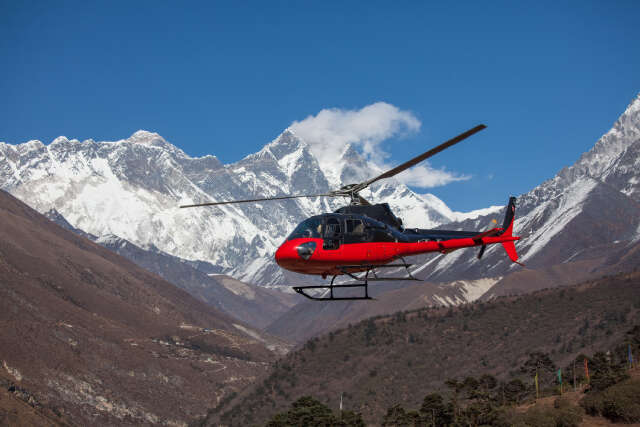
- Flights: EBC includes the Lukla flights, and a cancelled flight can add hotel nights, meals or a helicopter charter. ABC travel is by road.
- Altitude support: EBC needs more acclimatisation days and higher insurance cover.
- Extras on both: international flights, visas where applicable, drinks, charging, hot showers, tips and any extra days.
Park and permit fees are almost the same on both treks, as the next section shows. Ask for a written quote that lists what is and is not included before comparing prices between operators.
Permits and fees
This section uses government pages only. A reputable operator includes these permits in the package.
| Permit | EBC | ABC | Source |
|---|---|---|---|
| Licensed guide and agency-issued TIMS card | Required (Everest Basecamp Trek is on the list) | Required (Poon Hill-ABC Trek is on the list) | NTB TIMS page, effective 31 March 2023 |
| TIMS card fee | NPR 2,000 (SAARC: NPR 1,000), payable through the agency | NTB TIMS page | |
| Park or conservation area entry | Sagarmatha National Park: NPR 3,000 (SAARC: NPR 1,500) per entry | Annapurna Conservation Area: NPR 3,000 (SAARC: NPR 1,000) per entry | NTB park entry fees page |
Fees on NTB pages can differ. Another NTB page for the Annapurna Conservation Area still shows an older NPR 2,000 for foreigners and NPR 200 for SAARC nationals, and an older NTB trade page lists different TIMS fees. This guide uses the park entry fees page. Confirm the current figure on your travel date, and Indian citizens should check the documents and fees that apply to them.
Which trek is right for you?
| If you… | Better fit | Why |
|---|---|---|
| Have 10 days or fewer | ABC | It can be done in 10 days, with no flight to miss |
| Want to stand near the highest peaks and have about three weeks door to door | EBC | Base Camp at 5,364 m and Kala Patthar at 5,545 m |
| Are on your first big trek | ABC, with an extra acclimatisation night | Lower altitude overall, but split the final climb |
| Cope poorly with cold and thin air | ABC | One night above 3,000 m against nine |
| Prefer a well-paced climb with rest days | EBC | Rest days follow the two biggest gains |
| Are interested in monasteries and festivals | EBC | Tengboche Monastery and the October Mani Rimdu festival |
| Are interested in hill-village life and varied scenery | ABC | Gurung and Magar villages, terraces and forest |
| Dislike small-plane flights or have a fixed return date | ABC | All travel is by road |
The verdict
Choose EBC for the full high-Himalaya experience, if you can give it the time, spare days and training. Choose ABC for a shorter, lower trek with more variety in villages and forest, and add an acclimatisation night before the final climb. If you cannot decide, do ABC first and EBC on a later trip, once you know how you handle altitude.
Can you do both?
Yes. Do the lower ABC trek first, take a few rest days in Kathmandu or Pokhara, and then start EBC. A gap of several days lets your legs recover, but acclimatisation does not carry over, so EBC still needs its own rest days. Plan flights and spare days for EBC around the combined itinerary.
Plan EBC or ABC with Base Camp Hikes
Base Camp Hikes runs both treks with licensed guides and porters, and the packages include the permits and TIMS card. View the Everest Base Camp trek, the 14-day Annapurna Base Camp trek or the 10-day Annapurna Base Camp trek for itineraries and current prices. Send your dates, fitness and budget, and the team will recommend one: call or WhatsApp +91 932 595 1234 (9 am to 7 pm IST), email info@basecamphikes.com or use the enquiry form.
Related reading: the complete Everest Base Camp guide for 2027 and the post on trekking Everest Base Camp without a guide.
FAQ
Is Everest Base Camp harder than Annapurna Base Camp? EBC is graded strenuous and ABC moderate. EBC is harder because of the time spent at high altitude. ABC’s single hard day is the final climb, which gains about 1,260 m in one day.
Which trek has the better views? They are different. EBC gives a high-valley view of Everest, Lhotse and Ama Dablam from places such as Kala Patthar and Tengboche. ABC puts you inside a ring of peaks including Annapurna I, with Machhapuchhre and Dhaulagiri along the way.
Can you get altitude sickness on the ABC trek? Yes. NTB advises treating symptoms as altitude sickness anywhere above 2,500 m, and ABC reaches 4,130 m. The risk comes from the fast final climb. Descending the next day helps, but an extra night at Deurali or Machhapuchhre Base Camp is a safer plan.
How high is Annapurna Base Camp? Annapurna Base Camp is at 4,130 m (about 13,550 ft), about 1,230 m lower than Everest Base Camp at 5,364 m.
How high is Everest Base Camp? Everest Base Camp is at 5,364 m, and the Kala Patthar viewpoint above Gorak Shep is at 5,545 m.
Which is better in October? Both are within their best seasons. October also brings the Mani Rimdu festival at Tengboche on the EBC route, according to NTB.
Do I need a guide for both treks? The NTB TIMS page requires a licensed guide and an agency-issued TIMS card on its listed routes. The Everest Basecamp Trek and the Poon Hill-ABC Trek are both on that list.
Which trek costs less? ABC usually costs less because it is shorter and avoids mountain flights. Compare written quotes that list inclusions and extras, because the park fees are almost the same on both treks.
Which trek is more crowded? Neither is quiet. NTB calls the Everest route one of the most visited regions in the Himalaya, and NTNC says the Annapurna Conservation Area attracts the majority of the country’s trekkers.
Is Everest Base Camp suitable for a first-time trekker? It can be, for a fit trekker who takes both rest days and the full itinerary. ABC is the gentler introduction, and many people choose it first.
How many days do I need? About 10 to 14 days for ABC and about two weeks for EBC, plus at least two spare days at the end of EBC for flight delays.
What accommodation is there? Both treks use lodges and tea houses. NTB lists lodges, tea houses and camping sites on the Everest route, and NTNC reports more than 1,000 lodges and teashops across the Annapurna Conservation Area.
Sources
- Nepal Tourism Board, safety in the mountains (ascent and rest-day guidance, altitude sickness, aid posts)
- Nepal Tourism Board, TIMS card (guide and TIMS rule, routes, fees)
- Nepal Tourism Board, park entry fees
- Nepal Tourism Board, Annapurna Conservation Area, Sagarmatha National Park, Everest region, Annapurna region and Tengboche (seasons, culture, views, access)
- National Trust for Nature Conservation, Annapurna Conservation Area Project (area, people, species, lodges)
- Civil Aviation Authority of Nepal, Tenzing-Hillary Airport profile (Lukla elevation, runway, visual flight rules)
- Night-by-night altitudes, distances and walking hours come from the standard 14-day Base Camp Hikes itineraries for Everest Base Camp and Annapurna Base Camp. Annapurna Base Camp’s height of 4,130 m is the commonly cited figure; no government page states it.
Information correct as of 22 October 2026.