 By
The Annapurna North Base Camp vs South Base Camp choice comes down to comfort against quiet. South Base Camp, usually called Annapurna Base Camp, is the classic trek. It reaches 4,130 m, with village lodges and a clear trail from Nayapul near Pokhara. North Base Camp is a newer, camping-style route. It starts at Narchyang near Tatopani in Myagdi district and reaches the glaciers below the north face of Annapurna I. Choose the south side if this is your first Himalayan trek. Choose the north side if you are fit, camp happily and want few other trekkers.
North vs South Annapurna Base Camp at a glance
- South Base Camp (Annapurna Base Camp): 4,130 m, according to the Nepal Tourism Board. Lodges throughout. Our itineraries take 10 days from Pokhara or 14 from Kathmandu.
- North Base Camp: about 4,190 m near Panchakunda Lake, with a high camp at 4,068 m (ours). Camping. 10 days from Kathmandu on our standard schedule.
- Start points: Nayapul (south) and Narchyang near Tatopani on the Beni to Jomsom road (north).
- Permits: Annapurna Conservation Area entry, plus TIMS and a licensed guide. The Nepal Tourism Board lists the Annapurna Base Camp route among those needing a guide.
- Best seasons: March to May and September to November, according to the Nepal Tourism Board for the Annapurna region.
Last checked: 12 November 2026. The Annapurna Base Camp altitude, the north route’s start point, season, permits and safety rules come from Nepal Tourism Board pages. The north side has very little government documentation. Our north-side routes, times, camps and difficulty come from our own guiding, so we mark them “(ours)”. Fees change by government notice, so confirm before you pay. This guide covers the Annapurna massif only and is not about the Kanchenjunga North and South Base Camps.
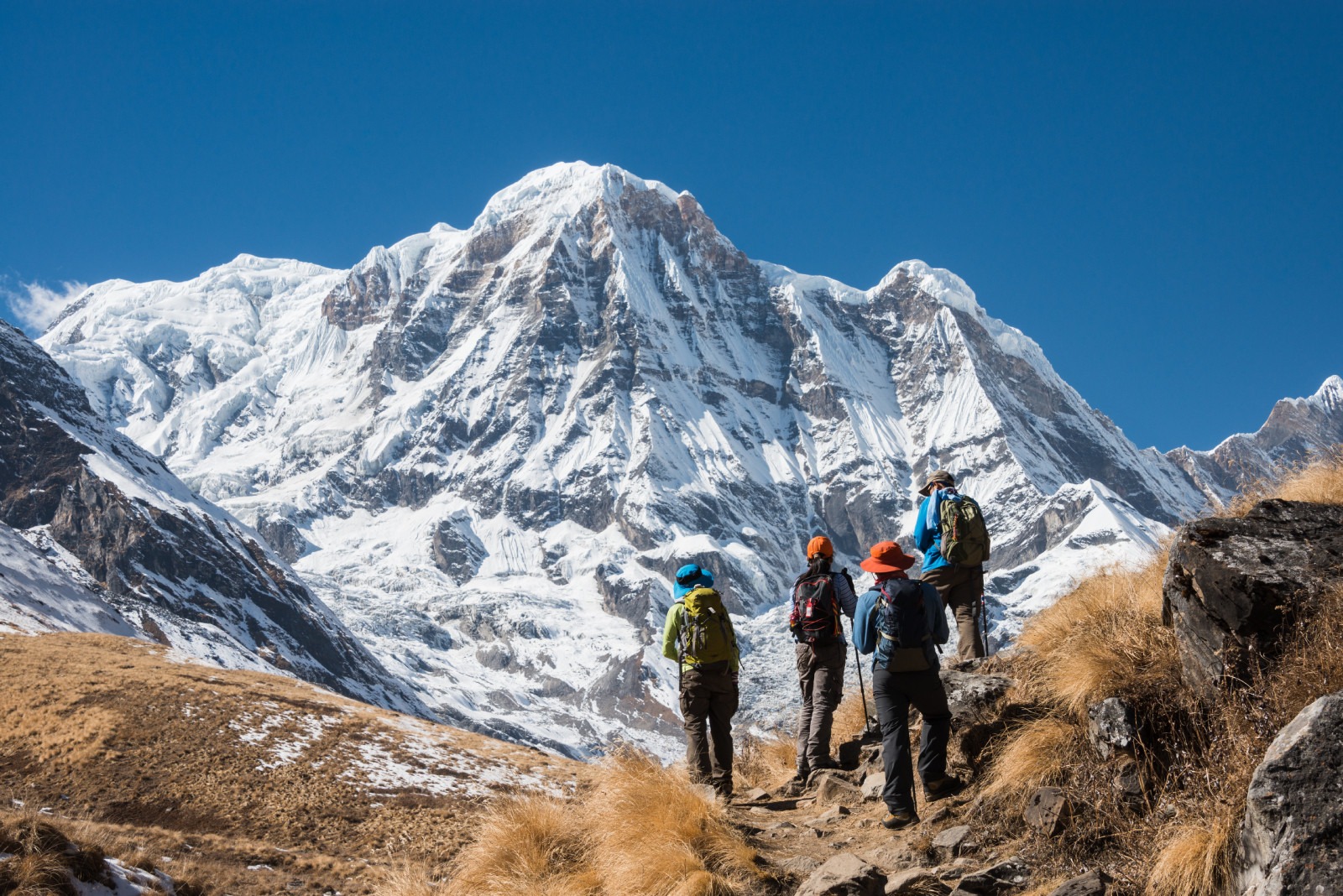
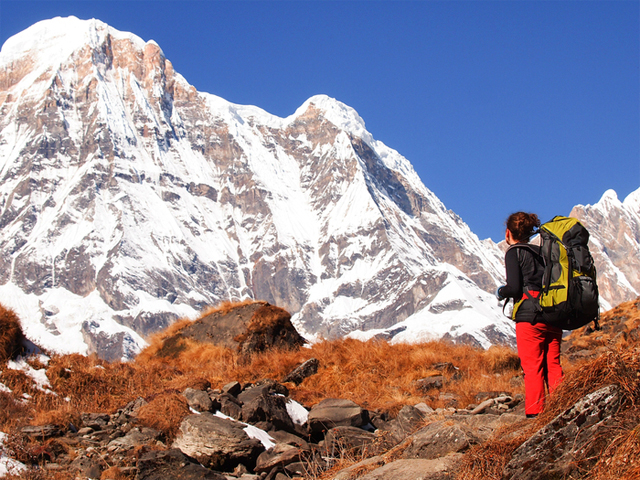
Trekking trail in Nepal’s Annapurna region with the majestic Annapurna South peak in the background.
In this guide: Side-by-side table | South route | North route | Altitude and effort | Permits | Season and safety | Cost | Which to choose | FAQ
Annapurna North Base Camp vs South Base Camp: the comparison
| South Base Camp (ABC) | North Base Camp | |
|---|---|---|
| District and start | Kaski; Nayapul near Pokhara | Myagdi; Narchyang near Tatopani, on the Beni to Jomsom road (NTB) |
| Base camp altitude | 4,130 m (NTB) | about 4,190 m, in the Panchakunda Lake area (ours) |
| Highest sleeping altitude | 4,130 m at base camp | 4,068 m at the high camp (ours) |
| Surrounding peaks | Annapurna I (8,091 m), Machhapuchhre and Hiunchuli (NTB) | The north side of Annapurna I (ours) |
| Typical length | 10 days from Pokhara, or 14 days from Kathmandu | 10 days from Kathmandu, 7 on foot (ours) |
| Where you sleep | Village lodges and teahouses | Homestay on night one, then tents (ours) |
| Trail | Established, with stone staircases and signposts | Newer, steeper and less marked in places (ours) |
| Crowds | Busy in March to May and October to November (ours) | Far quieter, though numbers are rising (ours) |
| Difficulty | Moderate | Moderate terrain, demanding altitude gain and cold (ours) |
| First-timer friendly? | Yes, with preparation | Not our first choice for a beginner |
| Price from India | Rs 60,000 (10 days) or Rs 75,000 (14 days) per person, two sharing | Quoted on request |
South Base Camp: the Annapurna Sanctuary route
The Nepal Tourism Board describes the Annapurna Base Camp trek as leading “into the heart of the Annapurna Sanctuary at 4,130 m”, surrounded by Annapurna I (8,091 m), Machhapuchhre (Fishtail) and Hiunchuli. The route passes Machhapuchhre Base Camp, and you can add Poon Hill for sunrise. The Board also says Ghandruk has one of the best views of Annapurna South, Gangapurna, Annapurna III, Hiunchuli and Machhapuchhre. It has a Gurung museum and lies about 54.8 km from Pokhara.
Our 14-day schedule passes these stops (altitudes rounded):
| Stop | Altitude | What to expect (ours) |
|---|---|---|
| Nayapul | about 1,070 m | Road start, a short transfer from Pokhara |
| Ghandruk | 2,000 m | Gurung village, stone staircases and a first big view |
| Chhomrong | 2,340 m | Last large village; the trail passes through it twice |
| Himalaya Hotel | 2,870 m | Forest, bamboo and the start of the narrow gorge |
| Annapurna Base Camp | 4,130 m | Sleep at base camp and watch sunrise on the peaks |
| Bamboo | 2,400 m | Long descent the next day |
The full day-by-day plan, costs and inclusions are in our Annapurna Base Camp trek cost and itinerary from India. For a comparison with Everest, see Everest Base Camp vs Annapurna Base Camp.
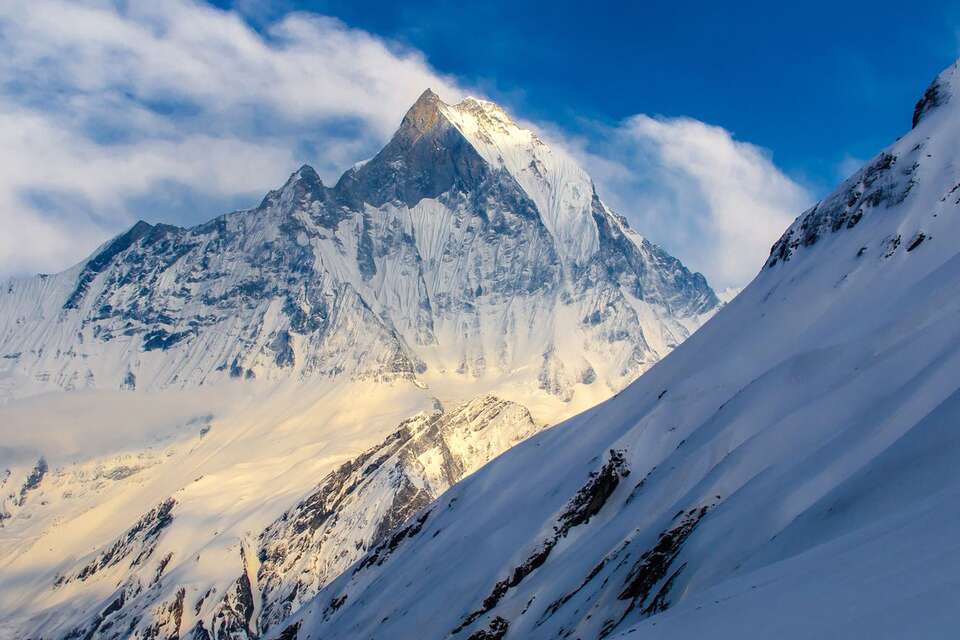
Machhapuchhre (Fishtail) stands beside the south base camp route.
North Base Camp: the Myagdi route
The north side is where the first ascent of Annapurna began. The Nepal Tourism Board reported a 2020 familiarisation trip to North Annapurna Base Camp, run with the Trekking Agencies’ Association of Nepal in Pokhara. It said the route starts at Narchyang near Tatopani on the Beni to Jomsom road. It also said the route follows the footsteps of Maurice Herzog, who reached above 8,000 m in 1950. The Board’s page for Beni, the Myagdi district headquarters, says Beni is a 3-hour drive from Pokhara.
Beyond that, government documentation is thin. Our own 10-day schedule looks like this (ours):
| Day | Route | Walking | Sleep |
|---|---|---|---|
| 1 | Arrive in Kathmandu | Hotel | |
| 2 | Fly to Pokhara; gear check and briefing | Hotel, Pokhara | |
| 3 | Drive Pokhara to Tatopani via Beni (6 to 7 hours), then walk to Upper Narchyang | 2 hours | Homestay, 2,140 m |
| 4 | Upper Narchyang to Chhotepa | 7 hours, 14 km | Camp, 2,370 m |
| 5 | Chhotepa to Sandhikharka | 6 to 7 hours, 9 km | Camp, 3,160 m |
| 6 | Sandhikharka to the north base camp area | 7 to 8 hours, 9.5 km | Camp, 4,068 m |
| 7 | Explore the glaciers and Panchakunda Lake (about 4,190 m), then descend | about 7.5 hours | Camp, 3,160 m |
| 8 | Down to Chhotepa, then drive to Lower Narchyang | 6 to 7 hours | Homestay or lodge |
| 9 | Walk to Tatopani; drive to Pokhara | Hotel, Pokhara | |
| 10 | Fly to Kathmandu; onward departure |
Panchakunda means “five ponds” (ours). On the exploration day you walk to the lake area and the glaciers below the north face. Our schedule needs no technical climbing or fixed ropes. The trail is steep, though, and the tent camps are cold (ours). The north side is the hardest and least visited of the main Annapurna options. It suits fit trekkers with a guide who knows it, as we say in our Annapurna region options guide.

Annapurna South from the south side near Jhinu Danda. The north side looks very different: fewer villages and more camping.
Altitude and effort: which is harder?
The Nepal Tourism Board’s safety page gives two rules. Above 2,500 m, your sleeping altitude should rise by no more than 300 to 500 m a day. It also advises a rest day for every 1,000 m of altitude gained. Neither route meets both rules, so go slowly and speak up early.
| Measure | South Base Camp | North Base Camp (ours) |
|---|---|---|
| Highest sleeping altitude | 4,130 m | 4,068 m |
| Biggest one-night gain | +1,260 m, Himalaya Hotel to base camp on the 14-day schedule | about +910 m, Sandhikharka to the high camp |
| Base camp day | Arrive, sleep and descend the next day | Explore at about 4,190 m, then descend to 3,160 m |
| Nights in tents | None | 4 (ours) |
| Cold | Cold at base camp | Colder; tents above 3,000 m are well below freezing in winter |
The north route sleeps lower than base camp. It still gains height in one steep day, and it has no lodges to retreat to. South Base Camp has more people and lodges around you if someone feels unwell. Neither route is safe for a rapid ascent. If you get a headache, nausea or dizziness, stop climbing and tell your guide. If symptoms worsen, descend at once, as the Board advises.
Permits for both base camps
Both routes lie inside the Annapurna Conservation Area, so you need the entry permit. Nepal Tourism Board pages list different figures. One gives NPR 3,000 for foreigners and NPR 1,000 for SAARC nationals. Another gives NPR 2,000 and NPR 200. Confirm the fee when the permit is issued. TIMS costs NPR 1,000 for SAARC nationals and NPR 2,000 for others. Since 31 March 2023, the Board says, trekkers on the Annapurna Base Camp route must go with a licensed guide. They must also carry an agency-issued TIMS card.
The Board’s guide-route list that we checked names Annapurna Base Camp but does not name the north route separately. We therefore confirm requirements when we apply for your permits. We always send a licensed guide on the north side (ours). Neither route is a restricted area, so you need no restricted-area permit. See our Annapurna permits and TIMS guide.
Best season and weather safety
The Nepal Tourism Board lists March to May and September to November as the best seasons for the Annapurna region. It says winters are usually extreme, with snowfall at higher altitude. Our own notes follow.
| Season | South Base Camp | North Base Camp |
|---|---|---|
| March to May | Rhododendron forest and clear mornings; busy lodges | Good; snow patches can remain high on the trail early on |
| June to August | Monsoon rain, leeches and landslides on the approach roads. Not our first choice. | Same. Rivers and landslides make the road and trail risky |
| September to November | Clearest weather and the busiest lodges | Our favourite time; nights are below freezing at the high camp |
| December to February | Snow and avalanche risk in the Sanctuary; some lodges close | Possible only with winter equipment; heavy snow likely |
Weather can close routes. In October 2025 the Nepal Tourism Board warned of heavy snow and rain. It said the Annapurna Base Camp route was temporarily restricted until the evening of 31 October. It told trekkers to stay in safe shelters and follow official weather updates. It also told them to call the Tourist Police on 1144 if they faced difficulty. We build spare days into every Annapurna itinerary for this reason (ours).
Cost: South vs North
Our South Base Camp packages cost Rs 60,000 per person for 10 days from Pokhara and Rs 75,000 for 14 days from Kathmandu. Both assume two sharing. They include permits, guide, porter, lodges and meals on the trail. North Base Camp needs tents, camp staff and food carried in. The price depends on group size, so we quote it on request. Budget for tips, insurance and weather days on both. Our South Base Camp cost guide lists the extras.
Which Annapurna base camp should you choose?
| If you are | Choose | Why |
|---|---|---|
| A first-time Himalayan trekker | South Base Camp | Lodges, an established trail and help nearby |
| Travelling with limited time and no flight | South Base Camp (10 days from Pokhara) | Short road transfer from Pokhara |
| Fit and happy to camp | North Base Camp | Quiet trail and a close look at the north side |
| Wanting Gurung villages and cultural stops | South Base Camp | Ghandruk, Chhomrong and the lodges |
| Experienced, with a good guide and spare days | Either, or both on separate trips | The two sides offer very different Annapurna views |
| Travelling in winter | Neither is ideal | Both face snow; choose spring or autumn |
Still deciding between this and a longer walk? See our Annapurna Circuit guide, or our autumn treks guide for seasonal options.
FAQ
What is the difference between Annapurna North and South Base Camp? South Base Camp (Annapurna Base Camp) is the lodge-based Sanctuary trek from Nayapul at 4,130 m. North Base Camp is a camping trek from Narchyang in Myagdi district. It reaches the glaciers below the north face at about 4,190 m by our guides’ figures.
Which is harder, North or South Annapurna Base Camp? North is harder on the body: camping, cold nights and a steep climb of about 910 m in one day. South is easier to organise but still moderate, with a final gain of about 1,260 m on our 14-day schedule.
How high is Annapurna Base Camp? 4,130 m, according to the Nepal Tourism Board.
How high is North Annapurna Base Camp? About 4,190 m in the Panchakunda Lake area by our guides’ figures, with a high camp at 4,068 m. Government pages give no figure, so treat it as approximate.
Where does the North Base Camp trek start? At Narchyang near Tatopani on the Beni to Jomsom road, according to the Nepal Tourism Board, in Myagdi district.
How many days does each trek take? Our South Base Camp trek takes 10 days from Pokhara or 14 days from Kathmandu. Our North Base Camp trek takes 10 days from Kathmandu, with 7 days on foot.
Do I need a guide for Annapurna Base Camp? Yes. The Nepal Tourism Board says trekkers on this route must go with a licensed guide. They must also carry an agency-issued TIMS card.
How much is the Annapurna Conservation Area permit? Nepal Tourism Board pages differ. One lists NPR 3,000 for foreigners, and another lists NPR 2,000. SAARC rates are NPR 1,000 and NPR 200. Confirm the fee when the permit is issued.
Is North Annapurna Base Camp suitable for beginners? We do not recommend it as a first Himalayan trek. It involves camping, cold nights and a steep climb, with few facilities.
What is the best month for Annapurna base camp treks? March to May and September to November, according to the Nepal Tourism Board. Autumn is our favourite time.
Is Annapurna Base Camp ever closed? Yes. In October 2025 the Nepal Tourism Board said the route was temporarily restricted because of heavy snow and rain. Keep spare days in your plan.
Can Base Camp Hikes arrange both treks? Yes. We apply for your permits and TIMS card. We also arrange a licensed guide and transport, and plan the days around your fitness.
Plan your Annapurna base camp trek with Base Camp Hikes
Tell us your dates, fitness and whether you prefer lodges or camping. We will recommend the north or south side with a day-by-day plan. Message the team on WhatsApp or phone at +91 932 595 1234 (9 am to 7 pm IST), write to info@basecamphikes.com, or use our enquiry form.
Sources
- Nepal Tourism Board: Top trekking destinations in Nepal (Annapurna Base Camp altitude and peaks)
- Nepal Tourism Board: Familiarization tour to North Annapurna Base Camp (start at Narchyang, Herzog route)
- Nepal Tourism Board: Beni (Myagdi headquarters, drive from Pokhara)
- Nepal Tourism Board: Ghandruk (views and distance from Pokhara)
- Nepal Tourism Board: Annapurna region (season, permits)
- Nepal Tourism Board: Safety in the mountains (altitude rules)
- Nepal Tourism Board: TIMS card (fees, licensed-guide routes)
- Nepal Tourism Board: NTB urges caution for travellers in high Himalayan regions (October 2025 alert)