
 By
Lobuche East Peak climbing sits in a sweet spot: high enough to feel like a real Himalayan summit at 6,119 m, reached by walking the Everest Base Camp trail, and short enough to fit into about two and a half weeks. It is also a serious undertaking. The summit day is long and cold, the upper section is steep snow and ice, and altitude does not care how fit you are. This guide explains the route, the difficulty, a realistic itinerary, the best add-ons and what to check before you book.
The short version, as of 16 October 2026: our Lobuche Peak climbing package is 18 days, Rs 180,000 per person (two sharing), with the climbing permit, a licensed climbing guide, porters, climbing gear and transfers included. Summit day starts at 2 am and takes about 10 hours. Groups are 1 to 10 climbers, with one guide for every two.
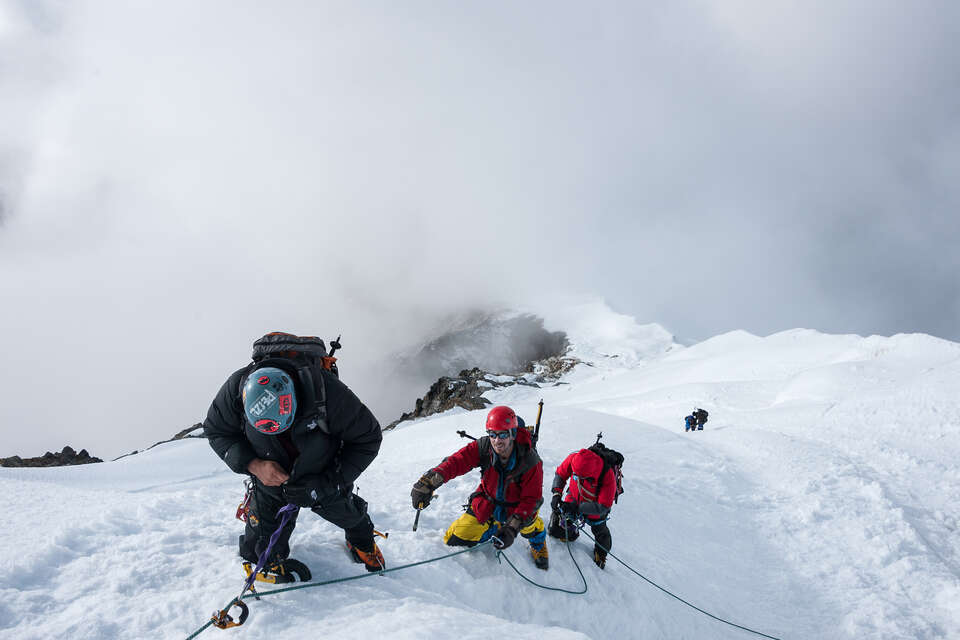
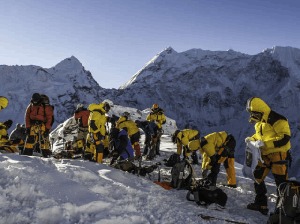
Climbers heading for the summit of Lobuche East.
What is Lobuche East, and why do climbers choose it?
Lobuche East lies in the Khumbu region of Sagarmatha National Park, above the village of Lobuche and close to the Khumbu Glacier. Its height is 6,119 m (about 20,075 ft). It was first climbed on 25 April 1984 by Laurence Nielson and Ang Gyalzen Sherpa.
Climbers pick it for four reasons:
- 🏔️ Location. The approach is the classic Everest trail, so you see Namche, the Dudh Kosi valley and Khumbu villages on the way.
- ⛰ Altitude on a manageable scale. It is above 6,000 m but, with a guide, within reach of a fit trekker.
- 🧗 A genuine climb. You use harness, crampons and ice axe, which a trek never asks of you.
- 📷 Scenery. The summit looks across the high peaks of the Everest region.
Lobuche East vs Lobuche West: what is the difference?
Lobuche is two mountains, not one. They share a name and a valley but not much else.
| ⛰️ Feature | Lobuche East | Lobuche West |
|---|---|---|
| Height | 6,119 m | Higher than the East peak; published figures differ slightly |
| Category | Trekking peak | Separate peak with its own permit rules |
| Typical use | Climbed by most guided groups | Rarely climbed |
| First ascent | 1984, Nielson and Ang Gyalzen Sherpa | 1955, via the South Shoulder (climbers not named) |
| Link between them | A long, deeply notched ridge makes it impractical to go from one to the other | |
Operators sometimes swap the names, so confirm that your itinerary says Lobuche East. Technical routes on the faces of both peaks exist, but they are expedition-level climbs for experienced alpinists and are not what a guided Lobuche East trip involves. Permit groups differ, so confirm which peak your permit covers.
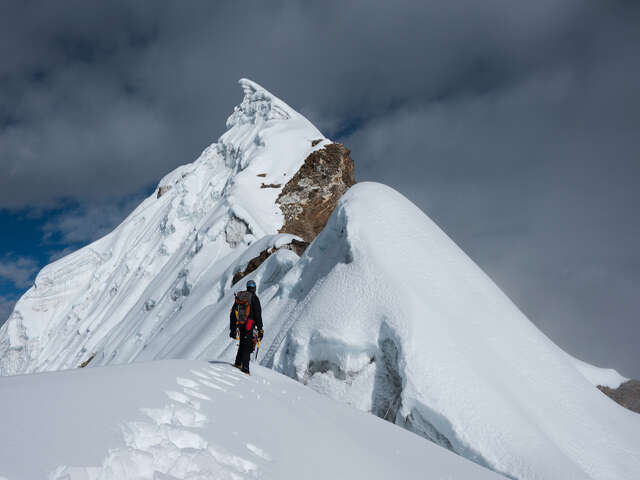
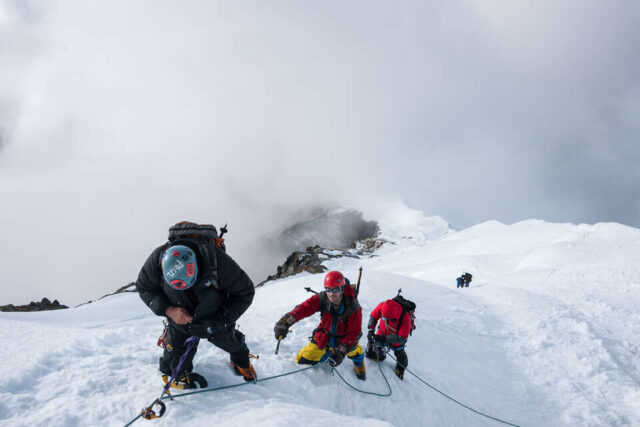
The upper ridge is where rope, crampons and ice axe come into play.
How do you get there?
Everything starts in Kathmandu. From there you fly to Lukla, the gateway to the Everest region. Because of airport works, many Lukla flights currently leave from Ramechhap, a drive of about 4 hours 30 minutes from Kathmandu, and the flight itself is about 15 minutes. Our page describes this, so check on the day which airport your flight uses.
From Lukla the trail follows the Dudh Kosi valley: Phakding, Namche Bazaar, then onwards via Tengboche or Phortse, Dingboche and finally Lobuche village. Our itinerary takes the Phortse side, which is quieter. The Lobuche East base camp lies a short walk from Lobuche, near the foot of the mountain.
How is the climb structured?
A guided Lobuche East trip has four phases:
- Approach (Days 3-10). You walk up the Everest trail, with rest days built in at Namche Bazaar and Dingboche. Our plan then continues to Everest Base Camp, so you also gain extra altitude exposure.
- Base camp and training (Days 11-12). You move to Lobuche base camp, check equipment and practise rope and crampon skills.
- Summit attempt (Day 13). You leave at 2 am and return to base camp about 10 hours later, according to our itinerary. Some operators use a high camp to split the climb into two days. That reduces the length of the summit push but means a night on the mountain, so ask how your operator plans it.
- Descent (Days 14-18). You retrace the valley to Lukla and fly out, with buffer days for weather.
What is the summit climb actually like?
This section is general information, not technical instruction. Your guide teaches the real skills on the mountain.
- ⏰ Start in the dark. An early start gets you onto snow while it is firm and leaves time to descend before the day warms.
- 🪨 Rock and scree first. The lower section is a steep scramble. You need good boots and careful footing, because rockfall is a risk when climbers are above you.
- 🧗 Snow and ice higher up. Crampons and ice axe come on where the slope turns to snow or ice. Fixed ropes, usually fitted by the guides, protect the steeper sections. You clip in with a harness and an ascender (often called a jumar), and descend by abseiling or by a controlled walk down, depending on the section.
- 🚩 A false summit. Many climbers who turn back do so near here, a few hours short of the top. Cold, wind and fatigue decide most outcomes, not technical difficulty.
- ⚠️ Exposure on the ridge. The summit ridge is narrow in places. You move slowly, in a team and in step with your guide.
- 🌅 Coming down is half the day. Many accidents happen on the descent, when tired climbers lose focus. Your guide sets the pace.
A professional guide is not optional here. They read the weather, decide when to turn back, fix ropes and manage the group. Our package includes a licensed climbing guide for every two climbers, and our page advises hiring one even for simple routes.
How hard is Lobuche East?
It is officially a trekking peak, but it is generally described as harder than Island Peak: a longer summit day and steeper snow and ice. Our page gives no formal grade, so ask us about the current conditions before you book.
The demands, in order of importance:
- 💪 Fitness. You should be able to walk for 6 to 8 hours on consecutive days with a pack. Build up with hill walking, stair work, cycling or running for at least 8 to 12 weeks beforehand.
- 🧗 Technical skill. None required, though some mountain or high-altitude trekking experience helps. The training day on Day 12 covers the basics.
- ⛰ Altitude tolerance. This matters most. If you have never been above 4,000 m, consider a high trek first.
- 🧠 Mindset. Cold starts, thin air and a long day. Calm persistence beats raw strength.
The minimum age for the climbing permit is 17.
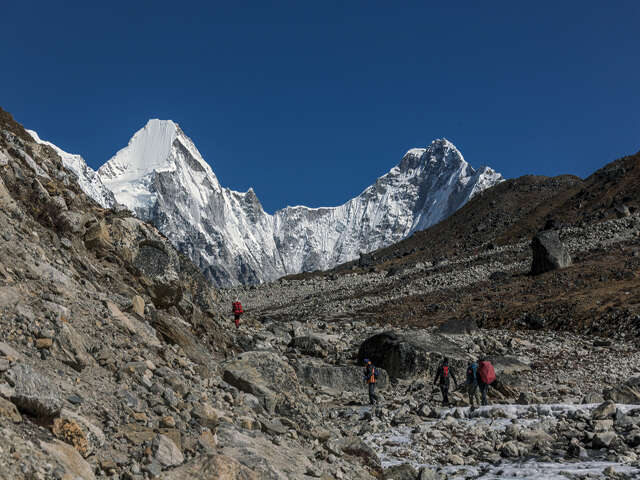
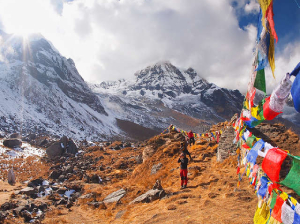
The trail between Lobuche and Gorakshep, on the way to Everest Base Camp.
What does the 18-day itinerary look like?
Here is our plan, with altitudes as stated on the package page.

| 📅 Days | Where | Notes |
|---|---|---|
| 1-2 | Kathmandu (1,350 m) | Arrival, gear check and rental |
| 3 | Lukla to Phakding (2,652 m) | 8 km, 3-4 hours |
| 4-5 | Namche Bazaar (3,440 m) | Rest and acclimatisation day on Day 5, with an optional 2-hour hike to Everest View Point |
| 6 | Phortse (3,700 m) | About 6 hours |
| 7-8 | Dingboche (4,400 m) | Second rest day on Day 8 |
| 9 | Lobuche (4,900 m) | 6-7 hours |
| 10 | Gorakshep (5,180 m) and Everest Base Camp (5,364 m) | 6-8 hours round trip |
| 11-12 | Lobuche base camp | About 5 hours to get there; Day 12 is climbing training |
| 13 | Lobuche East summit (6,119 m) | 2 am start, about 10 hours |
| 14-16 | Dingboche, Namche, Lukla | Descent by the same valley |
| 17-18 | Flight to Kathmandu, departure | Keep one or two spare days for weather |
The summit sits about 750 m above Everest Base Camp, so Day 13 is the largest altitude jump of the trip. The gradual build before it is what makes it realistic.

What can you add to the trip?
Add-ons fall into two groups. Trekking extensions are walks and viewpoints that need no climbing skills. Separate climbing objectives need their own planning, gear and acclimatisation. Do not mix them up.
| ➕ Option | Type | Height (approx.) | Added time | Fit with Lobuche East |
|---|---|---|---|---|
| Everest Base Camp | Trekking | 5,364 m | Already in our plan (Day 10) | Excellent |
| Kala Patthar | Trekking viewpoint | About 5,545 m; sources vary | Early start from Gorakshep, 1.5-2 hours up | Very good, on the same side |
| Chhukung valley | Trekking | Village at about 4,700 m | 1-2 days | Good, a side trip from Dingboche |
| Gokyo Lakes and Gokyo Ri | Trekking | Lakes about 4,700-5,000 m | 4-6 days | Possible, but a different valley |
| Island Peak | Separate technical climb | About 6,165 m; sources vary | 5-7 days | Doable only with extra planning |
Everest Base Camp and Kala Patthar are a natural fit. Everest Base Camp is already part of our itinerary. Kala Patthar is a steep ridge above Gorakshep with the closest accessible view of Everest, Nuptse and Changtse. The climb takes 1.5 to 2 hours. Published heights differ, from about 5,545 m to over 5,600 m, because the ridge has several minor tops.
Chhukung sits in the Imja valley above Dingboche. It is the usual base for Island Peak and a good acclimatisation side trip. It adds about a day and gives a view of the Lhotse and Ama Dablam region.
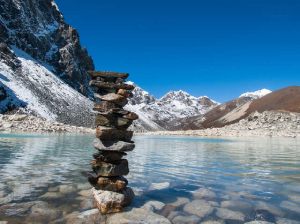
Gokyo Lakes and Gokyo Ri are a separate valley west of the main trail. The Gokyo lakes are a Ramsar-listed wetland of about 19 lakes between roughly 4,710 and 4,950 m, fed by the Ngozumpa Glacier. Adding Gokyo means several more days and a different return route, so most climbers do it as a separate trek. See our Everest Base Camp and Gokyo Lakes trek.
Island Peak (Imja Tse) is a second technical objective. Its height is quoted as 6,165 m in some sources and about 6,189 m in others. It involves a glacier approach, a steep headwall and fixed ropes, and its crevasse conditions change by season. Combining it with Lobuche East is a plan for experienced, well-acclimatised climbers, and it adds several days, a second permit and a second summit day. Talk to us before you plan it, as we do not offer it as a standard add-on on this page.
Which combination suits you?
| 👤 Who you are | Suggested plan |
|---|---|
| First-timer at altitude | Our 18-day plan as written, or do the Everest Base Camp trek first and climb a year later |
| Experienced trekker | The 18-day plan plus Kala Patthar at dawn from Gorakshep |
| Photographer | The 18-day plan, an extra buffer day or two, and Kala Patthar at sunrise or sunset |
| Experienced mountaineer | Lobuche East, then Island Peak if the schedule and your acclimatisation allow |
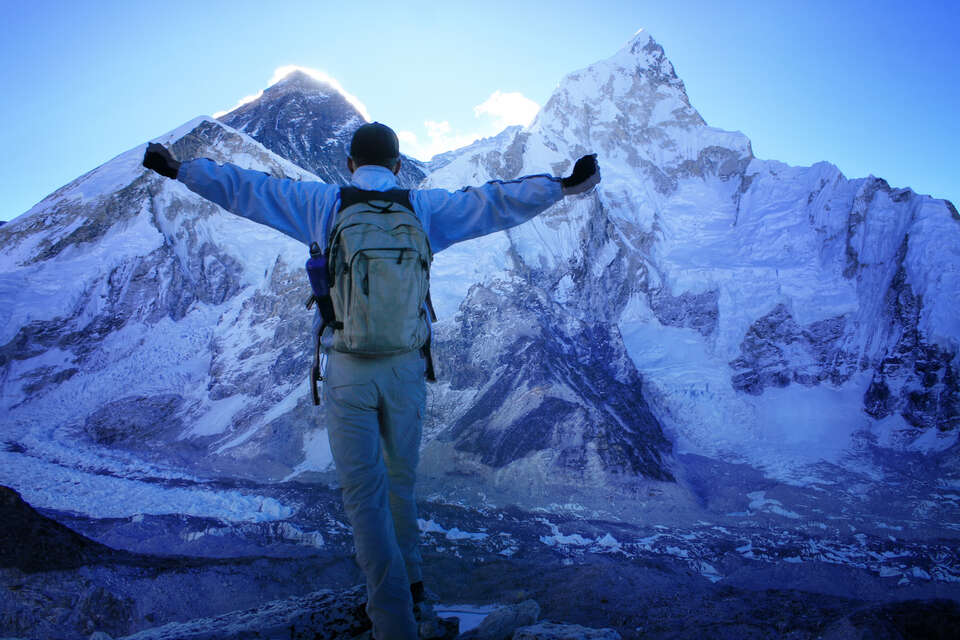
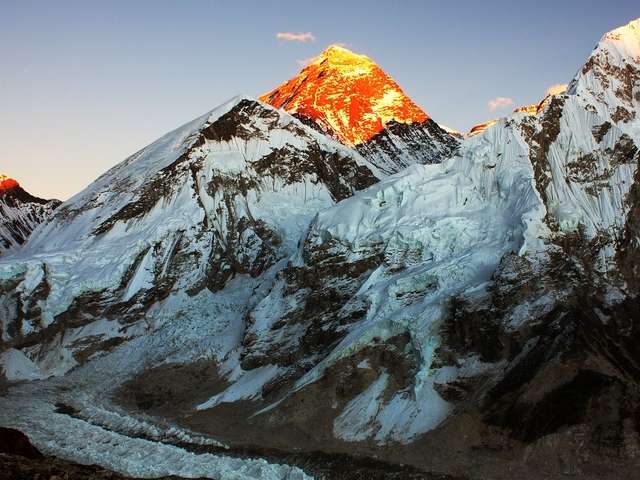
Everest and Nuptse at first light from Kala Patthar.
When is the best time to climb Lobuche East?
Spring (April and May) and autumn (October and November) are the main seasons for Lobuche East climbing.
| 🌤️ | Autumn (Oct-Nov) | Spring (Apr-May) |
|---|---|---|
| Weather | Stable, dry, crisp | Warmer, with more afternoon cloud as May goes on |
| Visibility | Typically very clear after the monsoon | Good, with some haze at lower levels |
| Cold | Cold at night, and colder later in November | Milder, though summit day is still very cold |
| Crowds | Busier, so book early | Busy, with expedition traffic on Everest |
| Snow and ice | Often hard-packed, with less fresh snow | More snow cover early in the season |
These are general patterns, not guarantees. Conditions vary year by year. Our current fixed departures, each 18 days with a guaranteed start, are 23 October to 9 November, 30 October to 16 November, 6 to 23 November, 13 to 30 November and 20 November to 7 December 2026. Later dates are colder, so pack accordingly. More dates are on the package page.
What gear do you need?
Our package includes boots, harness and helmet. Items such as ice axe, crampons and the clothing below are listed on our page as things to bring or confirm in the rental:
| 🎒 Group | Items |
|---|---|
| Technical | Ice axe, crampons, screw-gate carabiner, descender, prusik loops, ascender (ask what is included), mountaineering boots |
| Warmth | Down jacket, fleece, thermal layers, waterproof jacket and trousers, gloves, balaclava or warm hat |
| Head and eyes | Sunglasses, sun hat, headlamp with spare batteries |
| Feet | Liner socks, thick wool socks, sturdy trekking boots for the approach |
| Sleeping and carry | Sleeping bag rated to 0°C (warmer for late-November dates), duffel bag, water bottle or bladder |
| Personal | Toiletries, sun cream, lip balm, medicines, trekking poles (optional) |
Permits, guides, accommodation and cost
The package price is Rs 180,000 per person with two sharing. It covers airport transfers, flights to and from Lukla, a licensed guide, porters, three nights in Kathmandu with breakfast, climbing gear, all applicable permits and fees, a farewell dinner and a trip certificate. Teahouses on the trail and a tented base camp serve as accommodation, with meals prepared by the team at base camp.
| 💰 Item | Cost |
|---|---|
| Package price (two sharing) | Rs 180,000 per person |
| Personal costs: visa, rentals, showers, Wi-Fi, charging, snacks and tips | About INR 20,000-25,000, our estimate |
| Extra day on the mountain | INR 6,000 per day, with lodging and three meals |
| Solo traveller on a departure | INR 1,500 per day porter fee, waived if others join |
| Travel insurance with rescue cover | Required, you arrange it |
Permit. Climbing permits for Nepal’s trekking peaks are issued by the Nepal Mountaineering Association (NMA), and the fee depends on the peak and the season. Your package price already includes the climbing permit, the Everest region entry permits and all applicable fees, so you do not pay them separately. We confirm the current NMA fee when you book. Indian citizens may pay different rates, so contact us for the documents and fees that apply.
Safety and acclimatisation
- ⛰ Go up slowly. Rest days at Namche and Dingboche are not optional. Do not skip them to save time.
- 🩺 Know the warning signs. Persistent headache, nausea, dizziness, unusual tiredness and poor sleep can be early signs of altitude sickness. Tell your guide at once.
- ⬇️ Descend if you get worse. Going down is the cure. Confusion, loss of balance or breathlessness at rest are emergencies.
- 🌧️ Accept a turnaround. Wind, cold, new snow or slow progress can end an attempt. The guide’s call is final.
- 📋 Insure properly. Your policy must cover climbing to at least 6,119 m and helicopter evacuation. Check the small print, because many standard trekking policies stop lower.
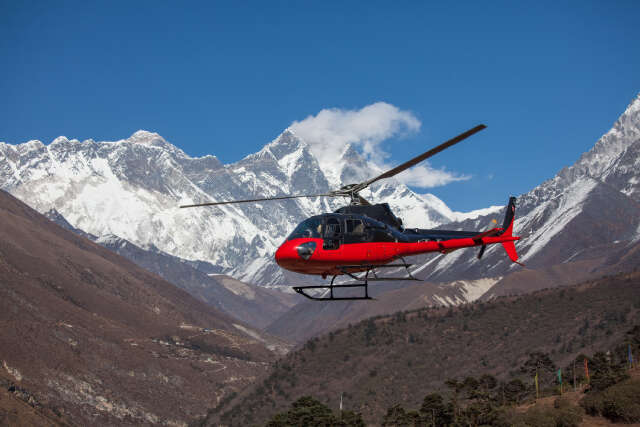
- 🚁 Know the helicopter cost. A helicopter from Lukla to Kathmandu costs US$600 or more (INR 65,000 or more) per person and rises with demand. It is optional and not part of the package.
Lukla flights can be held by cloud for a day or more, so keep one or two spare days. Extra Kathmandu nights and meals caused by delays are not included. See our posts on extra hotel nights in Kathmandu and flying to Lukla.
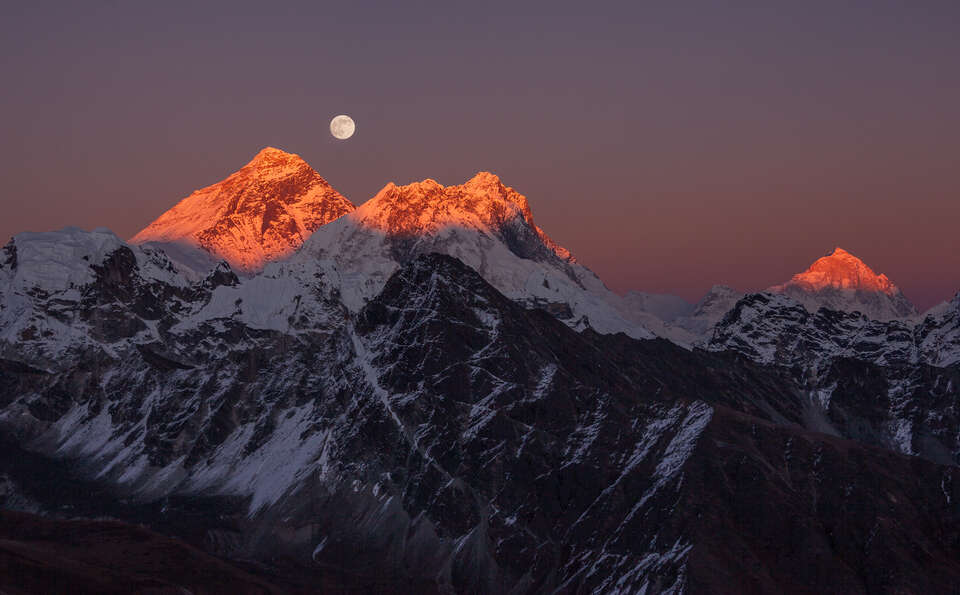
Everest and Makalu at sunset, seen from the Khumbu.
Sherpa culture and responsible trekking
The Khumbu is the homeland of the Sherpa people, and many of your guides and porters come from these valleys. Small things show respect.
- 🙏 Walk clockwise around mani walls, chortens and prayer wheels, keeping them on your right.
- 🏛️ Behave quietly at monasteries, such as Tengboche if your route passes it. Ask before taking photos inside.
- ♻️ Carry out your rubbish. Sagarmatha National Park is a protected area, so leave no litter and use refillable bottles or treatment tablets rather than plastic bottles where you can.
- 🤝 Look after your crew. Treat porters and guides as partners. Fair pay and tipping matter, and so do proper clothing and shelter for the team.
- 💰 Spend locally. Eat and sleep in family-run lodges.
Plan your Lobuche East climb with Base Camp Hikes
Ready to book, or just want to check your fitness and dates? See the 18-day Lobuche Peak climbing package, then send an enquiry, WhatsApp us or call +91 932 595 1234 (9am-7pm IST). For a warm-up first, read our Everest Base Camp trek guide or look at the 14-day Everest Base Camp trek. Free advice, reply within 24 hours.
FAQ
How high is Lobuche East? 6,119 m (about 20,075 ft), in the Khumbu region of Nepal. Lobuche West is a separate, higher peak that is rarely climbed.
Is Lobuche East a good first 6,000 m peak? It can be, for a fit trekker with a guide, though it is generally considered harder than Island Peak. Our itinerary includes a training day before the summit attempt.
How difficult is Lobuche East Peak? Physically demanding rather than technically extreme. Expect a long summit day, cold, thin air and steep snow and ice near the top. We give no formal grade, so ask us for the latest conditions.
Do I need climbing experience? No prior experience is required, but you should be fit and comfortable at altitude. Our guides teach rope, crampon and ice-axe basics at base camp.
How long does the Lobuche Peak climbing itinerary take? Our plan is 18 days, with the summit attempt on Day 13. Keep one or two spare days for flight delays.
How long is summit day? About 10 hours from base camp and back, starting around 2 am.
What is the best time to climb Lobuche East? April and May, and October and November.
How much does Lobuche Peak climbing cost? Our package is Rs 180,000 per person with two sharing, including the climbing permit, guide, porters and climbing gear. Budget about INR 20,000-25,000 for personal costs, our estimate.
Is the climbing permit included? Yes, the NMA climbing permit and other applicable fees are part of the package price.
Can I climb Lobuche East without a guide? Our page advises against it, even on simple routes. The permit is arranged through us, and climbing without one is illegal.
Can I combine Lobuche East with Island Peak? Experienced climbers sometimes do, but Island Peak is a separate technical objective that needs extra days, its own permit and good acclimatisation. Ask us before planning it.
Can I combine it with Everest Base Camp and Kala Patthar? Yes. Everest Base Camp is part of our itinerary, and Kala Patthar can be added with an early start from Gorakshep.
Is travel insurance required? Yes. It must include climbing and helicopter rescue, and you send us proof before arrival.
Can Indian citizens climb Lobuche East? Yes. Contact us for the documents and fees that apply.
Conclusion: which itinerary is right for you?
Lobuche East rewards fitness, patience and respect for altitude. If you are new to high mountains, choose our 18-day plan as written: it gives you a full trek, two rest days and a training day before the summit. If you are an experienced trekker, add Kala Patthar. If you are a photographer, add buffer days for light and weather. If you are an experienced mountaineer with time to spare, consider Island Peak as a second objective, planned carefully. Whichever you choose, go with a licensed guide, insure properly and treat the summit as a bonus, not a promise.
Sources
- Base Camp Hikes: Lobuche Peak climbing, 18 days
- Nepal Mountaineering Association (permit authority)
Information correct as of 16 October 2026.