 By
Altitude sickness is the main medical risk on the Everest Base Camp trek, and fitness does not protect against it. This guide explains what happens to the body, which symptoms are normal and which are warnings, how the 14-day schedule manages the climb, and what to do if you feel unwell, using guidance from the Nepal Tourism Board (NTB) and the US Centers for Disease Control and Prevention (CDC).
The short answer
- Cause: thinner air at height, so each breath carries less oxygen. Fitness does not change the risk.
- Warning sign: a headache plus loss of appetite, nausea, dizziness or unusual tiredness.
- Golden rule: never go up to sleep higher while you have symptoms.
- Emergency signs: confusion, staggering, breathlessness at rest or a wet cough. Descend at once.
- Where it starts: NTB treats feeling unwell above 2,500 m as possible altitude sickness until proven otherwise.
Last checked: 26 October 2026. This guide is general information and not medical advice. Talk to your doctor before the trek, especially about medicines.

Higher air is thinner, and the schedule is built around that.
In this guide: What altitude does | The schedule | Normal vs warning | AMS, HACE, HAPE | Safety rules | Oximeter | Medicines | Where to get help | FAQ
What altitude does to the body
The share of oxygen in air stays about the same, but the air itself is thinner at height. The CDC notes that at about 3,050 m, the oxygen pressure you breathe in is about 69% of the sea-level figure, and blood oxygen can fall to 88 to 91% on arrival. The body adjusts by breathing faster, and full adjustment takes about 3 to 5 days. Illness comes when you climb faster than the body can adapt.
Risk does not depend on strength. The CDC states that training and fitness do not change the risk, that children are as susceptible as adults, and that people with a past history of altitude illness and those who sleep high on the first day are at higher risk. Genes play a part, and there is no simple screening test.
How the 14-day schedule manages the climb
| Night | Sleeping altitude | Change from previous night | What it means |
|---|---|---|---|
| Day 2 Phakding | 2,652 m / 8,701 ft | from Lukla 2,800 m: -148 m | First night above 2,500 m. Easy. |
| Day 3 Namche Bazaar | 3,440 m / 11,286 ft | +788 m | Largest step of the trek, followed by a rest day. |
| Day 4 Namche Bazaar (rest) | 3,440 m / 11,286 ft | 0 m | Rest day. A two-hour walk up and back down helps. |
| Day 5 Deboche | 3,700 m / 12,139 ft | +260 m | Gentle step. |
| Day 6 Dingboche | 4,400 m / 14,436 ft | +700 m | Second large step, followed by a rest day. |
| Day 7 Dingboche (rest) | 4,400 m / 14,436 ft | 0 m | Rest day. Walk high, sleep low. |
| Day 8 Lobuche | 4,900 m / 16,076 ft | +500 m | At the 500 m limit, and cold at night. |
| Day 9 Gorak Shep | 5,180 m / 16,995 ft | +280 m | Highest sleep. Symptoms often show up here. |
| Day 10 Pheriche | 4,320 m / 14,173 ft | -860 m | Descent, where recovery usually begins. |
NTB advises that above 2,500 m, sleeping altitude should rise by no more than 300 to 500 m a day from the previous night, with a rest day after every 1,000 m gained. The CDC gives a similar rule: above 3,000 m, add no more than 500 m of sleeping altitude a day, and add an extra day for every further 1,000 m. Most nights above are within range. The two larger steps, to Namche Bazaar and Dingboche, are each followed by a rest day. The acclimatisation guide explains the reasoning, and the full itinerary shows each day.
The rest days are active. Walking higher in the day and returning to sleep lower, the “climb high, sleep low” method, adds exposure without raising the sleeping altitude.
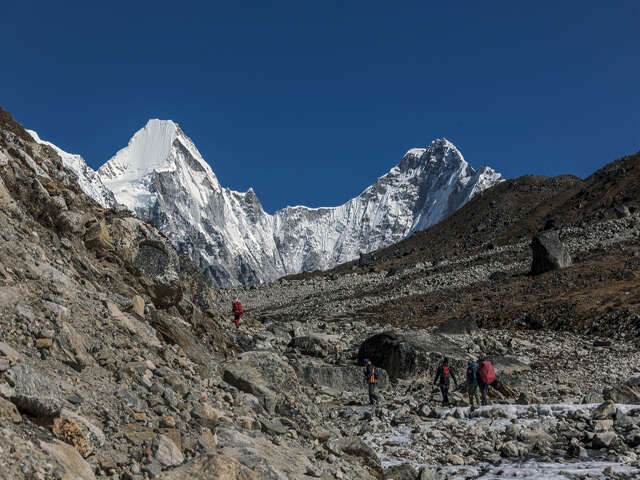
Gorak Shep, at 5,180 m, is the highest night on the trek.
Normal at altitude, or a warning?
| Group | What you notice | What to do |
|---|---|---|
| Usually normal | Faster breathing on effort, needing to pass urine more often, light or broken sleep, and breathing that seems to pause at night | Keep walking at an easy pace and keep drinking |
| Early altitude sickness (AMS) | Headache with at least one of: poor appetite, nausea, dizziness, unusual tiredness | Tell your guide. Do not go higher. Rest and drink. Go higher only when symptoms have fully gone |
| Getting worse | Symptoms grow despite rest, or vomiting starts | Descend with a companion, and do not go back up until symptoms have gone |
| Emergency | Severe headache, staggering, confusion or drowsiness, breathlessness at rest, a wet or bloody cough | Descend immediately and arrange evacuation |
NTB sums it up as: if you are unwell above 2,500 m, it may be altitude sickness until proven otherwise. A headache on its own is not enough to say AMS, but a headache with any other symptom is, and the symptoms resemble a hangover. The CDC says symptoms usually begin 2 to 12 hours after arriving or climbing, and settle within 12 to 48 hours if you do not go higher. Symptoms that start after three days with no further climb are unlikely to be AMS, so tell your guide anyway.
AMS, HACE and HAPE
| Illness | What it is | Signs | Action |
|---|---|---|---|
| AMS, acute mountain sickness | The common, mild form | Headache plus loss of appetite, nausea, dizziness or tiredness | Stop climbing, rest and drink, descend if worse |
| HACE, high-altitude cerebral edema | Swelling of the brain, a medical emergency | Confusion, drowsiness, staggering that resembles drunkenness | Descend at once, with oxygen and medicine if available |
| HAPE, high-altitude pulmonary edema | Fluid in the lungs, a medical emergency | Cough, chest congestion, breathless at rest, sometimes a bloody cough | Descend urgently, and evacuate in most cases |
Emergency: the CDC says coma can follow HACE within 24 hours, and that descent and oxygen work much better than medicine. Do not wait for morning, and do not let a person with confusion or severe breathlessness walk down alone.
Six rules that keep trekkers safe
- Tell your guide the moment you feel off. Hiding symptoms puts you and the group at risk.
- Never go up to sleep with symptoms. This is the CDC’s core rule, even for minor symptoms.
- Descend if symptoms worsen. NTB’s advice for severe signs is to descend immediately.
- Keep to the schedule. Do not skip the rest days at Namche Bazaar and Dingboche to save time.
- Drink plenty of clean water. NTB lists this among its prevention rules.
- Go easy on the first 48 hours at altitude. The CDC suggests mild activity only, and no alcohol.
Pulse oximeters
A pulse oximeter clips onto a finger and shows blood oxygen and heart rate. The CDC says a reading in AMS is usually normal for the altitude or a little lower, and that a relatively high reading for the altitude is protective. In HAPE, readings often fall at least 10 points below those of healthy people at the same height. Guides check trekkers each day, but a number alone never decides anything, and symptoms and behaviour matter more. Fast breathing can hold readings up in a person who is unwell.
Medicines
NTB lists acetazolamide (Diamox) as an option for early AMS, at 250 mg twice a day. The CDC describes the same drug for prevention at 125 mg twice a day, starting the day before the climb and continuing for the first two days at altitude, and says it can be taken for symptoms too. It is not a replacement for acclimatisation, and it can make fizzy drinks taste flat. Dexamethasone and nifedipine are prescription medicines used in emergencies for HACE and HAPE, and they support descent without replacing it. The CDC says ibuprofen may help prevent AMS but less effectively than acetazolamide. Painkillers can hide symptoms, so tell your guide if you take them. Ask your doctor before travel about what to carry and what suits you, and do not rely on advice from other trekkers.
Alcohol, coffee and water
The CDC advises avoiding alcohol for the first 48 hours at altitude, and avoiding alcohol and opiate sleep aids altogether, since they slow breathing at night. People who drink coffee daily should keep their usual amount, because stopping causes a headache that can be mistaken for altitude headache. Drink clean water throughout the day.

A slow, steady pace is the best protection at altitude.
Where to get help on the trail
The Himalayan Rescue Association (HRA), a non-profit founded in 1973, runs aid posts staffed by volunteer doctors in the spring and autumn seasons. NTB lists the Everest route post at Pheriche, at 4,250 m, and an emergency clinic at Everest Base Camp, at about 5,350 m, open since 2003. The Pheriche post gives a talk on altitude sickness at 3 pm in the season, and the HRA office in Kathmandu also holds talks. The HRA office phone numbers, as given by NTB, are +977 1 4440292 and +977 1 4440293. The Tourist Police number is 1144.
Insurance must cover trekking at altitude and helicopter evacuation. Read the insurance and evacuation guide, and the altitude sickness guide for the team’s own practice.
Altitude is the main difference between these treks and Africa’s highest mountain. Our Everest and Kilimanjaro comparison shows how the two differ.
FAQ
What is altitude sickness? It is illness caused by climbing too fast for the body to adapt to thinner air. The mild form is called acute mountain sickness, or AMS.
At what height does it start? NTB says to treat feeling unwell above 2,500 m as possible AMS until proven otherwise. The CDC says unacclimatised people sleeping at 2,450 m or higher are at risk.
What are the first symptoms? Headache, loss of appetite, nausea, unusual tiredness and dizziness.
Can fit people get it? Yes. The CDC says fitness and training do not change the risk.
Do children and older people get it? Children are as susceptible as adults, and the CDC says people over 50 have slightly lower risk.
Where is it most likely on the trek? At and after Dingboche and Lobuche, and most often at Gorak Shep, the highest night at 5,180 m.
Should I take Diamox? That is a decision for you and your doctor. NTB lists it as an option, and the CDC describes its use for prevention and treatment.
Can I keep walking with a mild headache? Not higher. Rest, drink and tell your guide. Go up again only when all symptoms are gone.
What if my symptoms get worse? Descend with a companion. For confusion, staggering or breathlessness at rest, descend immediately and arrange evacuation.
Is a pulse oximeter enough? No. It helps, but symptoms matter more than a number.
Can I drink alcohol on the trek? The CDC advises avoiding it for the first 48 hours at altitude, and notes that it slows breathing at night.
Where is medical help? HRA aid posts operate at Pheriche in the season, and there is an emergency clinic at Base Camp.
Do the rest days matter? Yes. They are the main protection, so do not skip them.
What about insurance? It must cover high-altitude trekking and helicopter evacuation.
Trek with the team
The 14-day Everest Base Camp trek builds in rest days at Namche Bazaar and Dingboche, and guides check trekkers daily. For questions, message the team on WhatsApp or phone at +91 932 595 1234 (9 am to 7 pm IST), write to info@basecamphikes.com, or use the enquiry form.
Sources
- Nepal Tourism Board: safety in the mountains
- US Centers for Disease Control and Prevention: CDC Yellow Book, high-altitude travel and altitude illness
- Nepal Tourism Board: tourist police