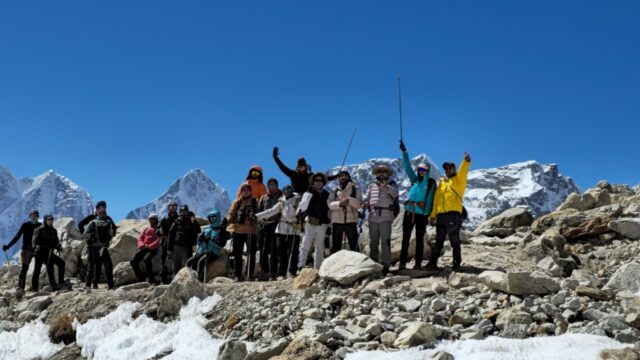
 By
The best photos on the Everest Base Camp trek come from 15 places, and most of them fall in one order along the trail: the suspension bridges before Namche, the Ama Dablam viewpoint, Tengboche Monastery, Base Camp and Kala Patthar at golden hour. This guide lists each spot with what to shoot, when the light is best and one practical tip, plus the rules for drones, photographing monks and keeping batteries alive in the cold.
Photographer’s cheat sheet
- Best light: sunrise and the last hour before sunset. Kala Patthar (5,545 m) works at either end of the day.
- Best seasons: October to November and March to May for dependable views. Winter skies are clear but very cold.
- Drones: inside Sagarmatha National Park you need park permission, obtained in several steps. Do not fly without it.
- Monasteries: ask before photographing people or interiors.
- Gear: spare batteries kept warm, a power bank, a small tripod and a lens cloth.
Last checked: 28 October 2026. Altitudes are approximate. Light, snow and festival dates change every year.
In this guide: 15 photo spots | Spots at a glance | Camera tips | FAQ
The 15 spots at a glance
| # | Spot | Where | Best light | Shot to take |
|---|---|---|---|---|
| 1 | Suspension bridges | Dudh Kosi, before Namche | Morning | Prayer flags with the river far below |
| 2 | Namche Bazaar | About 3,440 m | Dusk and night | Town lights in the amphitheatre |
| 3 | Everest View Hotel | Above Namche | Early morning | First view of Everest and Ama Dablam |
| 4 | Ama Dablam viewpoint | Beyond Namche | Morning | Stupa with Ama Dablam behind |
| 5 | Tengboche Monastery | Tengboche | Morning | Courtyard and mountain backdrop |
| 6 | Mani Rimdu festival | Tengboche, autumn | Daytime | Mask dances and chanting monks |
| 7 | Climbers’ memorial | Near Dughla | Anytime | Memorial stupas and flags |
| 8 | Everest Base Camp | 5,364 m | Midday, spring tents | The marker rock and tent city |
| 9 | Kala Patthar | 5,545 m | Sunrise or sunset | Everest and Nuptse in golden light |
| 10 | Yaks | On the trail | Anytime | Decorated yaks on the bridges |
| 11 | Milky Way | Any high village | New-moon nights | Stars over the peaks |
| 12 | Gokyo Ri | About 5,357 m | Sunrise | Everest above the lakes |
| 13 | Gokyo Lakes | Gokyo valley | Morning | Turquoise water and glacier |
| 14 | Cho La | About 5,420 m | Morning | Ama Dablam from the pass |
| 15 | Helicopters | Khumbu valleys | Anytime | A helicopter against huge peaks |
15 must-click spots on the Everest Base Camp trail
1. The suspension bridges

A suspension bridge on the way to Namche.
In the first days you cross the Dudh Kosi several times on long steel bridges hung with prayer flags. The last and highest crossing is the Hillary Bridge, just before the climb to Namche. Stand back from the middle, use a medium zoom and wait for a gap in traffic. Yak trains and porters cross these bridges all day, so keep right and let animals pass before you lift the camera.
2. Namche Bazaar

The view down over Namche from the slopes above.
Namche is the Khumbu’s main trading town, and it photographs best from above. Walk up the slopes behind the town at dusk, when the lamps come on, and you get a bowl of lights below you. After dark, the same spot gives you stars over the ridge if the sky is clear. Acclimatisation days are the right time for this, and the four day hikes from Namche show where to go.
3. Everest View Hotel

The Everest View Hotel above Namche.
The hotel sits on a ridge above Namche at roughly 3,880 m, and its terrace looks straight at Everest, Lhotse and Ama Dablam. You do not need to stay the night: a morning walk up from Namche with a hot drink on the terrace gives you the first big mountain view of the trek. Go early, before the clouds build up the valley.
4. Ama Dablam and the stupa viewpoint

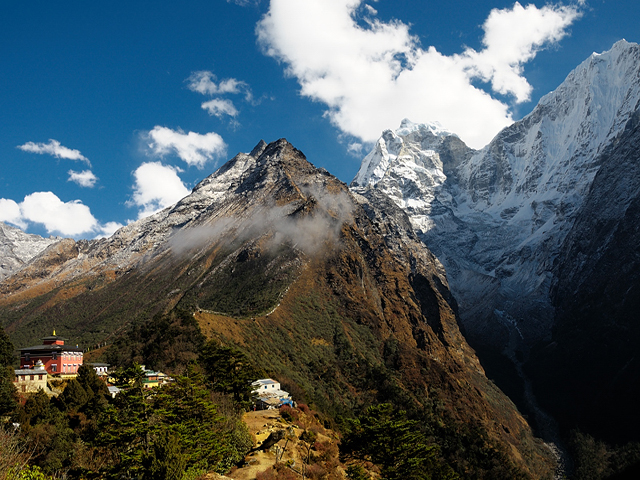
Ama Dablam from the viewpoint beyond Namche.
A few kilometres beyond Namche the trail levels out and Ama Dablam appears behind a white stupa. It is one of the best-known frames on the route and works with a normal lens: put the stupa low in the frame and let the peak fill the top half. Morning light is cleanest, and you will pass it again on the way down, so you get a second chance if clouds hide it.
5. Tengboche Monastery

Tengboche Monastery.
Tengboche is a Buddhist monastery on a ridge with a wide mountain view: Ama Dablam, Everest, Nuptse and Lhotse can all appear together on a clear day. Shoot the outside from the courtyard looking back at the front of the building, and ask a monk before photographing anyone or going inside. Prayer wheels, painted doors and butter lamps make good close-ups, but keep flash off during prayers.
6. The Mani Rimdu festival

The Mani Rimdu festival.
Mani Rimdu is the Sherpa festival held at Tengboche in autumn, with masked dances, long horns and chanting. Its dates follow the Tibetan lunar calendar, so they move each year; ask your operator whether your dates overlap. Arrive early for a spot at the edge of the courtyard, use a longer lens, and stay respectful. Read more in 7 must-see Nepalese festivals.
7. The climbers’ memorial

The memorial stupas near Dughla.
Above Dughla you reach a field of memorial stupas for climbers and Sherpas who died on the mountains. Prayer flags run through the cairns, which makes strong photographs, but it is also a place of grief for many families. Walk quietly, do not step on the stones and keep the shots simple. It is a good place to pause on the way to Lobuche.
8. Everest Base Camp

Everest Base Camp and its tent city.
Base Camp is at about 5,364 m, and the marker rock is where most trekkers take their victory photo. In spring the climbing teams put up a tent city on the glacier, which gives you colour and scale; outside the climbing season the ground can be bare. You cannot see the summit of Everest from here, so the Kala Patthar shot the next morning is the one that shows the mountain.
9. Kala Patthar

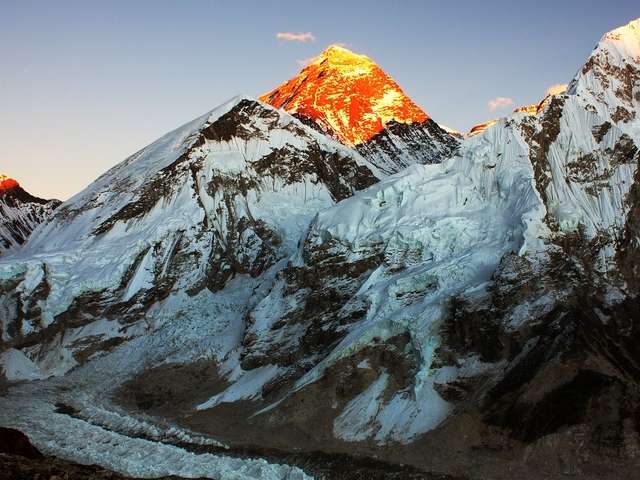
Kala Patthar at golden hour.
Kala Patthar (about 5,545 m) is the best viewpoint for Everest, with Nuptse, Pumori and the Khumbu Glacier in the frame. Sunrise gives soft pink light on the summit; sunset is a little warmer to stand in. Either way, carry a headlamp, wear all your layers and set up before the light arrives. Read the altitude sickness guide first, because this is the highest point of the trek.
10. The yaks

Yaks on the trail.
Yaks, or more often the yak-cow crosses used on the trail, carry supplies up the valley. Their bells ring before you see them. Step to the uphill side of the path, let them pass, then shoot from behind. Never stand on the outside edge of a narrow section while taking a photo, because loaded animals will not stop for you.
11. The Milky Way

A long-exposure night sky over the Himalaya.
With little light pollution, the Khumbu is one of the best places in Asia for night photos. Plan for new-moon nights, clear skies and a small tripod. Use the widest, fastest lens you have, a 15 to 25 second exposure and a high ISO. Temperatures drop well below freezing, so bring warm gloves with thin liners and keep a spare battery in an inner pocket.
12. Gokyo Ri

The view from Gokyo Ri.
Gokyo Ri (about 5,357 m) is a walk, not a climb, and it gives a wide view of Everest, Lhotse, Makalu and Cho Oyu above the lakes. It is on the Gokyo variant of the route. Start before dawn for the sunrise, and look at the Gokyo trek guide or Everest Base Camp vs Gokyo with Everest if you want to add it.
13. Gokyo Lakes

The Gokyo Lakes.
The Gokyo Lakes are a chain of blue-green glacial lakes below Gokyo Ri. Morning is best, when the water is calm and reflects the peaks. A polarising filter helps with glare, and a walk along the shore gives you new angles every few minutes.
14. Cho La

Cho La pass.
Cho La (about 5,420 m) connects the Everest Base Camp side with Gokyo and is part of a longer, harder route than the standard trek. Snow and ice on the pass make it a serious day, but the views of Ama Dablam and the glaciers reward the effort. See the Three Passes trek if you want to include it.
15. Bonus: helicopters

A helicopter in the Khumbu.
Helicopters carry supplies and passengers all along the valley, so keep the camera ready. A small helicopter against a huge peak shows the scale of the Himalaya better than a landscape alone. If you plan to fly back, read our helicopter return guide.
Camera tips for the Everest Base Camp trek
| Topic | What to do |
|---|---|
| Batteries | Keep spares in an inner pocket against your body. Cold drains them fast. Teahouses charge for electricity, so a power bank saves money. |
| Drones | Flying a drone in Sagarmatha National Park needs park permission, which comes after registration with the Civil Aviation Authority of Nepal and approval letters from the Department of National Parks and Wildlife Conservation and the district office in Salleri. Plan well ahead or leave it at home. |
| People and monks | Ask first. A smile and a gesture works; do not photograph people at prayer or inside a sacred room without permission. |
| Tripod | A small, light tripod is enough for night shots and low-light Kala Patthar. |
| Condensation | Seal your camera in a bag before entering a warm room, so lenses do not fog. |
| Back-up | Copy photos to a second card or phone each night. |
| Shot list | Write your list before the trek and mark which spots are on your route and which need a variant. |
For a month-by-month look at the light and sky, see the month-by-month guide to the best seasons, and for packing see the Everest Base Camp packing checklist. The full route is in the Everest Base Camp trek guide.
For more Everest on screen, see our list of Everest movies to watch.
FAQ
What are the best photo spots on the Everest Base Camp trek? The suspension bridges, Namche Bazaar, the Ama Dablam viewpoint, Tengboche Monastery, Everest Base Camp and Kala Patthar are the core list. Gokyo Ri, the Gokyo Lakes and Cho La are on the longer variants.
Where is the best view of Everest on the trek? Kala Patthar, at about 5,545 m, gives the clearest view of Everest. You cannot see the summit from Base Camp itself.
When is the best time to photograph the Everest region? October to November and March to May usually give the most dependable views. Winter skies are clear but very cold.
Can I fly a drone on the Everest Base Camp trek? Only with permission. Sagarmatha National Park requires you to register with the Civil Aviation Authority of Nepal, get approval letters from two offices and then park permission. Rules can change, so ask the park or your operator.
Is it okay to photograph monks and monasteries? Ask before photographing people or the interior of a monastery. Keep flash off during prayers.
What is the best time of day at Kala Patthar? Sunrise or sunset. Sunset is warmer to stand in, but the summit can be cloudy, so some trekkers try both.
How do I take Milky Way photos in the Himalaya? Use a tripod, a wide fast lens, 15 to 25 seconds, a high ISO and a new-moon night. Keep your batteries warm.
How do I keep camera batteries from dying in the cold? Keep them in an inner pocket and swap them in only when you shoot. Carry a power bank.
Can I charge my camera in teahouses? Yes, usually for a fee. A power bank is cheaper and more reliable.
When is the Mani Rimdu festival? It is held at Tengboche in autumn, and the dates follow the Tibetan lunar calendar. Ask your operator for this year’s dates.
Which spots need extra days? Gokyo Ri, the Gokyo Lakes and Cho La are on the longer routes: Everest Base Camp with Gokyo, Gokyo with Renjo La, or the Three Passes.
What lens should I bring? A 24 to 70 mm zoom covers most scenes; add a 70 to 200 mm for monks, festivals and distant peaks. A phone is fine for casual shots.
Plan your Everest Base Camp photo trek with Base Camp Hikes
See our Everest Base Camp trek and the Everest Base Camp with Gokyo Lakes route for the extra spots. For a quote, message the team on WhatsApp or phone at +91 932 595 1234 (9 am to 7 pm IST), write to info@basecamphikes.com, or use the enquiry form.