


 By
Teahouse trekking is the standard way to walk in the Nepal Himalaya. Each night is spent in a small village lodge that provides a bed and home-cooked meals, so there is no tent, stove or food to carry. This guide explains what a teahouse is actually like, what surprises first-time trekkers, and which treks have comfortable lodges and which are basic.
The short answer
- What it is: a family-run lodge in a mountain village with a twin room, a shared dining room and a kitchen.
- Everest and Annapurna: comfortable and well established, often with a hot shower, flush toilet and a long menu.
- Remote treks: Kanchenjunga, Makalu and Dolpo have basic lodges, set menus and a lot of camping.
- The four surprises: better lodges than expected, repetitive food, paid extras such as showers and charging, and thin walls.
- Carry: earplugs, a sleeping bag liner, a pillowcase, cash and a power bank.
Last checked: 26 October 2026. Prices and facilities vary by village and season, so treat the costs below as typical and confirm them on your trek.
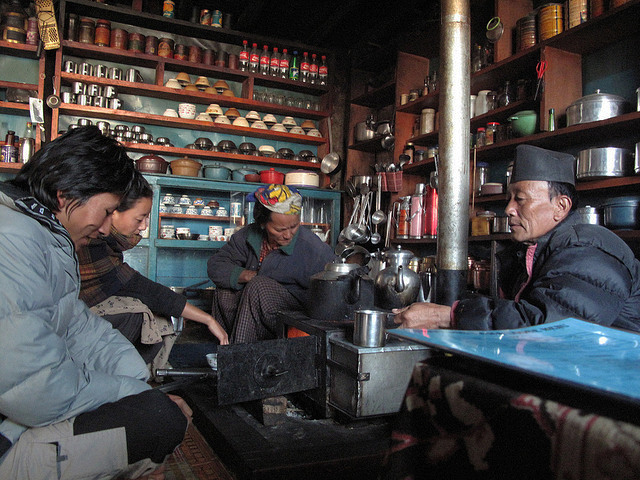
Breakfast around the stove in a Nepal teahouse.
In this guide: What a teahouse is | Four surprises | Basic teahouses | Teahouses by trek | What to pack | Etiquette | FAQ
What a teahouse is
A teahouse is a lodge run by a local family, usually in a village or at a junction on the trail. It has a dining room with a stove, a kitchen, and rooms upstairs or in a separate block. The name comes from the original service, a place to stop for tea. On popular routes the lodges are close enough together that a day’s walk ends at one, so a trekker only needs a daypack for the day and a duffel carried by a porter. NTB lists teahouse or lodge stays as the normal accommodation on the main trekking routes, and camping on the most remote ones.
Four things that surprise first-time trekkers
1. The lodges are better than expected
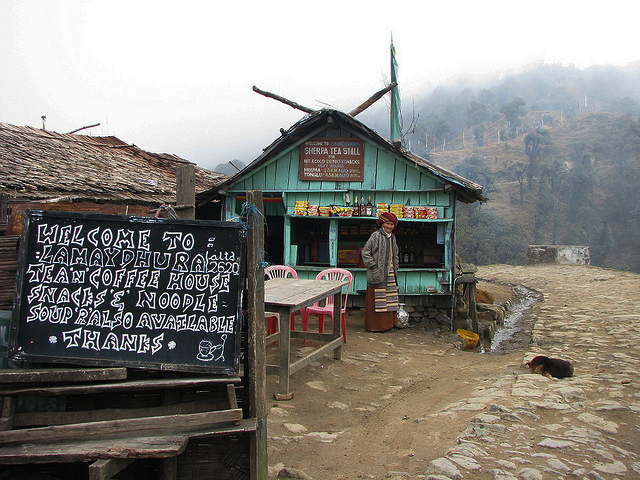
A teahouse on a Nepal trekking route.
On the busiest routes, competition and steady foot traffic have raised standards. Lodges in the Everest and Annapurna regions often have a heated dining room, a Western-style toilet, hot water and a wide drinks list that includes tea, coffee and sometimes beer. The dining room doubles as the social centre, where trekkers from different countries compare notes by the stove at the end of the day. The feel is closer to a family guesthouse than a hotel.
2. The food is hearty, but repetitive
Menus are long, with pasta, noodles, fried rice, eggs, pizza, soups, momos and pancakes, but many dishes share the same few ingredients, so after a week the variety feels smaller than the menu suggests. The reliable choice is dal bhat, rice with lentil soup and vegetable curry, which most lodges refill for free, so it suits a hungry walker and is cooked fresh. Some Everest lodges also add items for visitors, such as kimchi. Ordering the same dish as the group helps the kitchen, because it can cook in one batch.
3. Showers and charging cost extra
Very few lodges include everything in the room price. Hot showers are usually a paid extra, often a few dollars, and the price rises with altitude because fuel and water must be carried up. Charging phones and cameras is also commonly charged by the hour or by the device, with most sockets in the dining room. Wi-Fi, where it exists, is paid. Carry cash in rupees, since there are few card machines above the roadhead, and bring a power bank or a small solar charger.
4. The rooms are simple and thin-walled
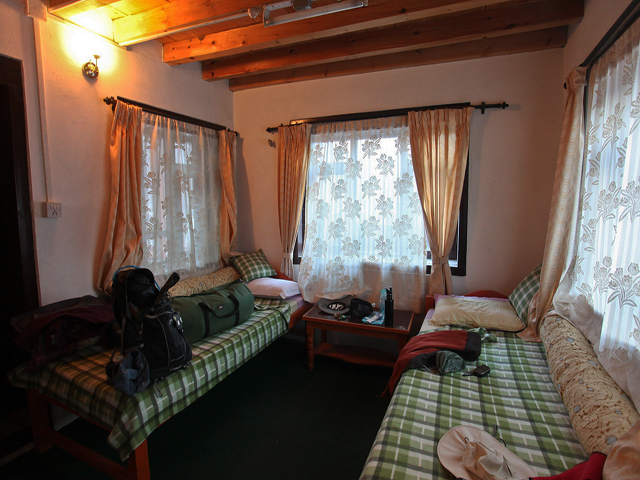
A twin room inside a teahouse.
A standard room has two single beds with a thin mattress and a pillow, and sometimes a blanket. Rooms are not heated, and the walls are thin partitions, so every snore and zip carries. Bathrooms are usually shared. Practical fixes are earplugs, a sleeping bag rated for the altitude, a liner for hygiene and your own pillowcase. Blankets are not always freshly washed, so a liner and a pillowcase add a layer of comfort. Bring a headlamp for night trips to the toilet.
Basic teahouses on remote treks
Outside the main regions of Everest, Annapurna and Langtang, lodging gets simpler. On treks such as Kanchenjunga, Makalu and Lower Dolpo, there are fewer lodges, the menu is a set meal, and everyone may sleep in the same common room. Cooking is often done over a wood or yak-dung fire, so the dining room can be smoky. Some trekkers bring their own tent and use the lodge only for meals and warmth. The local welcome is just as warm, and many trekkers say these treks give the most authentic view of everyday life in Nepal.
Teahouse standard on popular treks
| Trek | Teahouse standard |
|---|---|
| Everest Base Camp | Wide choice of comfortable lodges |
| Everest Three Passes | Wide choice of comfortable lodges |
| Ghorepani Poon Hill | Wide choice of comfortable lodges |
| Annapurna Base Camp | Wide choice of comfortable lodges |
| Annapurna Circuit | Wide choice of comfortable lodges |
| Manaslu Circuit | A moderate number of lodges, basic to good |
| Langtang | Good-quality lodges in the main villages |
| Kanchenjunga Base Camp | Very basic lodges, with camping |
| Phoksundo Lake | Very basic lodges, with camping |
| Makalu Base Camp | Very basic lodges, with camping |
| Everest Base Camp via Jiri | Basic lodges from Jiri to Lukla, then comfortable lodges to base camp |
Standards drop as the trail gains altitude on every route, with simpler rooms and higher prices for everything above the main villages.
What to pack for teahouse life
- Earplugs and an eye mask for thin walls and early starts.
- A sleeping bag rated for the highest night, plus a silk or cotton liner.
- A pillowcase of your own.
- Cash in small rupee notes for showers, charging, snacks and tips.
- A power bank and a charging cable for each device.
- A headlamp with spare batteries.
- Hand sanitiser and toilet paper, since toilet paper is often not supplied.
- Water purification tablets or a filter, to cut down on plastic bottles.
- Warm layers for the dining room, since the bedrooms have no heating.
Teahouse etiquette
- Eat your meals at the lodge where you sleep. The room price is low because the lodge earns from the food.
- Order dinner and breakfast in the evening, and be ready to wait when it is busy.
- Keep wet boots and clothes out of the beds, and dry them near the stove only as the family allows.
- Keep the dining room quiet after about 9 pm.
- Do not burn rubbish or leave batteries behind. Carry them down.
- Agree on prices for paid extras before you use them.
FAQ
What is teahouse trekking? Walking from village to village and sleeping in local lodges that also serve meals, so no tent or food needs to be carried.
Do I need to book teahouses in advance? On quiet routes, no. In the main seasons on Everest and Annapurna, rooms can fill in busy villages, so a guide or agent often calls ahead.
Are teahouse rooms private? Usually a twin room for two, with shared bathrooms. Remote lodges may use a shared common room.
Do teahouses have heating? Only the dining room, by a stove, and the rooms are unheated, so a warm sleeping bag matters.
Is there hot water? Often, for a fee. Hot showers cost extra and get more expensive with altitude. Many trekkers wash with a bucket or skip showers high up.
How do I charge my phone? Most lodges charge for it, often per hour or per device, from a socket in the dining room. A power bank saves money.
Is there Wi-Fi? At some lodges on the main routes, for a fee, and it is often slow. Higher up it may not exist.
Is the food safe? Hot, freshly cooked food such as dal bhat is the safest choice. Avoid raw salad and use treated water.
Is dal bhat really unlimited? Most lodges refill rice, lentils and curry for free, though the policy can differ at a few places.
Do I need a sleeping bag? Yes, for warmth at altitude. Many trekkers bring their own, and some operators supply one.
Should I tip? A small tip for the lodge staff is welcome, and guides and porters usually receive a larger group tip at the end of the trek.
Which trek has the best teahouses? Everest, Annapurna and Langtang have the widest choice. Kanchenjunga, Makalu and Dolpo are the most basic.
Can I camp instead? Yes, on remote treks it is common. Some trekkers bring a tent and use the lodge only for meals.
Plan a teahouse trek in Nepal
For routes, dates and a quote, see the Everest Base Camp trek or the Annapurna Base Camp trek, or message the team on WhatsApp or phone at +91 932 595 1234 (9 am to 7 pm IST), write to info@basecamphikes.com, or use the enquiry form.
Sources
- Nepal Tourism Board: trekking permit
- Nepal Tourism Board: Kanchenjunga
- Nepal Tourism Board: Kanchenjunga Conservation Area
Image credits: Gemma Amor, Laura Billings, Kat Stan, Greg Willis (Flickr).