 By
In the Kala Patthar vs Everest Base Camp question, Kala Patthar is the better viewpoint and Base Camp is the better milestone. From Kala Patthar (5,545 m) you see Mount Everest itself. From Base Camp (5,364 m) you stand on the Khumbu glacier but the summit is hidden behind Nuptse. Most trekkers do both from Gorak Shep, and this guide helps you decide the order, the timing and what to drop if your body says stop.
Many first-time trekkers assume the two are the same place. They are not. They are different walks, in different directions from the same village, with different rewards and different costs.
Kala Patthar vs Base Camp at a glance
- Everest summit view: Kala Patthar yes. Base Camp no, Nuptse blocks it.
- Altitude: Kala Patthar 5,545 m (Nepal Tourism Board). Base Camp 5,364 m (our trek figure).
- Start point: both are day walks from Gorak Shep at 5,180 m, the highest sleeping point on the standard route.
- Walk: Base Camp is a long glacier-moraine walk, up to five hours by the board. Kala Patthar is a steeper, shorter climb in the dark.
- Our advice: Base Camp in the afternoon of arrival, Kala Patthar at dawn next day.
Last checked: 5 November 2026. Kala Patthar’s height, the glacier-walk time and the Gorak Shep walk time come from Nepal Tourism Board pages. Base Camp’s altitude, climb times and timing advice come from our own itineraries and guiding, and are marked as ours. This is not medical advice.

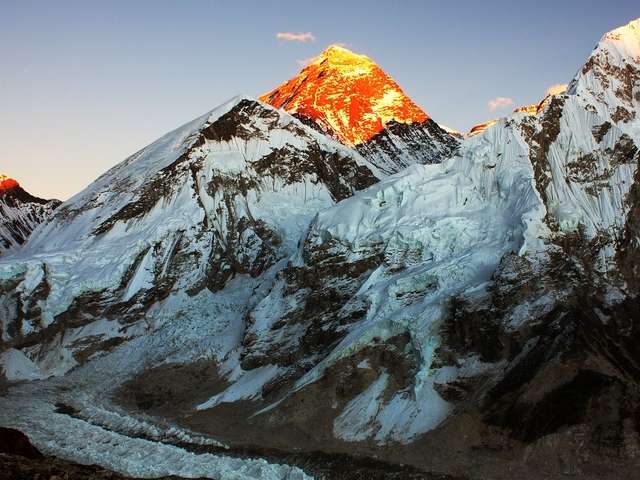
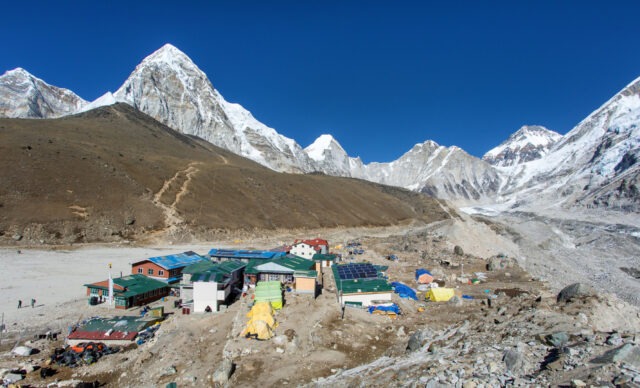
Kala Patthar, the black-rock ridge above Gorak Shep, where the trek’s best view of Everest is found.
In this guide: Side-by-side comparison | What you actually see | Effort and time | Which first | If you can only do one | Sunrise or sunset | FAQ
Kala Patthar vs Everest Base Camp: the comparison
| Everest Base Camp | Kala Patthar | |
|---|---|---|
| Altitude | 5,364 m (our figure) | 5,545 m (Nepal Tourism Board) |
| Start from | Gorak Shep, 5,180 m | Gorak Shep, 5,180 m |
| Height gained from Gorak Shep | About 184 m, net (our figures) | About 365 m, net (our figures) |
| Terrain | Glacier moraine, loose rock, ups and downs; the board calls the ground treacherous and says to walk cautiously | Steady trail on black rock and scree, then a rocky top with prayer flags |
| Time | The board says the glacier walk can take up to five hours | About 2 hours up and 1 hour down in our experience |
| Everest summit visible? | No, hidden behind Nuptse | Yes; the board says much of Mt. Everest is clearly visible |
| What you get | Marker rock, glacier, climbers’ tents in spring, the sense of arrival | The best view of Everest on the standard trek |
| Best time of day | Late morning to afternoon | Sunrise or the hour before sunset |
| Spring tents | Yes, expedition tent city in spring | No |
The altitude gain looks small, but it is not the whole story. Base Camp is long and tiring because of the terrain and the distance. Kala Patthar is short and hard because every step is up, in the cold, at the highest point of the trek.

What you actually see at each place
At Everest Base Camp
Base Camp sits on the Khumbu glacier. You stand among ice, rock and, in spring, the tents of expedition teams. Everest itself is not visible from here. Nuptse hides it. What you get is the feeling of arrival, the famous marker rock for photographs, and a close look at the glacier. Outside the climbing season the ground can look bare, and that surprises people who expect a busy tent city.
At Kala Patthar
Kala Patthar means “black rock”. It is not a summit in the climbing sense but a ridge of dark rock above Gorak Shep. The Nepal Tourism Board lists it at 5,545 m and says that from here much of Mt. Everest is clearly visible. You also look down on the Khumbu glacier and across to Nuptse and Lhotse. If you want one photograph of Everest from the trek, this is where you take it. If you see the mountain nowhere else, you will see it here.
For photo planning on the whole trail, see our guide to 15 must-click Everest Base Camp photos.
Effort and time: which is harder?
It depends on what you mean by hard. Base Camp is the longer day. Kala Patthar is the sharper effort. Here is how they feel.
| Everest Base Camp | Kala Patthar | |
|---|---|---|
| Pace | Long and steady, with many small ups and downs | Slow and steady uphill |
| Cold | Cold in the shade; wind on the glacier | Very cold before sunrise; wind at the top |
| Breathing | Heavy on the uphill sections | Heaviest in the last stretch |
| Tiring because of | Distance and rough ground | Altitude and early start |
| Easy to turn back? | Yes, at almost any point | Yes, but you lose the reward |
The effort rows are our guiding experience, not an official rating. What the board does say is that the glacier walk to Base Camp can take up to five hours, that Lobuche to Gorak Shep is roughly three hours, and that the ground near Base Camp is treacherous and needs care. Plan the day around those figures, and add time for your own pace.
Which should you do first?
On the standard 14-day plan, Base Camp and Kala Patthar are done on consecutive days. We put Base Camp first and Kala Patthar second, for these reasons:
- Arrival day. You reach Gorak Shep around midday, rest, have lunch, then walk to Base Camp and back. You sleep at 5,180 m afterwards.
- Dawn view. Kala Patthar works best at first light, so it belongs at the start of the next day, when the sky is usually clearer.
- Weather insurance. If cloud blocks your first Kala Patthar attempt, you may have another chance if your plan includes a spare morning. Ask us to add one.
- Energy. Doing the longer glacier walk when you are fresh from the previous night’s rest, and the short climb after a night at altitude, spreads the load.
The reverse order works too, and some groups do it when the sky is clear on arrival day. Tell your guide to make the call on the morning of the climb, not weeks before.

If you can only do one: how to decide
Bad weather, a headache or a tired body can mean you do not get to both. Here is how we advise:
| Your situation | Choose | Why |
|---|---|---|
| Clear sky, you feel well | Both | This is the standard plan. |
| Only one good-weather window | Kala Patthar | The Everest view is the one thing Base Camp cannot give you. |
| Tired, slightly breathless, no headache | Base Camp, then rest | Rest at Gorak Shep, then try Kala Patthar if you feel better. |
| Headache, nausea or poor sleep | Neither; tell your guide | These can be altitude sickness symptoms; do not climb higher. |
| Cloudy at dawn | Wait one hour, then decide | Clouds often lift. Do not wait long in the cold. |
| You wanted the Base Camp certificate photo | Base Camp | The marker rock is only there. |
Never push on with symptoms. The Nepal Tourism Board states that acclimatisation cannot be done in a hurry. If you are unwell, the answer is to stay or descend, not to chase a viewpoint.
Kala Patthar: sunrise or sunset?
Both work. The choice is between warmth and clarity.
| Sunrise | Sunset | |
|---|---|---|
| Start | In the dark, so a headlamp is needed | Mid-afternoon |
| Cold | Hardest; coldest part of the day | Colder as the sun sets, but you are warmer for the climb |
| Sky | Usually clearer | Clouds often build in the afternoon |
| Light | Everest and Nuptse turn gold and pink | Warm side light on the peaks |
| Our advice | Choose this if the plan allows one attempt | Choose this as a second attempt |
The rows are our field experience and conditions vary day to day. In October and November the sky is usually dependable; see our latest October conditions report for what we saw this season.
What to carry for both walks
- Headlamp with spare batteries for the Kala Patthar dawn start.
- Warm layers: a down jacket, hat, buff and warm gloves; wind chill is severe at the top.
- Water and snacks, kept inside your jacket so they do not freeze.
- Trekking poles, for loose rock and the steady climb.
- Camera battery kept warm in an inner pocket.
If you are still training, see our Everest Base Camp training guide, and for the full route and itinerary read our Everest Base Camp trek guide. First-timers will find our first-time trekker guide useful too, and if you want to fly down afterwards, see Everest Base Camp with a helicopter return.
FAQ
Is Kala Patthar higher than Everest Base Camp? Yes. The Nepal Tourism Board lists Kala Patthar at 5,545 m. Everest Base Camp is at 5,364 m on our trek figures.
Can you see Everest from Base Camp? No. Nuptse hides the summit from Base Camp. Trekkers climb Kala Patthar for the view.
Can you see Everest from Kala Patthar? Yes. The Nepal Tourism Board says much of Mt. Everest is clearly visible from the top of Kala Patthar.
Is Kala Patthar harder than Base Camp? Kala Patthar is shorter but steeper, colder and higher. Base Camp is longer and rougher underfoot. Most trekkers find the dawn climb the harder moment.
How long does Kala Patthar take? In our experience about 2 hours up and 1 hour down from Gorak Shep. Allow longer if you are slow or the trail is icy.
How long is the walk to Everest Base Camp? The Nepal Tourism Board says the glacier walk to Base Camp can take up to five hours.
Which should I do first? On our standard plan, Base Camp on the day you reach Gorak Shep and Kala Patthar at dawn the next morning.
Do I need to do both? No, but most trekkers want to. If you can only do one, pick Kala Patthar for the Everest view or Base Camp for the milestone photo.
Where do I sleep for both? At Gorak Shep, 5,180 m on our figures, which is the highest sleeping point on the standard route. Both are day walks from there.
Do I need a permit for Kala Patthar? Both walks are inside Sagarmatha National Park. Entry permits are checked at the park gate near Jorsale, according to the Nepal Tourism Board. Confirm current fees before you travel.
Is Kala Patthar a climbing peak? No. It is a trekking viewpoint, a ridge of black rock above Gorak Shep, and needs no ropes or technical gear.
Can Base Camp Hikes add a spare morning for Kala Patthar? Yes. Ask us to add a buffer day so you have a second chance if the sky is cloudy on your first attempt.
Plan both walks with Base Camp Hikes
See our Everest Base Camp trek, or message the team on WhatsApp or phone at +91 932 595 1234 (9 am to 7 pm IST), write to info@basecamphikes.com, or use our enquiry form.
Sources
- Nepal Tourism Board: Everest Region (Kala Patthar 5,545 m, Everest visibility, Sagarmatha National Park)
- Nepal Tourism Board: Everest Base Camp (glacier walk up to five hours, Lobuche to Gorak Shep, treacherous ground)
- Nepal Tourism Board: Everest Base Camp (Jorsale park entrance, permits checked)