By
Mount Everest stands 8,848.86 m (29,031.7 ft) above sea level, was first climbed on 29 May 1953, and has since collected more records than any other mountain on earth. This page gathers 50 of the best verified facts, records and extremes, from the first ascent and the fastest climbs to the weather at the top, and shows which of them you can see for yourself on the Everest Base Camp trek.
The short answer
- Height: 8,848.86 m, the figure Nepal and China announced together in December 2020.
- First ascent: Edmund Hillary and Tenzing Norgay, 29 May 1953.
- Most summits: Kami Rita Sherpa, reported at 32 Everest ascents by spring 2026.
- Coldest and thinnest air: the summit never rises above freezing, and the air holds about one third of the oxygen found at sea level.
- What trekkers see: Base Camp sits at 5,364 m, and the summit itself is hidden from there. Kala Patthar at 5,545 m gives the famous view.
Last checked: 27 October 2026. Records change as new seasons end, so the latest totals can differ from the ones shown here.
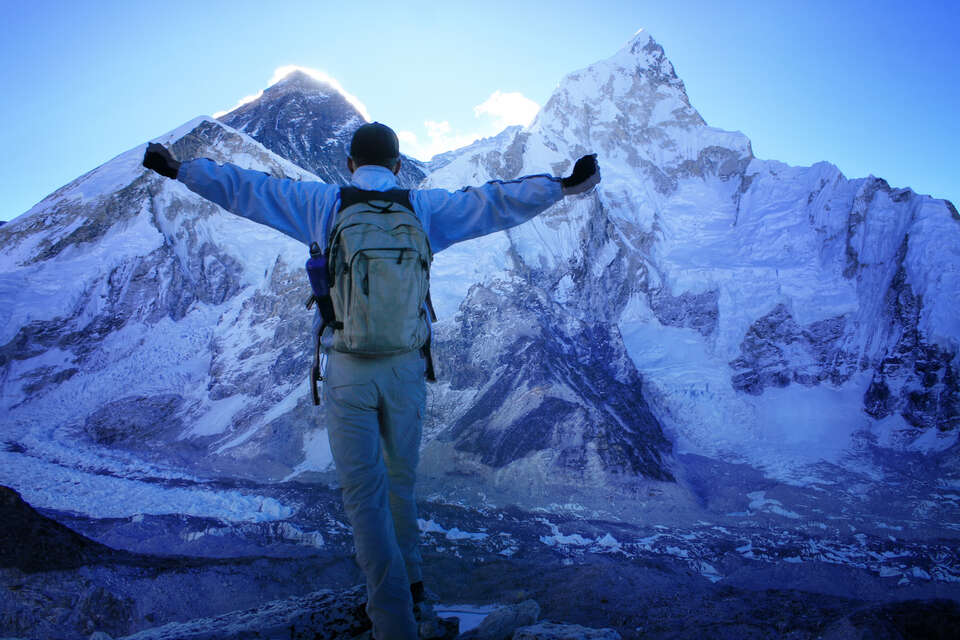
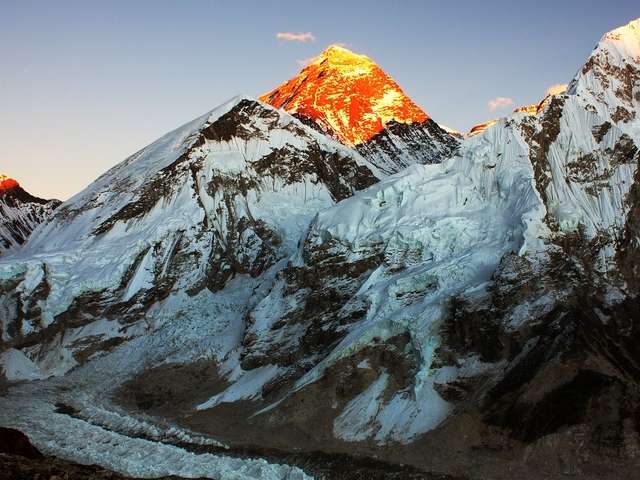
Everest (centre) and Nuptse before sunrise, seen from Kala Patthar.
In this guide: By the numbers | Height and names | Climbing firsts | Speed, age and endurance | In the air | Skiing and snowboarding | Weather | Geology | Dangers and disasters | See it on the trek | FAQ
Everest by the numbers
These figures give the scale of the mountain and how far a trekker travels to reach its foot.
| Measure | Figure |
|---|---|
| Height above sea level | 8,848.86 m (29,031.7 ft) |
| Location | Nepal and Tibet (China) border, Khumbu region of Nepal on the south side |
| Nepal-side Base Camp | 5,364 m |
| Kala Patthar viewpoint | 5,545 m |
| Lukla airstrip | 2,860 m |
| First ascent | 29 May 1953 |
| Most ascents by one person | 32 (Kami Rita Sherpa, reported by spring 2026) |
| Death zone | Above 8,000 m, where the body cannot acclimatise |
Height and names: 7 facts
- The official height is 8,848.86 m. Nepal and China announced the figure jointly in December 2020 after new surveys. It replaced the older 8,848 m number used for decades.
- A 19th-century calculation came very close. Survey teams working in British India announced a height of 29,002 ft in 1856, using calculations led by the mathematician Radhanath Sikdar. That is only about 30 ft below today’s figure.
- It began life as Peak XV. Surveyors numbered the Himalayan summits, and Peak XV was found to be the highest. It was later named after Sir George Everest, a former Surveyor General of India who never saw the mountain.
- It has two local names. Nepal calls it Sagarmatha, commonly translated as “forehead of the sky”. Tibetans call it Chomolungma, often translated as “holy mother”.
- Everest is not the farthest point from earth’s centre. Because the planet bulges at the equator, the summit of Chimborazo in Ecuador is farther from the centre, even though Everest is highest above sea level.
- Everest is not the tallest mountain from base to peak. Mauna Kea in Hawaii rises higher if you measure from the seafloor, while Everest holds the record for height above sea level.
- The air at the top holds about one third of the oxygen at sea level. This is why most climbers use bottled oxygen above the South Col.
Climbing firsts: 13 facts
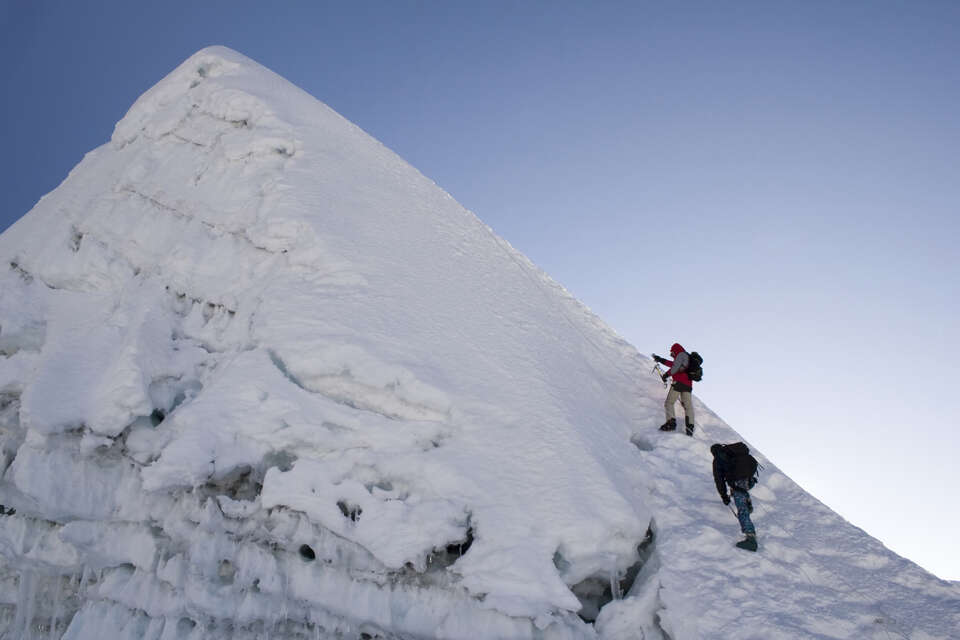
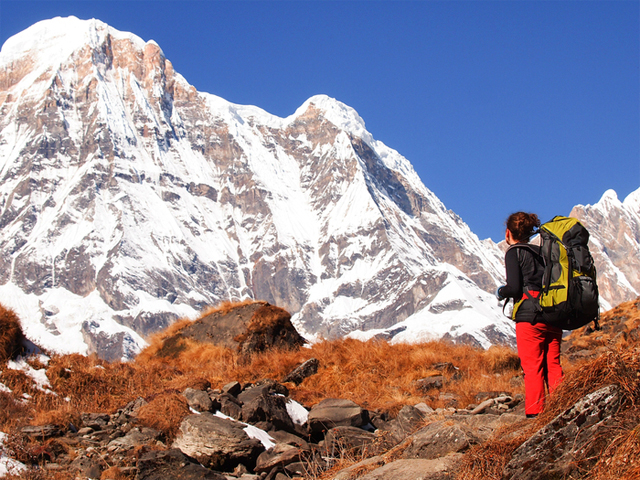
A climber nears a snowy Himalayan summit. On Everest, the final push from Camp 4 usually begins late at night.
- Hillary and Tenzing reached the top on 29 May 1953. Edmund Hillary of New Zealand and Tenzing Norgay, a Sherpa from the Khumbu, made the first confirmed ascent as part of a British expedition.
- A Swiss team came very close the year before. In 1952 Raymond Lambert and Tenzing Norgay climbed to roughly 8,600 m on the south-east ridge, about 250 m short of the summit.
- Hillary completed the “three poles”. After Everest in 1953 he also reached the South Pole (1958) and the North Pole (1985), and so stood on the three poles of the earth.
- The first American reached the summit in 1963. Jim Whittaker made the climb on 1 May. Three weeks later Willi Unsoeld and Tom Hornbein climbed the hard West Ridge and descended the South Col, the first traverse of the mountain.
- Nawang Gombu was the first to summit twice. He reached the top with Whittaker in 1963 and again in 1965 with an Indian expedition.
- Junko Tabei was the first woman on the summit. The Japanese climber stood on top on 16 May 1975.
- Messner and Habeler went without bottled oxygen. Reinhold Messner and Peter Habeler made the first oxygen-free ascent on 8 May 1978, and Messner then climbed it alone and without oxygen in 1980.
- The first winter ascent was in 1980. Leszek Cichy and Krzysztof Wielicki of Poland reached the summit on 17 February 1980.
- Pasang Lhamu Sherpa was the first Nepali woman to summit. She reached the top in April 1993 and died on the descent, and she is remembered as a national heroine in Nepal.
- Indian climbers have many firsts. Avtar Singh Cheema became the first Indian to summit in May 1965, and Bachendri Pal the first Indian woman in 1984. Santosh Yadav climbed it in 1992 and again in 1993.
- Arunima Sinha was the first female amputee to summit. The Indian climber, who lost a leg below the knee after a train accident, reached the top in May 2013.
- Tashi and Nungshi Malik became the first twin sisters on the summit. The two climbers from India reached the top together in May 2013.
- A Nepali couple reportedly married on the summit. Moni Mulepati and Pem Dorjee Sherpa held a wedding on the top in May 2005.
Speed, age and endurance: 7 facts
- Kami Rita Sherpa holds the ascent record. Apa Sherpa reached 21 summits by 2011, and Kami Rita has since passed that total, reaching a reported 32 by spring 2026.
- Lhakpa Sherpa holds the women’s record. Reports from the 2026 spring season put her at 11 summits, the most for any woman.
- Babu Chiri Sherpa stayed on the top for 21 hours. He spent that night at the summit in May 1999 without sleeping bag or tent, the longest known stay.
- He also climbed at remarkable speed. In 2000 Babu Chiri Sherpa made the climb from Base Camp to the summit in 16 hours and 56 minutes.
- Pemba Dorje Sherpa reported an even faster climb. His 2004 time of 8 hours and 10 minutes from Base Camp is the best-known speed record, although it has been disputed.
- Jordan Romero became the youngest summiter in 2010. The American was 13 years old and climbed from the Tibetan side. Nepal now requires climbers to be at least 16.
- Yuichiro Miura summited at age 80. The Japanese mountaineer reached the top in 2013, having also done so at 70 and 75.
In the air: 3 facts
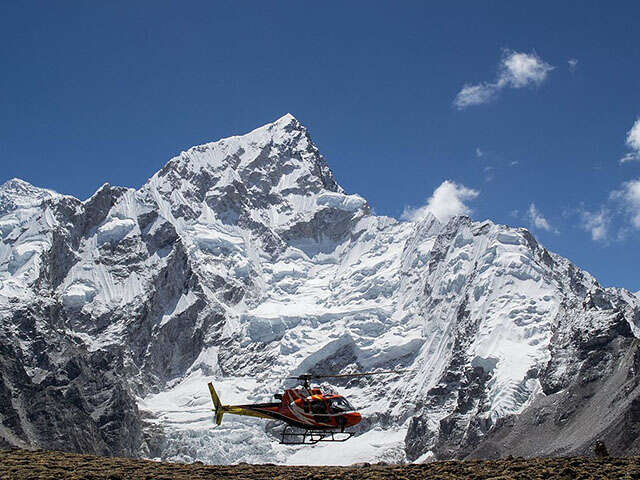
A helicopter lifts off from the Base Camp area. Landing at the summit has been done only once.
- The first flight over Everest was in 1933. Two British aircraft flew over the summit on 3 April 1933, led by the Marquess of Clydesdale and David McIntyre.
- A helicopter has landed on the summit once. French pilot Didier Delsalle touched down on the top in May 2005 in an AS350 B3 helicopter.
- Bear Grylls flew a paramotor above the summit. In 2007 he reached a reported 8,990 m, higher than the mountain’s top.
Skiing and snowboarding: 3 facts
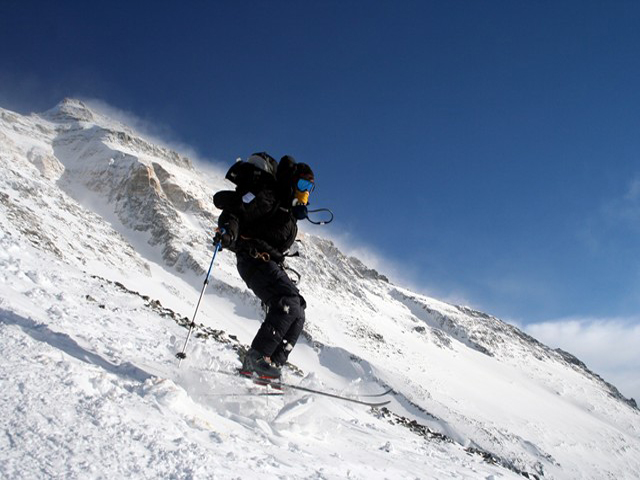
Skiing on Everest.
- Davo Karnicar made the first continuous ski descent in 2000. The Slovenian skied from the summit to Base Camp in a single descent.
- Marco Siffredi snowboarded Everest in 2001. The Frenchman returned in 2002 to try the steeper Norton Couloir and was never seen again.
- Yuichiro Miura skied from the South Col in 1970. He used a parachute to slow down, fell about 400 m (1,320 ft) and survived.
Weather: 4 facts
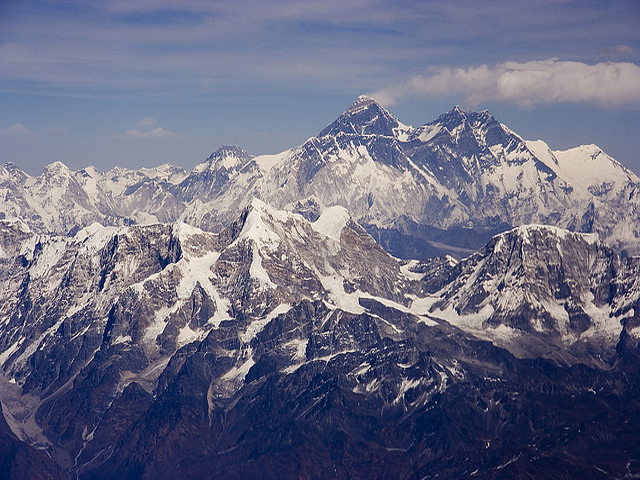
A banner cloud streams from the summit when strong winds blow across it.
Planning a trek rather than a climb? Read the Everest Base Camp weather guide and the best time to trek page.
- Mid-May is the best summit window. Winds usually ease and the monsoon has not yet arrived, so most ascents happen in a few days of the second half of May.
- The summit never rises above freezing. Average temperatures there are about -19 C in July and about -36 C in January.
- The summit may be the windiest place on earth. The jet stream sits on the peak in winter and brings hurricane-force wind.
- A banner cloud often streams off the top. This long plume forms when moist air is forced up and over the summit pyramid.
Geology: 3 facts
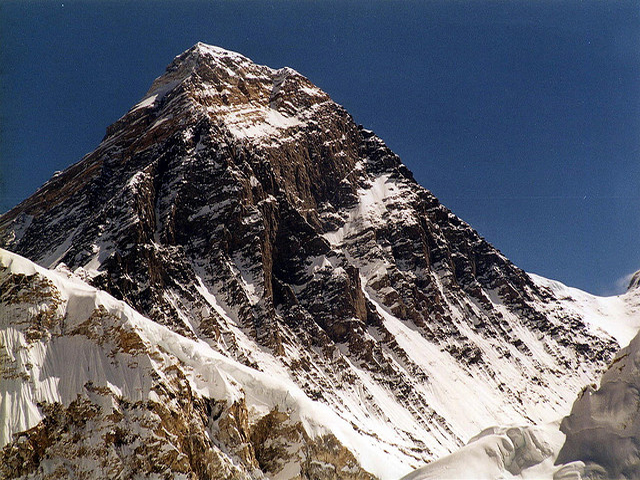
The pale Yellow Band is visible near the summit.
- Everest is still growing. The collision of the Indian and Eurasian plates pushes the Himalaya upward by a few millimetres a year.
- The summit is made of marine limestone. The rock was laid down on an ancient sea floor roughly 450 million years ago, and marine fossils have been found high on the mountain.
- The Yellow Band is a layer of metamorphosed rock. The pale band near the top is made of marble and related rock that was altered by heat and pressure.
Dangers and disasters: 5 facts
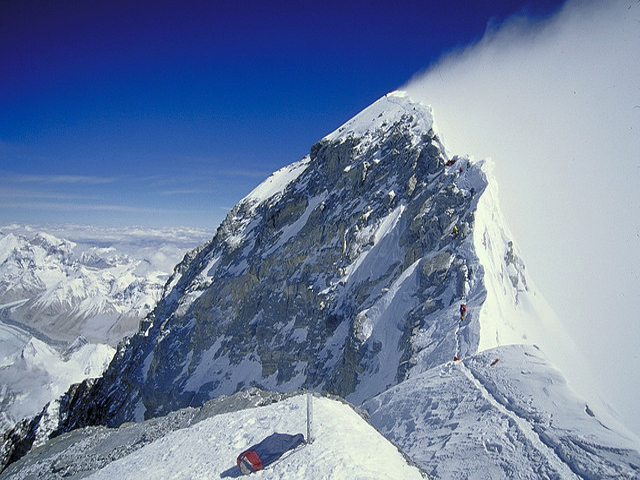
The traverse from the South Summit leads to the Hillary Step area.
- The Khumbu Icefall is the most hazardous section on the south side. It lies just above Base Camp, and a team of Sherpa climbers fixes ladders and ropes through it each season.
- More than 300 people have died on Everest. Avalanches, falls, altitude illness and exposure are the main causes.
- In May 1996 a storm killed eight climbers in two days. The disaster in 10 and 11 May became one of the best-known events in mountaineering.
- An avalanche in April 2014 killed 16 Nepali guides. It struck the Khumbu Icefall and led to a pause in that season’s climbing.
- The 2015 earthquake caused an avalanche at Base Camp. About twenty people were killed on 25 April, and the season was cancelled.
See it on the trek: 5 facts
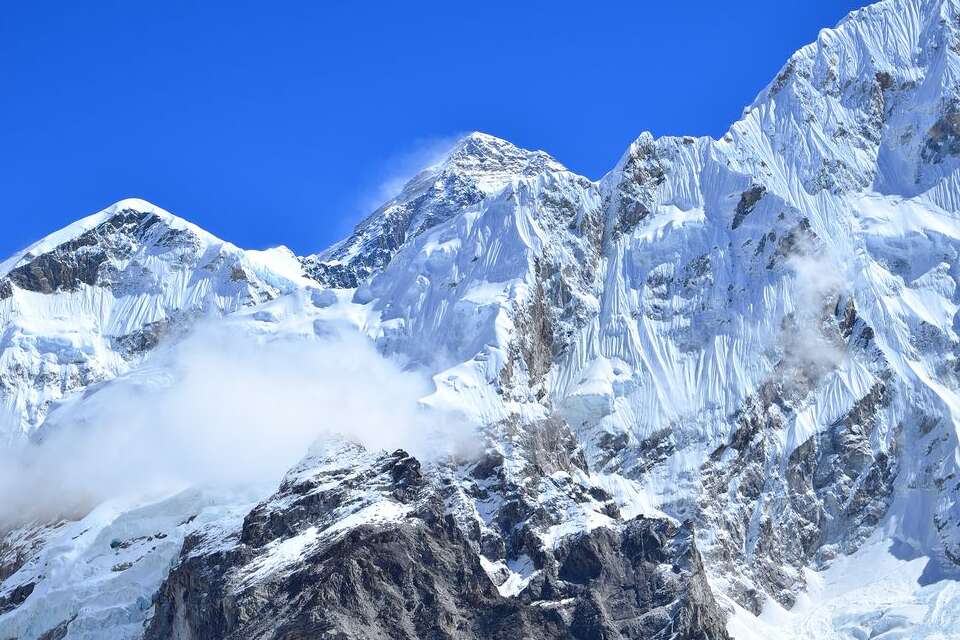
The view from Kala Patthar, the best viewpoint on the Base Camp trek.
- Everest is hidden from Base Camp itself. Nuptse blocks the summit, so most trekkers see it from Kala Patthar at 5,545 m. Compare the two in Kala Patthar vs Base Camp.
- The trek starts at an airport named after two men. Tenzing-Hillary Airport at Lukla (2,860 m) is named for the first summiters. See flying to Lukla.
- Base Camp is higher than any peak in the Alps. At 5,364 m it is above Mont Blanc (4,806 m).
- Memorials line the trail above Dughla. Stone chortens honour climbers and Sherpas who died on the mountain, including Babu Chiri Sherpa.
- Most trekkers reach Base Camp in about 12 days. The itinerary includes rest days for altitude. See the day-by-day itinerary.
Everest compared with trek altitudes
This table shows how far below the summit each stop on the Base Camp trek lies.
| Place | Altitude | Below the summit |
|---|---|---|
| Lukla | 2,860 m | About 5,990 m |
| Namche Bazaar | 3,440 m | About 5,410 m |
| Dingboche | 4,410 m | About 4,440 m |
| Gorak Shep | 5,164 m | About 3,680 m |
| Everest Base Camp | 5,364 m | About 3,480 m |
| Kala Patthar | 5,545 m | About 3,300 m |
| Summit | 8,848.86 m | 0 m |
Altitudes are rounded. Local signs and maps may differ by a few metres.
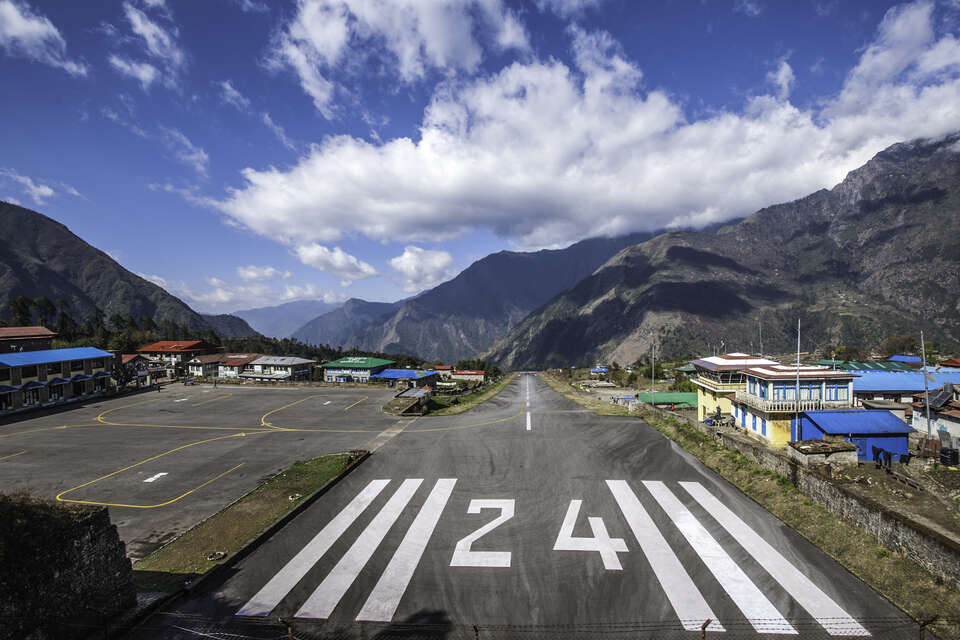
Tenzing-Hillary Airport in Lukla, where most Base Camp treks begin.
Want to see these stories on screen? Here are the best Everest movies, Hollywood and Bollywood.
FAQ
How tall is Mount Everest? 8,848.86 m (29,031.7 ft), the height announced by Nepal and China in December 2020.
Who climbed Everest first? Edmund Hillary and Tenzing Norgay reached the summit on 29 May 1953.
Who has climbed Everest the most times? Kami Rita Sherpa, with a reported 32 ascents by spring 2026.
Who was the first woman to climb Everest? Junko Tabei of Japan, on 16 May 1975.
Who was the first Indian to climb Everest? Avtar Singh Cheema, in May 1965. Bachendri Pal was the first Indian woman, in 1984.
Has anyone climbed Everest without oxygen? Yes. Reinhold Messner and Peter Habeler were the first, in 1978.
How cold is it at the summit? Averages are about -19 C in July and about -36 C in January, and it never rises above freezing.
How many people have died on Everest? More than 300 people have died on the mountain since climbing began.
Can you see the summit from Everest Base Camp? No. Nuptse hides it. The best trek viewpoint is Kala Patthar at 5,545 m.
How high is Everest Base Camp? The Nepal-side camp is at 5,364 m.
Do trekkers need to climb Everest to see it? No. The Base Camp trek gives close views of the peak without any technical climbing.
How long does the trek to Base Camp take? Most itineraries take about 12 days including acclimatisation. See the how many days guide.
Is the trek hard? It is a long walk at altitude rather than a technical climb. See how hard is the Base Camp trek.
What permits do trekkers need? See the permits guide, and check the Nepal Tourism Board for current rules.
Trek to Everest with Base Camp Hikes
If these facts make you want to stand beneath the mountain, see the Everest Base Camp trek, or read the complete trek guide. For dates and a quote, message the team on WhatsApp or phone at +91 932 595 1234 (9 am to 7 pm IST), write to info@basecamphikes.com, or use the enquiry form.
Sources
- Nepal Tourism Board: climate
- Nepal Tourism Board: safety in the mountains
Photo credits: Didrik Johnck, Olof Sundström and Martin Letzter, r12a, twiga269. Other photos are from Touristlink.