
 By
Climbers planning a first Himalayan summit meet two labels almost at once: “technical” and “non-technical”. Operators use them freely, but neither is an official category in Nepal. This guide explains what the words mean on the mountain, how Nepal actually classifies peaks, and how three popular climbs compare: Mera Peak, Island Peak and Lobuche East. The aim is to help you pick a first peak that matches your fitness and skills, not just a height.
The short answer
- Nepal has no “technical” class. It groups peaks by height and by who issues the permit. The Nepal Tourism Board (NTB) says the title “trekking peak” is misleading, because these mountains need real climbing skills and gear.
- Non-technical means walking, not easy. On Mera Peak the challenge is altitude, cold and length. Mera is the highest of the three at about 6,470 m.
- At the top end, expedition peaks above 6,500 m, such as Everest and Annapurna I, sit under the Ministry of Tourism with their own royalty and a Liaison Officer requirement.
- Technical means rope work. Island Peak and Lobuche East are lower than Mera, but they add fixed ropes, steep snow and ice, and exposed ridges.
Last checked: 22 October 2026. Permit fees and itineraries change, so confirm figures for your dates.
Pick your peak in 10 seconds
| If this describes you | Start with |
|---|---|
| You have never used crampons and want to test altitude | Mera Peak |
| You want a real climbing day with fixed ropes | Island Peak |
| You already handle ropes and want a shorter, steeper summit day | Lobuche East |
| You have never been above 4,000 m | Trek first, then choose |
In this guide: What the words mean | How Nepal classes peaks | Three peaks compared | Skills | Itineraries | Summit day | Gear | Are you ready? | Permits | Season | Risks | Expedition peaks | FAQ

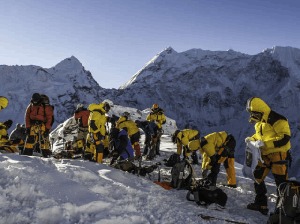
Climbers on Island Peak (Imja Tse), the best-known fixed-rope climb among the trekking peaks.
What “technical” and “non-technical” mean
Non-technical means walking on snow; technical means rope work. Neither word tells you the height or the danger.
Both words are industry shorthand, so this guide uses a clear working definition.
- Non-technical: the route is walking on snow or glacier. You wear crampons, carry an ice axe and are roped to your guide on the glacier, but you do not climb steep ice or rock. The difficulty comes from altitude, cold and a long summit day.
- Technical: parts of the route need climbing movement and rope systems. That means fixed ropes with an ascender, steep snow or ice, scrambling over rock, abseiling on the descent and narrow, exposed ridges.
Neither label tells you the height, the danger or the effort. A non-technical peak can be higher and colder than a technical one, and the reverse is true too.
How Nepal classifies peaks
Nepal sorts peaks by height and permit authority, not by technical difficulty.
NTB’s mountaineering page draws the official lines. Two bodies are involved, and a third band needs no climbing permit.
| Band | Height | Managed by | What NTB says |
|---|---|---|---|
| Expedition peaks | Above 6,500 m | Ministry of Tourism | Expeditions to peaks above 6,500 m must employ a Liaison Officer |
| Trekking peaks (NMA peaks) | 5,800 m to 6,584 m | Nepal Mountaineering Association (NMA) | The “trekking peak” title is misleading: real climbing skills and gear are needed |
| Lower peaks | Below 5,800 m | No climbing permit | Regional permits may still apply for the area |
NMA’s current list names 27 trekking peaks. The heights and fees on NMA’s pages are the official figures used in this guide. NTB’s page also notes that its own 6,500 m and 5,800 to 6,584 m bands overlap between 6,500 m and 6,584 m, so the line is not clean.
Three peaks compared by skill, not just height
Mera is the highest and least technical; Island Peak and Lobuche East are lower and more technical.
| Peak | Height (NMA list) | Region | Type | Rope work and terrain | Summit day |
|---|---|---|---|---|---|
| Mera Peak | 6,470 m | Khumbu (Hinku) | Non-technical | Roped glacier walking in crampons. No steep ice or rock. | 12 to 15 hours round trip, from High Camp to Khare |
| Island Peak (Imja Tse) | 6,160 m | Khumbu | Technical | Steep scramble, glacier, a headwall of about 100 m with fixed ropes, and an exposed summit ridge | 12 to 14 hours from base camp |
| Lobuche East | 6,090 m | Khumbu | Technical | Steep scramble, then snow and ice with fixed ropes, and an exposed ridge | About 10 hours from base camp |
Heights differ by source: operator pages give Island Peak at 6,189 m, Lobuche East at 6,119 m and Mera Peak at 6,476 m, against NMA’s 6,160 m, 6,090 m and 6,470 m. This guide uses NMA’s figures for the list and the route facts from the climbs’ itineraries.
Mera is the highest of the three but needs the least climbing skill, while Island Peak and Lobuche East are lower and need more. That is the point of separating height from skill.
The bars below compare the three peaks on the facts in this guide. They are an editorial comparison drawn from the route descriptions, not an official grade, and each bar carries a word label.
| Measure | Mera Peak | Island Peak | Lobuche East |
|---|---|---|---|
| Summit height (NMA) |
6,470 m |
6,160 m |
6,090 m |
| Climbing skill needed |
Low: roped walking |
Medium to high: fixed ropes |
Medium to high: ice and ridge |
| Summit day, round trip |
12 to 15 hours |
12 to 14 hours |
About 10 hours |

The Mera Peak ascent is a roped walk on glacier, high but without steep ice.
Non-technical does not mean easy
Mera Peak needs no steep climbing, but it tests altitude and endurance.
Mera Peak: an altitude test
6,470 m
17 days
Non-technical
US$350 spring, US$175 other seasons
Spring and autumn
Mera is the highest of the three peaks and needs no steep climbing. Its high camp sits at about 5,780 m, where the Mera Peak itinerary reports night temperatures commonly between -15 and -25 degrees Celsius. Summit day starts around 1 am. The walk up takes about 6 to 8 hours, and the round trip back to Khare takes 12 to 15 hours. The itinerary lists “basic mountaineering skills for crossing glaciers roped together in crampons”, with crampon, rope and ice-axe training at Mera Base Camp.
Measured against NTB’s ascent rules (no more than 300 to 500 m of sleeping altitude gain a day above 2,500 m, and a rest day after every 1,000 m), the standard approach looks like this:
| Night | Sleeping altitude | Change from previous night | NTB guidance (300 to 500 m a day above 2,500 m) | Profile |
|---|---|---|---|---|
| Day 3, Lukla | 2,800 m | +1,450 m (by flight) | Within (300 m above 2,500 m) |
|
| Day 4, Chutanga | 3,450 m | +650 m | Above (150 m over the top of the range) |
|
| Day 5, Khartitang | 3,900 m | +450 m | Within |
|
| Day 6, Kothe | 4,095 m | +195 m | Within |
|
| Day 7, Tangnang | 4,350 m | +255 m | Within |
|
| Day 8, Tangnang | 4,350 m | 0 m | Rest day acclimatisation day |
|
| Day 9, Khare | 5,045 m | +695 m | Above (195 m over the top of the range) |
|
| Day 10, Mera Base Camp | 5,300 m | +255 m | Within |
|
| Day 11, High Camp | 5,780 m | +480 m | Within (summit attempt follows) |
|
The itinerary exceeds the daily limit twice, at Chutanga (+650 m) and Khare (+695 m), and builds in a rest day at Tangnang. After that, the climb from Tangnang (4,350 m) to High Camp (5,780 m) is about 1,430 m with no further rest day. The constraint on this peak is how well your body copes with altitude, not rope skill.
Technical does not mean extreme
Island Peak and Lobuche East add fixed ropes and exposure, taught on the mountain.
Island Peak: the classic first fixed-rope climb
6,160 m
18 days
Technical
US$350 spring, US$175 other seasons
Spring and autumn
Island Peak has a steep scramble and gully, a glacier crossing, a headwall of about 100 m where fixed ropes are normally used, and a narrow, exposed summit ridge. A crevasse at the foot of the headwall has at times forced teams back. The usual plan starts from base camp around midnight and takes 12 to 14 hours. The descent often includes abseiling. A training day at base camp covers harness, ascender, crampon and rope handling, and no prior climbing is required.
Lobuche East: a shorter summit day with snow and ice
6,090 m
18 days
Technical
US$350 spring, US$175 other seasons
Spring and autumn
Lobuche East has a rock and scree section, snow and ice higher up protected by fixed ropes, a false summit and an exposed ridge. The summit day starts at 2 am and takes about 10 hours. Rockfall is a risk on the lower section when climbers are above you, and many accidents happen on the descent. The operator’s page gives no formal grade, so ask about conditions on your dates.

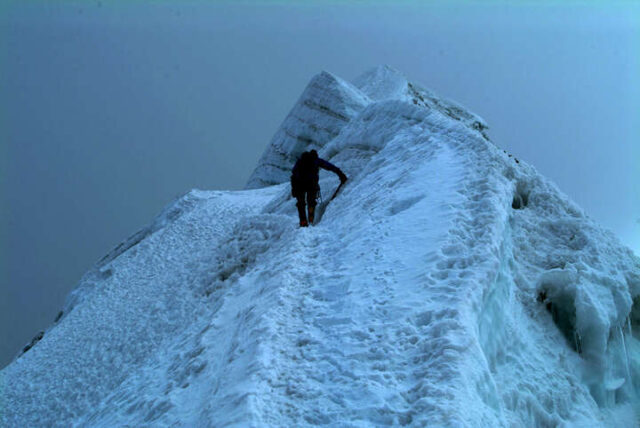
A snowy ridge near Lobuche Peak: the exposure that marks the technical climbs.
Which skills each peak actually uses
Fixed ropes, steep ice and exposed ridges separate the technical peaks from Mera.
| Skill | Mera Peak | Island Peak | Lobuche East |
|---|---|---|---|
| Walking in crampons on snow or glacier | Yes | Yes | Yes |
| Roped glacier travel | Yes | Yes | Yes |
| Fixed rope and ascender | Not described | Yes | Yes |
| Steep snow or ice | No (no steep ice or rock) | Yes (headwall) | Yes |
| Abseiling on descent | Not described | Often | Depends on the section |
| Exposed summit ridge | Not described | Yes | Yes |
“Not described” means the operator’s page does not mention the skill, not that it is impossible. All three climbs are led by licensed guides who teach the skills on the mountain, so no prior climbing experience is required on the operator’s pages.
A sensible progression for a first-time climber
Trek high first, then choose the altitude path or the skills path.
- Trek above 4,000 m first. If you have never been that high, do a high trek before any peak. Everest Base Camp is a common warm-up.
- Choose your path. Take the altitude path, Mera Peak, to test how you cope above 6,000 m without rope work. Or take the skills path, Island Peak, to learn fixed ropes on a well-known route.
- Lobuche East once you are comfortable with rope work and a long, cold summit day.
This sequence is a suggestion, not an official ladder. It rests on the demands each peak’s own itinerary describes.
How the package itineraries are built
Island Peak and Lobuche East start with the Everest Base Camp trek, which builds acclimatisation. Mera has its own approach.
| Stage | Mera Peak (17 days) | Island Peak (18 days) | Lobuche East (18 days) |
|---|---|---|---|
| Build-up | Fly to Lukla, then seven days via Chutanga, Zatrwa La (4,600 m), Khartitang, Kothe and Tangnang | Everest Base Camp trek first: Namche, Dingboche, Lobuche, Gorakshep, EBC and Kala Patthar | Everest Base Camp trek first: Namche, Dingboche, Lobuche, Gorakshep and EBC |
| Rest days before the climb | One, at Tangnang (4,350 m) | Two, at Namche and Dingboche | Two, at Namche and Dingboche |
| Base camp | Mera Base Camp, 5,300 m, then High Camp, 5,780 m | Island Peak Base Camp, 5,200 m | Lobuche Base Camp (altitude not listed) |
| Skills day | Crampon, rope and ice-axe training at Mera Base Camp | Climbing training at base camp (day 12) | Acclimatisation day at base camp (day 12) |
| Summit day | Day 12, back to Khare | Day 13, back to Chukhung | Day 13, back to base camp |
| Back in Kathmandu | Day 16 | Day 17 | Day 17 |
The Island Peak and Lobuche East pages state heights of 6,189 m and 6,119 m, against NMA’s 6,160 m and 6,090 m. Treat the itinerary as a guide: guides adjust it to weather and how the group is feeling.
What a summit day looks like
A summit day starts in the dark and is mostly about patience, cold and a careful descent.
| Mera Peak | Island Peak | Lobuche East | |
|---|---|---|---|
| Start | Around 1 am from High Camp | Around midnight from base camp | 2 am from base camp |
| Climb | Roped glacier walk in crampons, about 6 to 8 hours up | Scramble, glacier, then a headwall of about 100 m on fixed ropes and a ridge | Rock and scree, then snow and ice on fixed ropes, a false summit and a ridge |
| Total | 12 to 15 hours, back to Khare | 12 to 14 hours | About 10 hours |
| Descent | Long and tiring | Often includes abseiling | Many accidents happen here |
Gear: what the packages provide and what to bring
The package pages include boots, harness and helmet; confirm the rest in writing before you book.
| Item | Status on the package pages |
|---|---|
| Climbing boots, harness, helmet | Included |
| Crampons, ice axe, ascender | Inclusions say “all climbing gear”, but the gear list names these as items to obtain. Ask for written confirmation. |
| Sleeping bag (rated to 0 C) and down jacket | Rental: INR 1,200 each for Indian guests, US$20 and US$15 for others |
| Layers, gloves, socks, head torch, sunglasses | Bring. Trekking gear can also be rented or bought in Kathmandu. |
| Baggage | Pages give both 15 kg (gear list) and 20 kg (inclusions). Confirm before packing. |
Not ready yet? Do this first
A short checklist that matters more than the peak you choose.
- Complete a high trek above 4,000 m, such as Everest Base Camp, and note how you felt.
- Walk 6 to 8 hours on consecutive days with a pack, comfortably.
- Train for 8 to 12 weeks with hill walking, stairs, cycling or running.
- Practise early starts and cold hands: summit days begin between midnight and 2 am.
- Take out insurance that covers climbing above 6,000 m and helicopter evacuation.
- Ask your operator which gear is included and who guides the climb.
Can a beginner climb Island Peak? The operator’s page says no prior climbing is needed and a training day covers the skills, but trekking above 4,000 m first is strongly advised.
Fitness and training
Summit day is the hardest day on every peak, so train for long, consecutive days.
On every one of these peaks, summit day is the hardest day. Train for it:
- Be able to walk 6 to 8 hours on consecutive days with a pack.
- Build up with hill walking, stair work, cycling or running for at least 8 to 12 weeks beforehand.
- Rope, crampon and ice-axe skills are taught at base camp, so you do not need to learn them in advance.
- Altitude tolerance cannot be trained at home. Spend time above 4,000 m before you commit to a 6,000 m peak.
Permits, fees and rules
Trekking peaks are permitted by NMA, expedition peaks by the Ministry of Tourism.
Government pages and the Nepal Mountaineering Association’s own pages are the only sources used here. NTB names NMA as the body responsible for trekking peaks.
| Item | What the official pages say | Source |
|---|---|---|
| Permit authority | NMA for trekking peaks. Ministry of Tourism above 6,500 m. | NTB |
| Royalty, standard group | US$350 in spring (March to May), US$175 in other seasons | NMA |
| Royalty, Chulu East and Singu Chuli | US$500 spring, US$250 autumn, US$200 winter and summer | NMA |
| Permit period | One month. Up to two weeks extra, at 25% of the fee per extra week. | NMA |
| Group and guide | Up to 12 people, with an NMA-registered guide | NMA |
| Liaison and cover | Kathmandu liaison. Rs 200,000 accident cover for staff above base camp. | NMA |
| Peaks below 5,800 m | No climbing permit. Regional permits may apply. | NTB |
NMA’s service charges page gives no effective date, and its rules page dates from 1981, so confirm current figures on your dates. A reputable operator includes the climbing permit in the package. Indian citizens should contact the operator for the documents and fees that apply. Operators’ pages give 17 as the minimum age for a climbing permit, so confirm the current rule.
Best season
Spring and autumn are the usual windows.
NTB says pre-monsoon is the best season for expeditions, though visibility may be limited, and autumn suits the lower peaks. The Mera Peak itinerary lists April to May and October to November. NTB’s Everest region page describes winters at high altitude as extreme, with heavy snow, and summers as cool by day and cold at night and in the rain, so most climbs are planned for spring and autumn.
Risks on technical and non-technical peaks
Altitude is the main risk on all three; ropes and rockfall add risk on the technical peaks.
| Risk | Non-technical (Mera) | Technical (Island, Lobuche East) | What helps |
|---|---|---|---|
| Altitude sickness | Main risk, high camp at 5,780 m | Serious, summit above 6,000 m | Slow ascent, rest days, descend if symptoms worsen |
| Cold and wind | -15 to -25 C at high camp | Long, cold pre-dawn start | Warm sleeping system and the guide’s call to turn back |
| Crevasses | Roped glacier walking | A crevasse has stopped teams at Island Peak’s headwall | Roped teams, current conditions |
| Rockfall and exposure | Low | Rockfall on lower Lobuche East, exposed ridges | Helmet, clipping in, spacing |
| Descent accidents | Fatigue | Many accidents happen on the way down | Stay focused until base camp |
Insurance should cover climbing above 6,000 m and helicopter evacuation, which can cost US$5,000 or more according to operator terms. NTB’s advice on altitude sickness applies on every peak: treat headache, nausea, loss of appetite, dizziness or unusual fatigue above 2,500 m as altitude sickness until proven otherwise, do not go higher, and descend if symptoms worsen.
Which peak is right for you?
Choose by what limits you: altitude, skills or time.
| If you… | Better fit | Why |
|---|---|---|
| Want a 6,000 m peak without rope work | Mera Peak | Glacier walking only, but you need strong altitude tolerance |
| Want to learn fixed ropes on a well-known route | Island Peak | A single, clear headwall and a training day at base camp |
| Are comfortable with rope work and want a shorter summit day | Lobuche East | About 10 hours, with snow and ice higher up |
| Have never been above 4,000 m | Trek first | Test your altitude response before committing to a peak |
| Are building towards an 8,000 m peak | Island Peak, then Lobuche East | They teach fixed ropes, crampon work and behaviour above 6,000 m |
The verdict
Choose by what limits you. If altitude worries you more than ropes, start with Mera Peak. If you want to build climbing skills, go to Island Peak and then Lobuche East. Do not choose on height alone, and do not read “non-technical” as “easy”.
The next level: expedition peaks in brief
Everest and Annapurna I are expedition peaks above 6,500 m, a step beyond any trekking peak.
Above the trekking peaks sit the expedition peaks, the mountains most people mean by “high-end climbing”. NTB says Nepal has eight peaks above 8,000 m and 326 other peaks open to expeditions, 103 of which have never been climbed. Expedition peaks above 6,500 m fall under the Ministry of Tourism, must employ a Liaison Officer and pay a refundable garbage deposit. Two names dominate: Everest and Annapurna I.
| Everest | Annapurna I | |
|---|---|---|
| Height | 8,848 m | 8,091 m, the tenth highest mountain in the world |
| Managed by | Ministry of Tourism, with a Liaison Officer | Ministry of Tourism, with a Liaison Officer |
| Royalty | US$15,000, against US$350 for smaller peaks, according to an NTB trade notice of August 2025 | Not stated on the NTB pages read. Confirm with the Department of Tourism. |
| History | Home to the standard trek to Base Camp covered in this guide | The first 8,000 m peak ever climbed: Maurice Herzog and Louis Lachenal reached the top on 3 June 1950 by the north face. The first Nepali to summit was Sonam Wolang Sherpa on 13 October 1977. |
| Season | Pre-monsoon is the best season for expeditions (NTB) | NTB says May is the best time to climb in the Himalaya. The 1950 team summited on 3 June, two days before the monsoon turned. |
| What it demands | An expedition, not a longer trekking peak: weeks on the mountain, several camps above base camp and a far higher level of experience | NTB’s account of 1950 records snowstorms, avalanches and freezing cold, and says the hardest part came on the way down |
The jump from a 6,000 m trekking peak to an 8,000 m expedition is large. Island Peak, Lobuche East and Mera Peak build the base skills of crampons, fixed ropes and behaviour above 6,000 m, but they do not replace expedition experience. Anyone aiming at Everest or Annapurna should treat the trekking peaks as the first rung and plan the rest of the ladder with an expedition specialist.
Plan a peak climb with Base Camp Hikes
Send your dates, fitness and experience and the team will recommend a peak.
Base Camp Hikes runs guided climbs of all three peaks, with licensed guides, climbing gear and permits arranged. See the itineraries and current prices for Mera Peak, Island Peak and Lobuche East. Send your dates, fitness and experience, and the team will recommend a peak: call or WhatsApp +91 932 595 1234 (9 am to 7 pm IST), email info@basecamphikes.com or use the enquiry form.
Related reading: the Island Peak climbing guide, the Lobuche East climbing guide and the complete Everest Base Camp guide for 2027.
FAQ
Is Island Peak harder than Mera Peak? Island Peak needs more climbing skill (fixed ropes, a headwall of about 100 m and an exposed ridge), while Mera Peak is higher (6,470 m against 6,160 m by NMA’s list) and has a longer summit day. Which is harder depends on whether altitude or technique limits you.
Is Lobuche East harder than Island Peak? Both are technical. Operator pages give Lobuche East a shorter summit day, about 10 hours against 12 to 14, but add snow and ice higher up and rockfall on the lower section. No government body grades either peak.
Can a beginner climb Island Peak? Operators say no prior climbing is required and a training day covers harness, ascender, crampons and rope handling. Trek above 4,000 m first, and be honest about your fitness.
How much does an Everest permit cost? An NTB trade notice of August 2025 gives climbing fees of US$15,000 for Everest, against US$350 for smaller peaks. Expedition peaks are managed by the Ministry of Tourism, so confirm the current royalty before budgeting.
How many 8,000 m peaks are there in Nepal? Eight, according to NTB. Everest (8,848 m) and Annapurna I (8,091 m) are two of them.
What is the difference between technical and non-technical peaks in Nepal? There is no official class. In operator usage, a non-technical peak is climbed by walking on snow or glacier in crampons, while a technical peak needs fixed ropes, steep snow or ice, abseiling or exposed ridges.
Is a “trekking peak” easy? No. NTB calls the title misleading and says these peaks need real climbing skills and gear.
What is the easiest peak to climb in Nepal? NMA lists 27 peaks and no official ranking of difficulty. Among the three in this guide, Mera Peak needs the fewest climbing skills, but it is the highest and has the longest summit day, so it is not easy.
Is Mera Peak technical? Operators describe it as non-technical: roped glacier walking in crampons, with no steep ice or rock. Its difficulty is altitude, cold and a 12 to 15 hour summit day.
Is Island Peak technical? Yes, in part. It has a headwall of about 100 m with fixed ropes, an exposed summit ridge and often an abseil on the descent. No prior climbing is needed, and a training day covers the skills.
Do I need climbing experience? Operators’ pages say none is required for these three peaks, and that skills are taught at base camp. Prior trekking above 4,000 m helps.
How high are trekking peaks? NTB gives a range of 5,800 m to 6,584 m for NMA trekking peaks.
Which permit do I need? A climbing permit from NMA, plus the trekking and park permits for the region. Your operator should arrange them.
Do peaks below 5,800 m need a climbing permit? NTB says no, though regional permits may still apply.
How much is the NMA royalty? For the standard group, US$350 in spring and US$175 in autumn, winter and summer, according to NMA’s service charges page. Check the current figure on your dates.
How fit do I need to be? You should be able to walk 6 to 8 hours on consecutive days with a pack and then manage a long summit day. Train for at least 8 to 12 weeks.
When is the best time to climb? April to May and October to November. NTB says pre-monsoon is best for expeditions and autumn suits the lower peaks.
Sources
- Nepal Tourism Board, mountaineering (peak classes, 5,800 m and 6,500 m lines, seasons)
- Nepal Mountaineering Association, NMA peaks (27 peaks and heights)
- Nepal Mountaineering Association, service charges (royalties)
- Nepal Mountaineering Association, rules and guidelines (permit period, group size, guides, insurance)
- Nepal Tourism Board, Everest, Annapurna and Maurice Herzog and the climb of Annapurna (heights, first ascent, season)
- Nepal Tourism Board trade notice on peak permit fees (Everest and small-peak fees, August 2025)
- Nepal Tourism Board, safety in the mountains (ascent rules, altitude sickness)
- Route facts, summit-day lengths and altitudes come from the Base Camp Hikes itineraries for Mera Peak, Island Peak and Lobuche East.
- Not found: no Annapurna I royalty on the pages read, and no government page defines “technical” or “non-technical” or grades individual peaks, and NMA’s service charges page gives no effective date.
Information correct as of 22 October 2026.