By
Choose Everest Base Camp if you want big mountain scenery, Sherpa villages and a gradual climb you have time to adjust to. Choose Kilimanjaro if you have less time and want a summit at 5,895 m, with the toughest single day. Neither is technical. Kilimanjaro’s summit night is harder than any day on the Base Camp trek, but Base Camp is the longer test of endurance and the safer climb for altitude. This guide compares the two on difficulty, altitude, scenery, lodging, season and logistics, using the Marangu route on Kilimanjaro.
Everest or Kilimanjaro at a glance
- Highest point: Kilimanjaro, 5,895 m (Kibo, the summit). Everest Base Camp trek, 5,364 m at Base Camp and 5,545 m at Kala Patthar.
- Time: Everest Base Camp, 14 days from Kathmandu with 9 walking days. Kilimanjaro, 5 to 8 days on the mountain depending on the route (TANAPA).
- Hardest day: Kilimanjaro summit night. Everest Base Camp has no single day that hard.
- Altitude risk: higher on Kilimanjaro’s short routes, because you gain height quickly.
- Scenery: Everest Base Camp wins for mountains; Kilimanjaro for climate zones and a lone volcano.
Last checked: 29 October 2026. Heights, distances and times are approximate. Confirm routes, seasons and rules with your operator.
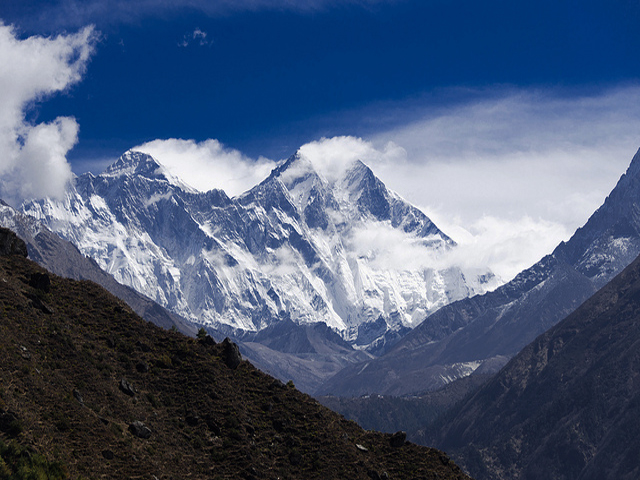
Everest and Lhotse from Namche Bazaar.
In this guide: Side by side | Which is harder? | Acclimatisation | Scenery and lodging | Season | Which to choose | FAQ
Everest Base Camp vs Kilimanjaro side by side
| Everest Base Camp trek | Kilimanjaro (Marangu route) | |
|---|---|---|
| Highest point | Base Camp 5,364 m; Kala Patthar 5,545 m | Kibo summit, 5,895 m |
| Time | 14 days from Kathmandu, 9 walking days | 5 to 8 days on the mountain, depending on the route |
| Walking distance | About 106 to 112 km over 9 days | About 70 km in total (route figures vary) |
| Highest sleeping altitude | Gorak Shep, 5,180 m | Kibo Hut, about 4,695 m |
| Hardest day | Long days of 6 to 8 hours at altitude | Summit night: about 1,200 m up from Kibo Hut, then a long descent |
| Technical climbing | None | None |
| Lodging | Teahouses with shared dining rooms | National park huts on Marangu; camping on other routes |
| Scenery | Himalayan peaks, glaciers, monasteries | Rainforest to arctic summit on one volcano |
| Guide rules | Check the current rules; we recommend a guide | Licensed operator and guide required; no solo climbing (TANAPA) |
| Our package | 14 days, INR 85,000 | Not offered by us |
Which is harder, Everest Base Camp or Kilimanjaro?
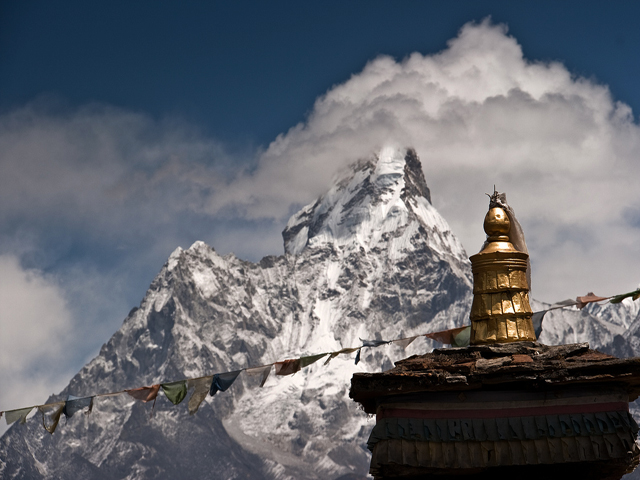
Ama Dablam on the Everest trek.
The two are hard in different ways. Kilimanjaro’s summit day is the more difficult single day: from Kibo Hut at about 4,695 m you climb roughly 1,200 m through the night to the summit, then descend more than 2,000 m to Horombo Hut the same day. The Everest Base Camp trek is milder day to day but longer, with nine walking days and two rest days, so it tests stamina and consistency instead of one big push. Both need real training: see training for Everest Base Camp.
| Everest Base Camp | Kilimanjaro (Marangu) | |
|---|---|---|
| Pace | Gradual, with two rest days | Fast, with few rest days |
| Biggest single day | About 6 to 8 hours of walking | 10 to 15 hours on summit day |
| Cold | Cold nights at 4,000 m and above | Very cold on summit night |
| What fails people | Altitude, stomach bugs, tiredness | Altitude, cold and the summit night itself |
Acclimatisation: the biggest difference
The Nepal Tourism Board advises that above 2,500 m your sleeping altitude should rise by no more than 300 to 500 m a day, with a rest day after every 1,000 m gained. Base Camp treks are built around that rule: Namche and Dingboche are rest days. Kilimanjaro’s Marangu route climbs about 950 m between huts on the first two stages, then about 1,000 m to Kibo Hut, which is well above the guideline. TANAPA advises choosing an itinerary with acclimatisation days, ascending slowly, staying hydrated and reporting symptoms promptly. A longer Kilimanjaro route gives you more time to adjust. Read the altitude sickness guide before either trip.
| Night | Everest Base Camp | Kilimanjaro (Marangu) |
|---|---|---|
| Early | Lukla 2,800 m, Phakding about 2,600 m | Mandara Hut, about 2,740 m |
| Middle | Namche 3,440 m (rest day), Dingboche about 4,400 m (rest day) | Horombo Hut, about 3,690 m |
| High | Lobuche 4,900 m | Kibo Hut, about 4,695 m |
| Top sleeping point | Gorak Shep 5,180 m | Kibo Hut, about 4,695 m |
| Summit | Base Camp 5,364 m / Kala Patthar 5,545 m | Kibo 5,895 m |
Scenery and the lodging experience
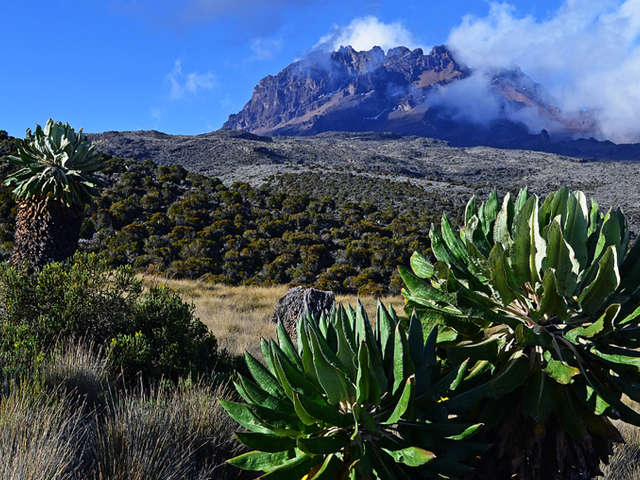
Giant groundsel and Mawenzi Peak on Kilimanjaro.
Kilimanjaro. It stands alone, so you do not get a wall of peaks. Instead you walk up through five or more climate zones (TANAPA), from rainforest and mossy heath to moorland with giant groundsel and lobelia plants, then alpine desert and the snow-covered summit. Kibo is the highest point at 5,895 m and Mawenzi is the second peak at 5,149 m. Sunrise on the summit glaciers is the main reward.
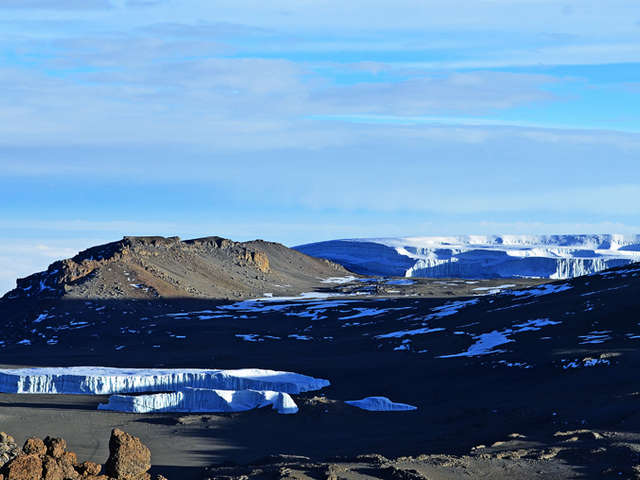
Ice fields near the summit of Kilimanjaro.
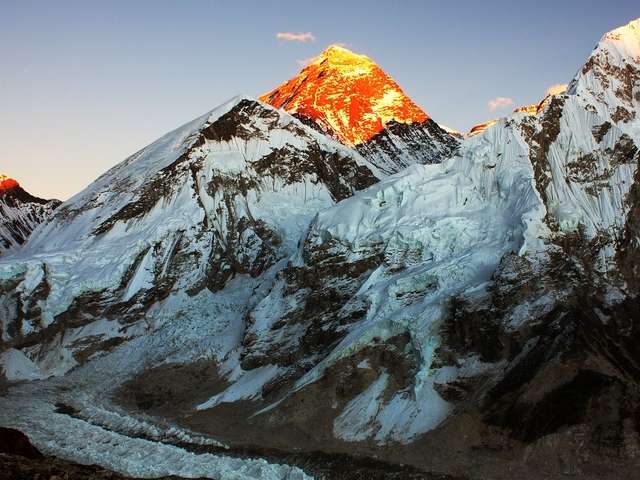
Everest Base Camp. The scenery gets bigger after Namche Bazaar: Ama Dablam, Everest, Lhotse, Nuptse and Cho Oyu appear along the route, with Sherpa villages, prayer flags and monasteries in between. Kala Patthar at 5,545 m is the best viewpoint. Read 15 must-click Everest Base Camp photos for the best spots.
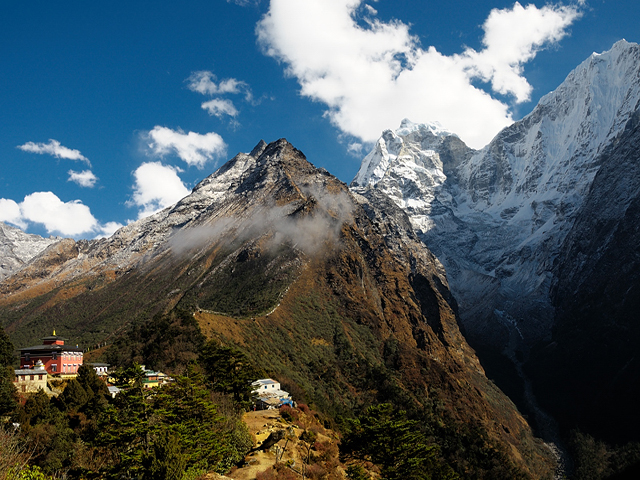
Tengboche Monastery on the Everest trek.
Lodging. On Kilimanjaro’s Marangu route, climbers sleep in park huts called Mandara, Horombo and Kibo, usually in shared rooms with bunks. Other routes use camping. In the Khumbu, teahouses offer one- or two-bed rooms and a shared dining room with a stove where trekkers swap stories. The teahouse system also puts your money into mountain villages, which is part of the experience. See what surprises first-time teahouse trekkers.
Best time to go
| Everest Base Camp | Kilimanjaro | |
|---|---|---|
| Best seasons | March to May; October to November | Dry seasons: roughly January to early March and June to October |
| Cold | December to February very cold | Summit nights cold all year |
| Avoid | June to September monsoon | Long rains, roughly April and May |
TANAPA says the park is open all year but gives no month-by-month advice, so confirm the dry-season dates with your operator. For Nepal, see Everest treks: the best seasons month by month.
Which one should you choose?
| If you… | Choose | Why |
|---|---|---|
| Want the best mountain views | Everest Base Camp | Himalayan peaks and Sherpa culture |
| Have only 7 to 8 days | Kilimanjaro | Shorter, but pick a longer route if you can |
| Worry about altitude sickness | Everest Base Camp | Slower, with built-in rest days |
| Want a summit | Kilimanjaro | Reach a true summit at 5,895 m |
| Prefer villages and teahouses | Everest Base Camp | Meals and lodging in Sherpa villages |
| Want to do a first big trek | Everest Base Camp | See the first-time trekker’s guide |
Cost and logistics
Prices vary widely by route, group size and season, so we do not quote other operators’ costs. Our Everest Base Camp trek is 14 days from Kathmandu at INR 85,000 per person on two sharing, with Lukla flights currently leaving from Ramechhap. See Lukla vs Ramechhap flights, the Everest Base Camp trek cost from India and the packing checklist. For Kilimanjaro, TANAPA requires a licensed operator and guide, so ask for a quote from an operator based in Tanzania, and check Tanzania’s entry rules for your passport.
FAQ
Is Everest Base Camp harder than Kilimanjaro? Not on any single day. Kilimanjaro’s summit night is harder. Base Camp is longer and tests endurance over nine walking days.
Which has a higher summit? Kilimanjaro, at 5,895 m. Everest Base Camp is at 5,364 m, and Kala Patthar at 5,545 m.
Which has a lower risk of altitude sickness? Everest Base Camp, because its schedule has rest days and slower gains. Kilimanjaro’s shorter routes gain height quickly.
How many days does each take? Our Base Camp trek is 14 days from Kathmandu. Kilimanjaro takes 5 to 8 days on the mountain, depending on the route.
Do I need technical skills? No. Neither climb is technical.
Do I need a guide? Kilimanjaro requires a licensed operator and guide. For Everest Base Camp, the rules are unsettled, so we recommend a guide.
Where do I sleep on each? Teahouses on Everest Base Camp. Park huts on Kilimanjaro’s Marangu route and tents on most other routes.
When is the best time for Everest? March to May and October to November.
When is the best time for Kilimanjaro? The dry seasons, roughly January to early March and June to October. Confirm with your operator.
Which gives better scenery? Everest Base Camp for mountains; Kilimanjaro for climate zones and a lone volcano.
Can beginners do either? Yes, with training and a sensible schedule. Both need good fitness and no technical skills.
Which should I do first? Many trekkers choose Everest Base Camp first for the slower pace. If you do Kilimanjaro, choose a longer route.
Plan your Everest Base Camp trek with Base Camp Hikes
See the 14-day Everest Base Camp trek. For a quote, message the team on WhatsApp or phone at +91 932 595 1234 (9 am to 7 pm IST), write to info@basecamphikes.com, or use the enquiry form.
Photo credits for the Kilimanjaro photographs: Pietro Columba, Franck Zecchin and Andy Hares.