By
Nepal’s official list of trekking peaks has 27 summits, from 5,849 m to 6,584 m, and you can climb them on a permit from the Nepal Mountaineering Association (NMA) instead of a full expedition licence. For a first climb, Mera Peak and Island Peak are the usual picks. This guide compares eight of the best-known peaks, including the three we guide ourselves, so you can match a mountain to your fitness, your skills and the trek you already plan to do.
Trekking peaks at a glance
- How many: 27 on the NMA list. Older web pages quote 28 or 33, which are not the current NMA figure.
- Height range: 5,849 m (Khongma Tse) to 6,584 m (Chulu East).
- NMA royalty, standard group: US$350 in spring (March to May), US$175 in other seasons.
- Permit rules: permit valid one month, group of up to 12, NMA-registered guide required.
- Best first climbs: Mera Peak (roped glacier walking) or Island Peak (fixed ropes, one steep headwall).
Last checked: 28 October 2026. Heights are NMA figures unless stated. Fees and rules can change, so confirm them for your dates.

Island Peak (Imja Tse), the most climbed trekking peak.
In this guide: Pick by goal | 8 peaks compared | Peak by peak | Trek and peak pairs | Permits and rules | FAQ
Pick your peak by goal
| If you want to… | Start with | Why |
|---|---|---|
| Test altitude without rope work | Mera Peak | Roped glacier walking in crampons; the challenge is height and cold |
| Learn fixed ropes on a classic route | Island Peak | One steep headwall of about 100 m, taught at base camp |
| Climb a steeper, shorter summit day | Lobuche East | Snow and ice higher up; needs some rope confidence |
| Add a summit to the Annapurna Circuit | Pisang Peak | Starts from the Manang side of the circuit |
| Add a summit to the Manaslu Circuit | Larkya Peak | Reached from the trail near Larkya La |
| Climb with real experience only | Cholatse | Steep and exposed; not a first peak |
| Try a snow summit near Kathmandu side | Yala Peak | Langtang valley, reached by road from Kathmandu |
8 trekking peaks compared
The table puts the eight peaks side by side. Technical level is our own plain-language summary, not an official grade: NMA does not rate peaks by difficulty.
| Peak | Height | Region | Pairs with | Skill level | NMA permit? |
|---|---|---|---|---|---|
| Mera Peak | 6,470 m | Hinku, Everest region | Own approach, 17 days | Non-technical, long summit day | Yes |
| Island Peak (Imja Tse) | 6,160 m | Khumbu | Everest Base Camp trek | Technical, fixed-rope headwall | Yes |
| Lobuche East | 6,090 m | Khumbu | Everest Base Camp trek | Technical, snow and ice | Yes |
| Pisang Peak | 6,091 m | Manang | Annapurna Circuit | Step up from Island Peak | Yes |
| Larkya Peak | 6,010 m | Manaslu | Manaslu Circuit | Snow slog, high camp needed | Yes |
| Cholatse (Chola Tse) | 6,440 m | Khumbu | Gokyo valley | Expert, steep and exposed | Yes |
| Yala Peak | about 5,500 to 5,700 m | Langtang | Langtang trek | Entry-level snow climb | Below NMA line* |
| Tent Peak | about 5,660 m | Annapurna Sanctuary | Annapurna Base Camp trek | Short, steep snow climb | Below NMA line* |
*NTB says peaks below 5,800 m need no climbing permit, though trekking and park permits still apply. Published heights for Yala Peak and Tent Peak vary by source, so treat them as approximate.
The 8 peaks, one by one
1. Island Peak (Imja Tse), 6,160 m
Island Peak is the Everest region’s best-known climb. It rises from a wide glacial valley above Chhukung and gets its English name from the way it looks like an island in a sea of ice when seen from the Dingboche side. The route is a scramble, a glacier crossing and a headwall of about 100 m on fixed ropes, followed by a narrow summit ridge. Altitude and the long, cold midnight start are the real tests. Operators sometimes quote 6,189 m, while NMA lists 6,160 m. We run it as an 18-day climb that follows the Everest Base Camp trek first, which builds acclimatisation. See the full Island Peak climbing guide and our 9 tips to summit Island Peak.
2. Mera Peak, 6,470 m

Mera Peak, the highest NMA trekking peak that needs little rope skill.
Mera is higher than Island Peak but asks for less climbing skill. The summit route is roped glacier walking in crampons, and the challenge is altitude: high camp sits at about 5,780 m, where night temperatures are commonly well below freezing. It is a good choice for strong trekkers who want a 6,000 m summit without steep ice. Give yourself a slow approach, because the climb is only as good as your acclimatisation. NMA lists 6,470 m, while some pages print 6,476 m. Our Mera Peak climb is 17 days, and the Mera Peak guide covers the route in detail.
3. Lobuche East, 6,090 m

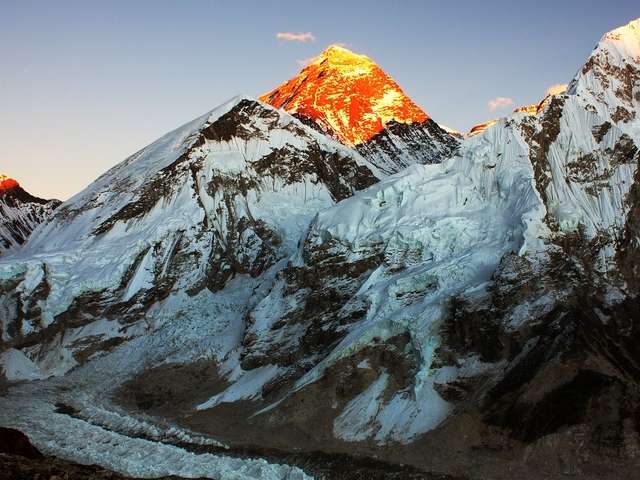
Lobuche East above the Khumbu Glacier.
Lobuche East stands above the Khumbu Glacier, opposite the Everest massif. NMA spells it “Lobuje East”, and you may also see it called Lobuche Far East. It has two neighbouring summits, Lobuche East and Lobuche West (6,145 m), and the East summit is the trekking peak most visitors mean. The route has rock and scree lower down, then snow and ice on fixed ropes, with a shorter summit day than Island Peak. It suits people who are already comfortable with ropes and want a steeper climb. Read the Lobuche East climbing guide or our 18-day Lobuche climb.
4. Pisang Peak, 6,091 m

Pisang Peak, the summit often added to the Annapurna Circuit.
Pisang Peak is the classic add-on to the Annapurna Circuit, climbed from the Manang side after you have already spent days above 3,000 m. That head start matters: you arrive acclimatised instead of fresh from the valley. The climb uses a base camp and a high camp, and the upper section is steeper and more demanding than Island Peak. Plan extra days for the climb itself, and the weather window before you cross Thorong La. Read how to cross Thorong La and the Annapurna Circuit guide for the trek section.
5. Larkya Peak, 6,010 m

Larkya Peak, reached from the Manaslu Circuit trail.
Larkya Peak sits near the pass of Larkya La on the Manaslu Circuit. NMA lists it at 6,010 m, which is lower than the figure often printed on older pages. The climb is a long slog through snow rather than a technical test, and it needs a high camp above base camp for the main summit. The view back toward Manaslu and across to the Annapurna range is the reward. It suits trekkers who like the Manaslu Circuit and have a few spare days. See the Manaslu Circuit preparation guide before you decide.
6. Cholatse (Chola Tse), 6,440 m

Cholatse, seen from the Gokyo valley side.
Cholatse is a steep-walled peak that rises between the Gokyo and Khumbu valleys. NMA lists it at 6,440 m as “Chola Tse”. In our view it is the hardest climb in this post: the faces are steep, the ridges are exposed, and mistakes are costly. Treat the “trekking peak” label as a permit category, not a promise of easy ground. Experienced climbers with ice and rock skills can reach it from the Gokyo side, and everyone else can enjoy it from Gokyo Ri. Our Gokyo trek guide shows the valley it overlooks.
7. Yala Peak, about 5,500 to 5,700 m

Yala Peak above the Langtang valley.
Yala Peak is the gentlest summit here and the easiest to reach: the Langtang valley is a road journey from Kathmandu, so there is no flight to Lukla. It sits below NMA’s 5,800 m line, so it does not need an NMA climbing permit, but it is still a high-altitude snow climb that needs acclimatisation. Combine it with a Langtang teahouse trek and you also miss the Everest crowds. Read why Langtang is worth choosing and Kyanjin Ri for the valley.
8. Tent Peak, about 5,660 m

Tent Peak, inside the Annapurna Sanctuary.
Tent Peak lies inside the Annapurna Sanctuary, with Annapurna I, Annapurna South, Fang and Machhapuchhre (Fishtail) around you. Like Yala, it is below NMA’s permit line, but the ground is short and steep and the summit is cold. A two-week plan from Pokhara can combine the Sanctuary trek with the climb. Ask your operator for current conditions and the exact grade before you book, and see trekking options in the Annapurna region.
Best trek and peak pairs
| Trek | Add this peak | Why it works |
|---|---|---|
| Everest Base Camp (guide) | Island Peak or Lobuche East | The trek builds acclimatisation first |
| Annapurna Circuit | Pisang Peak | You are already high when you reach Manang |
| Manaslu Circuit | Larkya Peak | The peak is on the trail near Larkya La |
| Langtang valley | Yala Peak | Road access and quieter trails |
| Annapurna Base Camp | Tent Peak | A short climb at the end of the Sanctuary |
Permits and rules for trekking peaks
Trekking peaks are permitted by NMA, while peaks above 6,500 m fall to the Ministry of Tourism. Two peaks on the NMA list, Chulu East and Singu Chuli, are above that line and carry a higher NMA royalty.
| Item | What the official pages say | Source |
|---|---|---|
| Permit authority | NMA for trekking peaks; Ministry of Tourism above 6,500 m | NTB |
| Royalty, standard group | US$350 in spring (March to May), US$175 in other seasons | NMA |
| Royalty, Chulu East and Singu Chuli | US$500 spring, US$250 autumn, US$200 winter and summer | NMA |
| Permit period | One month | NMA |
| Group and guide | Up to 12 people, with an NMA-registered guide | NMA |
| Peaks below 5,800 m | No climbing permit; regional permits may apply | NTB |
NMA’s service charges page gives no effective date and its rules page dates from 1981, so confirm figures on your dates. A good operator includes the climbing permit in the package price. Insurance should cover climbing above 6,000 m and helicopter evacuation: see our insurance guide. For the difference between technical and non-technical peaks, read technical vs non-technical peaks, and for the full 27-peak table see the list of peaks in Nepal.
Get fit for a 6,000 m peak
Allow 8 to 12 weeks of training: hill walking with a loaded pack, long cardio sessions and a few back-to-back hiking days. Follow the plan in training for Everest Base Camp and read altitude sickness so you can spot symptoms early. Above 3,000 m, raise your sleeping height by about 300 to 500 m a day and rest after big gains. Descending is always the right answer when symptoms worsen.
FAQ
How many trekking peaks are there in Nepal? The NMA list names 27 trekking peaks, from 5,849 m (Khongma Tse) to 6,584 m (Chulu East). Some older pages give other counts.
Which is the easiest trekking peak in Nepal? NMA does not rank difficulty. Among the popular peaks, Mera Peak needs the least rope skill, but it is high and cold. Yala Peak is gentler still, though it is below the NMA permit line.
Which trekking peak is best for beginners? Mera Peak or Island Peak, with good fitness, 8 to 12 weeks of training and a slow approach. Island Peak adds fixed ropes; Mera is mostly roped glacier walking.
Which is the highest trekking peak? Chulu East at 6,584 m, then Singu Chuli at 6,501 m and Mera Peak at 6,470 m, according to the NMA list.
Which is the hardest trekking peak? NMA gives no ranking. In our view Cholatse is the most demanding of the eight in this guide because of its steep, exposed faces.
How much is a trekking peak permit? For the standard group, NMA lists US$350 in spring and US$175 in other seasons. Chulu East and Singu Chuli cost more. Confirm current figures for your dates.
Do I need a guide? Yes. NMA rules require an NMA-registered guide, and the permit is arranged through a licensed company.
Do I need climbing experience? Not for Mera or Island Peak with a good operator, who teach crampons, ascenders and rope handling at base camp. You do need strong fitness and altitude tolerance.
What is the best season? Spring (March to May) and autumn (late September to November) are the usual windows. Winter and monsoon climbs are harder.
Is Yala Peak a trekking peak? Operators call it one, but it sits below NMA’s 5,800 m line and is not among the 27 listed peaks. Published heights for it vary by source.
Can I combine a trek and a peak? Yes. The classic pairs are Everest Base Camp with Island Peak or Lobuche East, the Annapurna Circuit with Pisang Peak and the Manaslu Circuit with Larkya Peak.
Which peaks does Base Camp Hikes run? Mera Peak (17 days), Island Peak (18 days) and Lobuche East (18 days). For other peaks, ask us to build a plan.
Climb a Nepal trekking peak with Base Camp Hikes
See the itineraries for Mera Peak, Island Peak and Lobuche East, each with licensed guides and permits arranged. For a quote, message the team on WhatsApp or phone at +91 932 595 1234 (9 am to 7 pm IST), write to info@basecamphikes.com, or use the enquiry form.
Sources
- Nepal Mountaineering Association, NMA peaks (27 trekking peaks and heights)
- Nepal Mountaineering Association, service charges and rules and guidelines
- Nepal Tourism Board, mountaineering (peak classes, 5,800 m and 6,500 m lines)